
HK Primary Interview editorial content · Updated:
The examples and exercises below are illustrative material, not real student case studies or school test questions. Use them for family preparation; check each school’s current requirements before submitting documents.
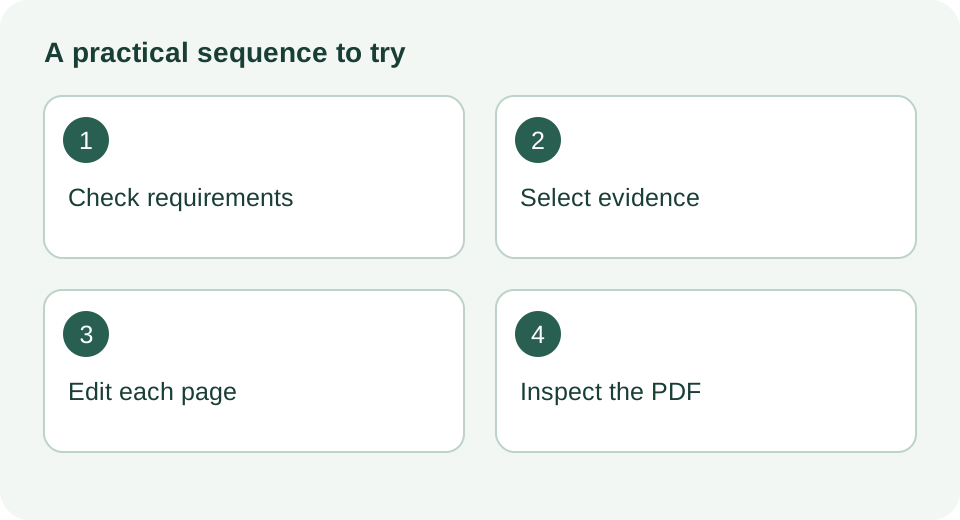
Step One: Check the Requirement Before You Build Anything
The biggest mistake parents make is spending weekends building a portfolio for a school that does not want one or penalises oversized submissions. Practices differ sharply across Direct Subsidy Scheme, private, aided and government schools, and change year to year. Some schools say a portfolio is not necessary; others set a page or file limit; some ask families to spend the time with their child instead of on paperwork.
So the rule of this guide is: the school's current admissions notice outranks every template, including ours. A generic 'standard' portfolio does not exist. Your first task costs nothing: find each school's admissions page or attend its information session and record four facts — does it accept portfolios at all, is there a page or file size limit, is submission physical, electronic or interview-only, and are any items requested or prohibited?
| What the school's notice says | What you should do |
|---|---|
| Portfolio not accepted / not necessary | Do not submit one. Redirect energy to interview practice and daily reading habits. |
| Silent on portfolios | Prepare a short 2–4 page courtesy version only if you can confirm it is welcome; keep it plain. |
| Page limit given (e.g. 4–6 pages) | Build to the limit, ideally a page or two under. Follow any format instructions exactly. |
| File size or format specified | Export to that specification and test the file before submission day. |
| Specific items requested | Provide exactly those items, in the order or format implied, and resist adding extras. |
A Simple Rule for Conflicting Advice
If a school's notice is silent on portfolios, ask before preparing one; silence does not confirm optional documents are welcome. If a limit is set, treat it as firm, not a target to nudge: 4 pages against a 6-page cap reads as good judgement; 9 pages reads as not having read the instructions.
One caution: discretionary allocation at aided and government schools and interview-based admission at many Direct Subsidy and private schools are different processes with different portfolio expectations. Never assume advice written for one applies to the other — verify against the specific notice for the route you are applying through.
Choosing Your Length: 2, 4 or 6 Pages as Editorial Options
Imagine the admissions teacher's stack: hundreds of families may submit documents, each receiving minutes of attention, not an evening. Around four to five A4 pages is a length commonly suggested — concentrated enough to read closely, and preparing it forces you to prioritise. An enormous document may not read as 'accomplished child'; it can read as 'the adults could not choose.' Going short also forces every page to earn its place, which pushes you toward authentic material and filters out padding. These three lengths are editorial options for you to choose between, not school rules.
Think of them as three different arguments. A 2-page portfolio makes a narrow, confident claim: 'Here is who she is, in her own words and one good photograph.' A 4-page portfolio makes a balanced claim: 'Here is his character, his learning, and how our family supports both.' A 6-page portfolio makes a documented claim for a child who genuinely has a body of verifiable evidence and is applying where a fuller document is welcome. Choose based on evidence density — how many items pass the rubric below with a clear 'yes'? — not fear or comparison.
The 2-Page Version: One Page of Character, One Page of Voice
Page 1 carries a clear photo, basic details (name, age, kindergarten), and three to four lines by you about who your child is. Page 2 is the child's page: one piece of their work photographed as-is, plus one activity photo with a one-line caption.
Worked example — character lines in a parent's voice: 'Mei-wai asks a question about everything she eats, sees or hears. Since March she has kept a 'wonder list' — currently 14 entries, including 'why do snails come out when it rains?' On Saturdays she helps her grandmother water the rooftop plants and has taken charge of the herb pots without being asked.' Three concrete behaviours, one number, one responsibility. No adjectives needed.
The 4-Page Version: The Balanced Default
Page 1: cover with photo and details. Page 2: your letter (half a page) plus 'learning at home' — reading habits, a routine showing curiosity. Page 3: two selected pieces of evidence with captions, chosen by the rubric. Page 4: 'our family' in five lines and two photos, plus one line on how your child talks about starting school. Nothing here depends on certificates.
Worked example — a Page 3 caption for a child with no competitions: 'Ho-yin has built marble runs from cardboard tubes every weekend since January. His longest run uses 23 tubes and three turns, and he rewrote the design four times after the marble kept flying off at the corner. Photo: run number three, taken in May.' This tells a teacher more about persistence than a participation certificate — and it is fully checkable, because it happened.
The 6-Page Version: Only When the Evidence Is Real
Use the extra pages for a third evidence page (a sustained activity over months, with dates), a full work sample instead of a cropped one, and a short 'growth story' — one honest account of something your child found hard and kept trying. Six thin pages are worse than four strong ones. If the school caps at 4, build 4.
Worked example — a growth story, kept truthful and small: 'Ching-man was the last child in her K2 class to hop on one foot, and she minded. Most of last autumn she practised in the corridor for five minutes after school. In December she managed ten hops in a row and insisted we phone her grandfather. We include this because it is exactly how she approaches everything difficult — quietly, daily, without drama.'
The Evidence Selection Rubric: What Earns a Page
Every candidate item — certificate, photo, work sample, story — faces the same four questions. If an item fails more than one, leave it out, however proud you are of it. Selection is the entire craft of a good portfolio; a page is a scarce resource and the reader's attention is scarcer still. Run the rubric with your child present where possible: their reaction is itself evidence of engagement, and it doubles as interview preparation, since a teacher who later asks about a photo will get a real answer.
- Include: one clear, recent, smiling photo; your child's own writing or drawing exactly as produced; one sustained interest with dates; one small act of responsibility or kindness, described factually.
- Leave out: certificates for events every applicant attended; stock-style studio portraits that erase your child's personality; anything the school's notice did not ask for; your own achievements and credentials in any detail.
| Question | Green light | Red flag |
|---|---|---|
| Can my child tell me about it in their own words? | They launch into the story without prompting | You have to explain it for them |
| Does it show something specific about THIS child? | It reveals a habit, effort or preference unique to them | Every K3 child in Hong Kong could submit the same item |
| Is it verifiable and honest? | Dates, names and roles are exactly accurate; nothing exaggerated | A 'participation' quietly upgraded, or a group effort claimed as solo |
| Does it earn its space? | A reader learns something in ten seconds | It fills a page but adds no new information |
No Awards? Your Portfolio Is Not Weaker — It Is Different
A five-year-old with no trophies is not a five-year-old without evidence. A portfolio built around dispositions — curiosity, persistence, kindness, self-help — gives a reader real information, and these show up in kitchens and playgrounds, not just exam halls. Describe ordinary life with the same precision other parents reserve for certificates: dates, numbers, direct quotes, before-and-after detail.
Worked example — three no-award captions, each matching a 5–6-year-old's real abilities. (1) Independence: 'Every school morning since last September, Ka-yan packs her own bag against a picture checklist she drew herself. She has forgotten her water bottle twice; both times she told the teacher herself and carried on.' (2) Curiosity: 'After a museum visit in April, Chun-hei spent two weeks asking everyone what dinosaurs ate, then made the chart on this page by copying names from a library book and drawing his own guesses. The guesses are wrong; the chart is entirely his.' (3) Social warmth: 'He is the child who waits. When the K3 class lines up, he is usually last out the door because he is putting someone's forgotten shoes by the rack. His teacher mentioned it to us twice, unprompted.'
None of these captions claim genius. They claim consistency, honesty and specific detail — usable information a reader can work with. One caution: never fabricate. Exaggerating a participation prize into a win, or ghost-writing a child's artwork, is the fastest way to turn a portfolio from an asset into a liability, and experienced readers notice.
Writing the Parent Letter Without Sounding Like a Template
Your letter exists to do one job the rest of the portfolio cannot: explain, in your own voice, why this particular school fits this particular child. Keep it to half a page to a page, write it yourself, and anchor every claim in an observable behaviour. If you find yourself writing 'gifted' or 'passionate about learning', delete the adjective and replace it with the Tuesday-morning scene that made you think it.
Read sample letters online for structure, never copy their sentences — staff who read many letters each cycle recognise recycled phrasing. Note also the distinction between document types: a self-recommendation letter is written by you to the school, while a recommendation letter comes from your child's kindergarten. These are different documents; check what your target school actually asks for.
If you want structural help rather than ghost-writing, our self-recommendation letter tool offers 100 combinations built from 20 scenarios and 5 tones, each editable and available in Chinese and English, with PDF export after entering a parent email address (no account or verified email is needed). Use a combination as scaffolding, then overwrite it with your family's real details.
A Worked Letter Opening (Original, for a Realistic Child)
'Dear Principal, I am writing about my daughter Lee Wai-yan, who is five and will tell you, if asked, that she is 'almost six'. We are drawn to your school's emphasis on learning through questions, because Wai-yan has been learning that way on her own: last month she tested three kinds of paper in the sink to find which boat lasted longest, and reported her results at dinner with a straight face and wet sleeves. She is not an early reader yet, but she is read to every night and now 'reads' her favourite picture book to her younger cousin, inventing the words she cannot yet decode. We would be glad for her to grow up in a school that treats her questions as a starting point.' Three observations, one honest admission, one specific school reason — the register to aim for throughout.
Photos, Building the Document, and Exporting the PDF
Photos carry more information per second than any paragraph. Choose natural, recent, well-lit shots of your child doing something true to them — reading on the sofa, elbow-deep in paint, mid-conversation with a grandparent. One clear photo of genuine engagement beats ten generic ones. Crop for the subject; do not over-filter, since heavy editing makes readers wonder what else was adjusted. Use photos from roughly the last year so the child shown is the child who will sit the interview, keep two or three full-resolution backups of each, and if the school wants a standard ID-style photo on the cover, follow that instruction for the cover and keep the natural shots inside.
Start with a folder called 'P1 portfolio' and drop every candidate item into it for a week: photos, scans of work, your letter draft, notes. Then run the rubric — only after selection do you open a design tool, because building first and selecting later is how documents bloat. Any plain layout tool works; the design should be quiet enough that your child is the only thing a reader notices.
For the fastest route, our portfolio builder offers 16 styles with editable rows and photo uploads, offers optional local draft saving, and exports a PDF for free after you enter a parent email address (no account or verified email is needed). Page counts and file limits are set by each school, so build to your target length and check the exported file size against the school's stated cap before submission day, not on it.
Worked example — a realistic one-evening build plan for a 4-page document. Minutes 0–20: run the rubric and mark your keepers. 20–50: upload your cover and two evidence photos, fill in name, age and kindergarten rows. 50–90: paste your half-page letter and the three captions you drafted. 90–110: read every page aloud once — your ear catches stiff phrasing your eye skips. 110–120: export the PDF, open it on a phone, confirm nothing is cropped. Let the draft sit for two days before a final read.
The Pre-Submission Checklist and Your Next Action
Before anything leaves your house or your inbox, run the whole document through this list. Every line exists because its omission is a common, avoidable failure:
- Every factual claim is accurate: dates, prize names, roles, and your child's exact contribution — nothing upgraded, nothing borrowed.
- The school's name on the cover or letter is this school's name, spelled correctly (fatal if you customised for multiple schools).
- Page count is within the school's stated limit, and the file size is within any stated cap if submitting electronically.
- File name is clear and professional, e.g. 'ChanTaiMing_Portfolio.pdf', not 'final_final_v3.pdf'.
- Every photo is recognisable to your child and they can say what is happening in it.
- Your child's own work is shown as produced — original spelling and wobbly lines included, not retyped or redrawn.
- Text is legible at print size: body text at roughly 11pt or larger, one language as the main text (matching the school's medium) rather than cluttered duplication.
- You have printed one test copy (if physical submission) or opened the PDF on a phone (if electronic) and checked every page.
- A second adult has proofread for typos, mixed punctuation and repeated words.
- You have kept the master file so next year's siblings — or a second school — need only light edits.
Your Next Action Today
Do the ten-minute check first: pull up each target school's current admissions notice and record whether a portfolio is accepted, capped, or declined. Then open a folder and start collecting candidates. When you have twenty or so items, run the rubric, pick your length — 2, 4 or 6 pages based on evidence, not anxiety — and build it in the portfolio builder with your child beside you, deciding together which photos make the cut. The document that results will not be the glossiest in the pile. It will be the truest, and over a full reading season, true reads faster than gloss.
Frequently asked questions
Does every Hong Kong primary school require a portfolio for Primary 1 admission?
No. Practices vary widely and change year to year: some schools welcome them, some set page or file limits, and some explicitly say one is not needed. Always confirm against the school's current admissions notice or information session, and never submit one to a school that has said it does not want them.
How many pages should a Primary 1 portfolio be?
If the school states a limit, stay within it — ideally a page or two under. If there is no stated limit, 2 to 4 well-chosen pages is a sound default for most families, expanding to 6 only when your child genuinely has sustained, verifiable material that passes the selection rubric. Length should follow evidence, not comparison with other parents.
My child has no certificates or awards. Is a portfolio still worth making?
It can be, if the school accepts one. Character, curiosity and persistence show up in ordinary life: a self-drawn packing checklist, a marble run redesigned four times, a habit of helping classmates. Describe real behaviour with dates and specifics — that is stronger evidence than a pile of participation certificates, and it stays honest.
Should I hire a designer or pay for a one-stop portfolio service?
You do not need to. Free tools, including our portfolio builder with 16 editable styles and free PDF export, produce clean, readable documents. What schools respond to is authentic, specific content, which no designer can manufacture. Be wary of any service promising admission outcomes — no portfolio can guarantee a place.
Can I copy a sample letter or portfolio text from the internet?
Use samples for structure only. Copying sentences misrepresents your child, and staff who read hundreds of applications recognise recycled phrasing quickly. Draft from your own observations, and if you want help with framing, use our self-recommendation letter tool's editable combinations as scaffolding you then overwrite with your family's details.
How should I submit the portfolio — printed or as a PDF?
Whichever the school's notice specifies, exactly. If electronic, export a clean PDF, keep the file size within any stated cap, name it clearly (for example 'ChanTaiMing_Portfolio.pdf'), and test it on a phone before submission day. If physical, print a single test copy first and check that nothing is cropped and all text is legible.
Put the preparation into practice
Find schools and official websites · Parent-child practice games · Editorial policy