
HK Primary Interview editorial content · Updated:
The examples and exercises below are illustrative material, not real student case studies or school test questions. Use them for family preparation; check each school’s current requirements before submitting documents.
What a knock-door letter is, and when your family actually needs one
In Hong Kong's Primary One Admission (POA) scheme, most children are placed through the discretionary phase and central allocation. When a child is not offered a seat the family is happy with, parents may approach schools directly hoping for a waitlist or leftover place. This is colloquially called knocking on doors, and the short letter you bring or send is the knock-door letter. It differs from the self-recommendation letter prepared during the application phase, though the two overlap in content and tone.
A knock-door letter does not change POA allocation criteria: discretionary admission follows EDB-prescribed categories and points, and central allocation uses school nets, choices and random numbers. The letter matters only for schools that manage their own waitlist or interview leftover applicants, and not every school does. Before writing a word, check the school's current admissions notice or contact the office to confirm whether they accept walk-in applications or letters at all. Do not assume a school is still accepting applications in September or at any other time; the school's own notice is the only reliable source for how and when to approach them.
The education portal My School HK frames entry paperwork around the 4P: an application letter, a principal's recommendation letter, a concise portfolio and a confident student photo (www.myschool.hk). That framework is a useful reminder that the letter is one piece of a small package. This article focuses on making the letter honest, specific and unmistakably about your child.
Further reading: www.myschool.hk · www.edb.gov.hk
Choosing the writer identity: whose voice is this letter in?
Decide who is writing before drafting. Three realistic options exist: the parent writing as the parent, the parent writing in the child's voice, or a joint effort where the child contributes dictated sentences. For a five- or six-year-old, the parent-as-writer letter is the default and safest choice; keep the letter in the adult voice so it speaks for the adults who will partner with the school. A child-voiced letter only works when the child could plausibly have produced it and could discuss its content if asked. 'I like dinosaurs and I can write my name' is believable from a K3 student; a paragraph on educational philosophy is not. If you use the child's voice at all, keep it to three or four simple sentences and read it aloud with your child.
One habit to avoid: writing in an ornate, semi-classical register no parent actually uses. Widely circulated forum templates model exactly this style, full of elaborate flattery (m.edu-kingdom.com). A reader reviewing many letters may spot a recycled template, and generic praise like calling the school famous says nothing about your child. The worked examples below use plain, warm, modern language a real parent would say out loud.
Further reading: m.edu-kingdom.com
The anatomy of a strong bilingual knock-door letter
A good letter does four things in under one page. First, it states the request plainly: which child, which school year, and what you are asking for, usually waitlist consideration or a chance to interview. Second, it gives two or three concrete, observable details about the child that connect to something you can honestly say about the school. Third, it gives one specific, true reason your family chose them. Fourth, it lists enclosures and how you can be reached.
Length matters: keep to roughly one A4 page, an editorial starting point of about 150 to 250 English words or a concise Chinese letter. This is a suggested editing target, not a school rule. The DictationEasy guide also discusses checking language expectations before choosing Chinese, English or both (dictationeasy.com). On the bilingual question, match the school's medium of instruction and the language of its own notice where you can. If you genuinely cannot tell, a Chinese letter with a short English closing line, or two tightly matched half-page versions, is a reasonable fallback. Do not submit two full-length letters saying the same thing twice.
Calibrate praise. 'We were impressed by how the senior students looked after the younger ones at your open day' is a specific observation a reader can trust. 'Your school is renowned and prestigious' could be pasted into any letter, so it persuades no one. Every general compliment you delete makes room for one more true detail about your child.
Further reading: dictationeasy.com
Original annotated Chinese worked example (parent voice, warm and direct)
This letter is written for an imaginary family; all names, kindergartens and details are placeholders to replace. It is deliberately modest, because a six-year-old's life is modest, and specificity is what makes it read as real.
The letter, with line-by-line annotations
The letter text: 尊敬的【校長姓氏】校長:您好!本人是【孩子姓名】的家長。在早前的統一派位中,【孩子姓名】未能獲派 貴校,但我們全家仍然以 貴校為首選,因此冒昧致函,懇請 校長考慮讓他以後補生身份入讀本學年小一。 Annotation: the opening answers who, what and why in three sentences, names the mechanism honestly, and states the request without over-apologising, a common weakness in parent letters.
The letter text: 【孩子姓名】今年六歲,剛在【幼稚園名稱】完成K3。他是個愛發問的孩子,最近着迷於恐龍和行星,常常翻看圖書後跑來問我們各種「點解」。他在家會自己整理書包、幫忙澆花,老師說他上課留心,也樂意借文具給忘記帶課本的同學。 Annotation: every claim is observable and small, things a K3 child genuinely does and could confirm in an interview. Compare this with adjectives like 勤奮 or 天資聰敏, which the reader must take on faith and which invite the question: compared to whom?
The letter text: 我們選擇 貴校,是因為去年開放日時,我們見到高年級同學帶領參觀、耐心回答家長提問,那份互助的氣氛令我們印象深刻。如【孩子姓名】有幸入讀,我們按實際情況配合學校,與老師保持溝通。 Annotation: the school-fit sentence cites one specific, checkable open-day observation. The closing commitment concerns parent cooperation, a sensible drafting aim, rather than a promise about future exam results.
The letter text: 隨函附上幼稚園成績表副本及近照一張,敬供參考。如蒙安排面談,我們樂於配合。如需補充資料,請致電【聯絡電話】與本人聯絡。敬祝 教安。【家長姓名】敬上 【日期】 Annotation: enclosures are listed so nothing in the envelope feels random, contact details are explicit, and the sign-off is respectful without being archaic. One optional photo is enough; a gallery distracts.
Further reading: www.edb.gov.hk
Original annotated English worked example (parent voice, plain and confident)
This version mirrors the Chinese letter in substance but is not a word-for-word translation; it is written the way a parent would naturally write in English. Every detail is a placeholder, and the imaginary child here is a different hypothetical boy, to show how easily the skeleton adapts.
The letter, with line-by-line annotations
The letter text: Dear Principal 【Surname】, I am writing to ask, respectfully, whether my son 【Child's Name】 might still be considered for a Primary One place at 【School Name】 under your waitlist arrangements. He was not allocated a place at your school in central allocation, but your school remains our family's first choice. Annotation: the formal opening suits most local and DSS schools; for an international school, 'Dear Admissions Team' is equally fine. 'Under your waitlist arrangements' quietly signals you have read the school's own notice.
The letter text: 【Child's Name】 is six years old and finished K3 at 【Kindergarten Name】 this summer. He can write his own name and is proud of it. He loves buses and maps: on weekend rides he tells us which bus goes where, and he has filled two notebooks with his own drawings of routes. His kindergarten teacher describes him as gentle and persistent, the child who keeps trying a jigsaw until the last piece fits. Annotation: the three details are realistic for a five-to-six-year-old and easy to verify in a short conversation. Quote a teacher's opinion only if it was actually said in the report; never invent one.
The letter text: We chose your school for a specific reason: at your open day we watched a Primary Five student patiently help our son find the hall when he was too shy to ask, and that small act told us a great deal about the culture you build. If a place becomes available, we would be glad to attend an interview at any time convenient to the school. Annotation: one concrete memory instead of flattery, and the closing offers flexibility rather than demanding a slot, the correct posture for a waitlist family.
The letter text: A copy of his kindergarten report is enclosed, and I am happy to provide anything further. I can be reached at 【phone number】 or 【email address】. Yours sincerely, 【Parent's Name】, parent of 【Child's Name】. Annotation: end with identification, so the reader knows exactly whose parent is signing. This matters more in English, where the 家長 convention does not do that work.
Further reading: www.edb.gov.hk
The placeholder and claim audit: ten minutes before you seal the envelope
Run a two-part audit. Part one, the placeholder pass: search your draft for every square bracket, 【】 or [ ], and every generic noun left behind, such as 'the school' where a name should be. Getting one school's name wrong in a letter to another school instantly converts your letter into evidence of a mass mail-out. Check the principal's correct title and surname too; calling a female principal 先生 or getting the surname wrong is an avoidable own goal.
Part two, the claim pass: for every sentence about your child, ask, is it true? Can my child demonstrate or discuss it if asked? Would I be comfortable if the school telephoned the kindergarten to confirm it? Delete anything that fails. Trouble-inviting claims include 'fluent in three languages' for a child who speaks home Cantonese and classroom English, award titles from activities that issued only participation certificates, and character references the child cannot act out in an interview room. If your child has any support needs, speech therapy, occupational therapy, developmental assessment, or a wait for any of these, decide deliberately rather than hoping it stays hidden. You need not write a medical history into one page, but do not make claims the file will contradict, and if asked directly at interview, answer honestly. 'He receives weekly speech therapy and has made steady progress' reads as organised and truthful, not weak.
A six-point audit checklist
Run through this list with the printed letter in front of you, not the on-screen draft:
Every placeholder replaced, including school name, principal's name and title, child's name in both languages where relevant, and your contact details.
Every claim about the child passes the 'true, demonstrable, confirmable' test.
The school-fit paragraph contains at least one observation specific to this school, from an open day, the school website or a current parent you actually know.
The enclosures listed match exactly what is in the envelope or attached file.
A phone number you actually answer during school hours, and an email address you check daily.
One honest read-aloud: if any sentence sounds like it came from a stranger, rewrite it in your own words.
Choosing a tone: five registers across twenty real-life scenarios
The same facts can be told warmly, formally, plainly, in the child's voice, or reflectively. Our companion library at bilingual letter editor organises drafts by twenty application scenarios crossed with five tones, one hundred combinations, each in Chinese and English. Every version is an editable starting skeleton, with free PDF export after providing a parent email address (no login or verified email required); you supply the true details, because only you know your child.
The warm-conversational tone suits most neighbourhood and aided schools and is the default of the two examples above. The formal-respectful tone suits traditional DSS schools and schools whose notices use formal register. The concise-factual tone suits busy office submissions. The child-voiced tone, used sparingly and only in the child's genuine words, can accompany a parent letter as a short enclosed note. The reflective tone, briefly acknowledging the allocation outcome and the family's reasons for persisting, suits knock-door letters in particular, where the reader already knows why you are writing.
| Family situation (hypothetical) | Suggested tone | Letter focus |
|---|---|---|
| First-choice aided school, missed in central allocation | Reflective, parent voice | Why this school specifically; parent commitment to home-school cooperation |
| Moved into the school's catchment after the application rounds | Concise-factual | New address, timeline of the move, request to join the waitlist |
| Child with speech therapy under way | Warm-conversational | True, steady progress described factually; no concealment, no over-disclosure |
| Non-Chinese-speaking family applying to a local school | Warm-conversational, bilingual | Home language environment, genuine Cantonese or Chinese exposure, family support plan |
| Younger sibling of a current or former student | Formal-respectful | State the family connection plainly and factually; let the school verify it |
| Twins applying together | Concise-factual | One letter covering both children, clearly labelled, emphasising their individual differences |
| Child who genuinely loves the school's uniform team or orchestra seen at open day | Warm-conversational | One concrete observed detail connecting the child's real interest to the school |
Further reading: www.edb.gov.hk
Formatting, submission practicalities, and your next action
If the school accepts email submission, export the letter as a PDF so the layout survives every device, keep the attachment small enough to open quickly on a phone, and use a clear file name: the child's name, the words KnockDoorLetter, and the year. These points echo widely shared Hong Kong parent guidance on electronic portfolio submission (dictationeasy.com). On paper, print single-sided on clean A4 in a readable 12-point font. Clip in this order: letter on top, then the kindergarten report, then at most one or two genuinely relevant pages. A thick folder of certificates can work against a waitlist family.
Enclose only what the school's notice asks for or what you can defend; treat a photo and recommendation letters as optional extras to include only if the named referee genuinely knows your child and has agreed. Whether any school wants these at the knock-door stage is a question only that school's current notice can answer. If you are also assembling a fuller portfolio, the builder at portfolio creator offers editable layouts with photo upload, optional local draft saving, and free PDF export after providing a parent email address (no login or verified email required). Keep a dated copy of exactly what you sent for every school, because if a school calls in October, the interview conversation must match the letter.
Four common mistakes are fixable in one editing session. First, the recycled template: if a sentence could appear in any letter to any school, it does no work. Second, inflated claims: a K3 child who enjoys English songs is not a proficient English speaker, and overclaiming sets up an interview mismatch. Third, the school-blind fit paragraph: naming the school eight times is not the same as one true observed thing. Fourth, the wrong letter for the wrong stage: a self-recommendation letter asking for an interview needs its opening rewritten to serve as a knock-door letter about waitlist places. A fifth, quieter mistake is treating the letter as a guarantee; it is one page in a queue, and its job is to make your child easy to remember and your family easy to work with.
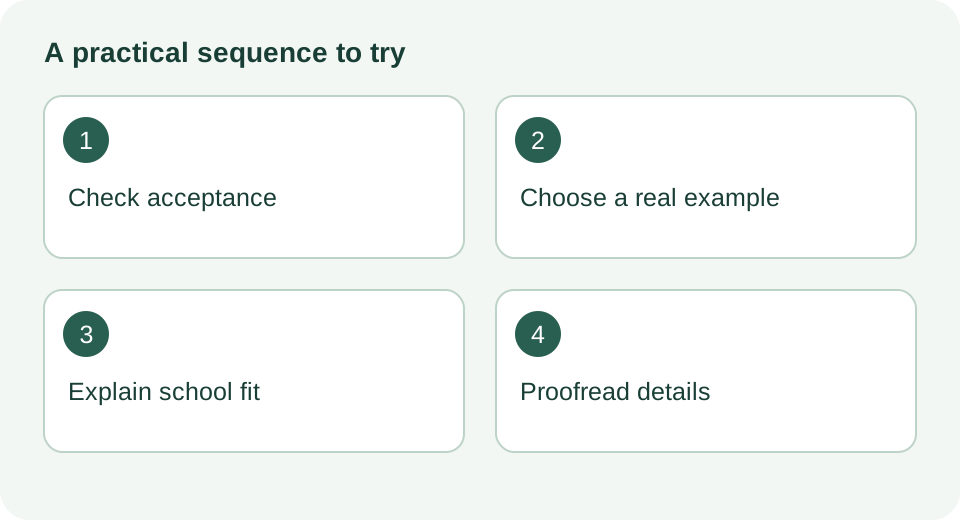
Do this today, in under an hour: pick the school you most want to approach, find its current admissions notice or call the office, and confirm three facts, whether they accept waitlist applications, how they want to receive them, and in which language. Then draft with the skeletons above, replace every placeholder, run the six-point audit, and prepare the envelope or PDF exactly as the school asked. If you want help choosing a tone, browse the scenario-and-tone combinations at bilingual letter editor and edit the version closest to your family's circumstances.
- Confirm from the school's own notice that knock-door applications are accepted, and how
- Draft with the annotated Chinese or English skeleton, using only true, observable details
- Replace every placeholder and verify every claim against the kindergarten report
- Limit the letter to one page; enclose only what the notice requests
- Save a dated copy of each school's letter and enclosures
Further reading: dictationeasy.com
Frequently asked questions
Does every Hong Kong primary school accept knock-door letters?
No. Some schools actively manage waitlists and welcome letters or walk-in applications, while others fill remaining places by other means or refer families back to the EDB. Always check the school's current admissions notice or call the office before writing or visiting.
Should the letter be in Chinese, English, or both?
Match the school's medium of instruction and the language of its own notice where you can. If unsure, a single-page Chinese letter with a brief English closing line, or two tightly matched half-page versions, is a sensible fallback. Avoid two full-length duplicates.
Can a knock-door letter guarantee my child an interview or a place?
No, and no honest guide should promise otherwise. The letter is one document among many in a school's waitlist process. Its realistic job is to present your child clearly and make your family easy to work with.
My child receives speech therapy. Should I mention it in the letter?
You need not write a full history into one page, but do not conceal support needs or make claims the file will contradict. A factual sentence about ongoing therapy and steady progress reads as honest and organised, and answer any direct interview question truthfully.
Can I reuse the same letter for every school?
The opening, the child description and the enclosures can largely carry over, but the school-fit paragraph must be rewritten for each school with one genuine observation, and every name, title and detail re-checked. A wrong school name is an avoidable error, so check it carefully.
Is it all right to let my six-year-old write part of the letter?
Only in the child's own genuine words, kept to three or four simple sentences, and only if the child could discuss the content if asked. A short child-voiced note can accompany a parent letter; it should never replace it or contain language a K3 child would not use.
Put the preparation into practice
Find schools and official websites · Parent-child practice games · Editorial policy