
HK Primary Interview editorial content · Updated:
The examples and exercises below are illustrative material, not real student case studies or school test questions. Use them for family preparation; check each school’s current requirements before submitting documents.
What a parent interview is really for
A parent conversation is not a second exam for your child. When a school asks to meet parents, it is usually trying to answer three plain questions: do these parents know their child as an individual, does what happens at home fit with how the school works, and can the family and school communicate when something goes wrong? Your answers matter less for being impressive than for being consistent and grounded in real observations.
This has one uncomfortable implication: memorised, polished paragraphs often work against you. Interviewers may follow up, and a parent whose polished answer rests on invented details tends to stall when a second example is requested. Preparing three or four honest observations beats twelve model sentences. Principals commenting publicly on this topic have also warned that coaching a child to recite prepared answers defeats the exercise, and that over-drilling is counterproductive; schools generally value basic courtesy highly (source: www.hk01.com).
| The interviewer probably wants to know | What a good answer does |
|---|---|
| Do you know your child? | Names one or two specific, recent observations rather than labels |
| Will home and school fit together? | Describes your actual routines and how you handle difficulty |
| Can you communicate with us? | Shows a calm, specific approach to raising a concern |
| Is the answer real? | Survives a follow-up question with a second example |
Further reading: www.hk01.com
How to use the twelve questions in this guide
Each question below has three parts: what to prepare, a weak answer showing a common trap, and a better answer avoiding it. The better answers are deliberately short, roughly thirty to sixty seconds spoken. They are shapes to fill with your own child's real details, not scripts. The children in the examples are fictional and deliberately ordinary: Cayden can count to thirty but muddles fifteen and fifty; Aisha loves drawing but freezes when a stranger asks her a direct question. If your child is not a prodigy, good: honest specificity is more persuasive than inflated claims. These illustrations carry no promise about admission outcomes at any school.
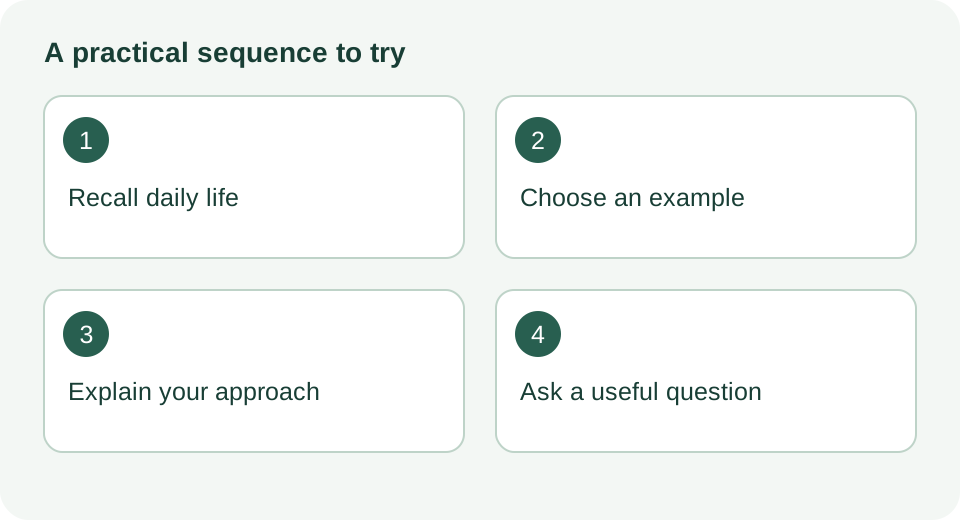
- Read all twelve questions once, without writing anything.
- Mark the five that feel hardest for your family.
- For each marked question, write one true observation from the last month.
- Practise saying the observation out loud, once, then stop drilling.
Questions 1 to 6: Knowing your child, strengths, support needs and hopes
Questions 1 to 3 reward describing a specific child rather than a generic well-behaved applicant; specificity is the whole game. Questions 4 to 6 are where many families stumble by over-correcting: pure praise sounds rehearsed, and hiding difficulties backfires later, but an unfiltered list of problems is equally unhelpful. The balanced move is to name one real strength, name one genuine area still developing, and show you are already doing something calm and specific about the second.
Question 1: Tell us about your child.
Prepare two or three concrete observations from recent weeks: something your child enjoys, something they find hard, one small habit only someone close would notice.
Weak answer: "He is very smart and well-behaved, and everyone says he is advanced for his age." This gives the interviewer nothing to picture and invites a sceptical follow-up.
Better answer: "Cayden is six in November. He spends most afternoons building things out of boxes and tape, and gets frustrated when the tape will not hold, but rarely gives up on a structure. He is quieter in groups of more than four or five. At home he tells very long, very detailed stories about his dinosaurs." Every sentence survives a follow-up.
Question 2: What does your child enjoy doing most?
Prepare one genuine interest described in enough detail to discuss for two minutes. It does not need to be a class or certificate activity.
Weak answer: "She likes reading and swimming and piano and drawing." A list of scheduled activities tells the interviewer about your calendar, not your child.
Better answer: "Aisha's real love at the moment is drawing, especially animals. Last month she drew a series of cats with different jobs, a doctor cat and a bus-driver cat, narrating their day while she drew. We are not doing a formal art class; this is what she does with paper at the kitchen table while I cook." The honesty about it being unstructured is a feature, not an apology.
Question 3: How would you describe your child's personality?
Prepare one or two neutral, accurate adjectives plus one everyday example of each. Avoid the sales pitch and the opposite trap of listing only difficulties.
Weak answer: "He is an angel at home, never any trouble." No five-year-old is never any trouble; this removes your credibility for everything that follows.
Better answer: "She is careful and a bit slow to warm up. With new people she watches before joining in, which her kindergarten teacher says improves noticeably by the second or third week of term. Once comfortable she is stubbornly determined; when she decided to learn to tie her shoelaces she practised for a week until she got it." The shyness is stated plainly, paired with evidence she adapts.
Question 4: What is your child's biggest strength?
Prepare one strength, one dated example, and a sentence about how you nurture it at home.
Weak answer: "He is gifted, honestly, he taught himself to read." Such claims are easily tested by a follow-up and put your child under unfair pressure.
Better answer: "His strength is persistence with things he cares about. He spent most of August trying to learn to whistle, badly, every dinner time, until he got it. When something interests him he simply will not drop it. We try to protect that by letting him choose one self-directed project at a time."
Question 5: Is there anything your child needs extra support with?
Prepare one genuine developmental area, phrased factually, plus the practical step you are taking. If your child has an assessed need, disclose it honestly; schools can help far more when they know in advance.
Weak answer: "No, nothing at all, she is perfect." This reads as unobservant or evasive.
Better answer: "Aisha's speech clarity is still developing; some blends come out jumbled. We had her hearing checked, which was fine, and our kindergarten teacher suggested simple sound games at home, which we do for a few minutes at bath time. She is getting clearer each term." Or, for an assessed need: "He has been assessed and receives speech therapy weekly. We wanted to tell you openly so his teacher and we can agree on the best approach from day one."
Question 6: What are your hopes for your child in Primary One?
Prepare hopes about the child, not results. Wanting a happy child who likes going to school is a legitimate, age-appropriate answer.
Weak answer: "We expect her to be first in her class and get into a top secondary school." This stacks pressure onto a six-year-old.
Better answer: "Honestly, our main hope is that she wants to go to school in the morning. She is at the age where confidence either grows or shrinks, and we would rather she finishes P1 feeling capable and willing to try, even in subjects she finds hard. Learning to read well is part of that, but it is not the only part."
Questions 7 and 8: Why this school, and how home supports learning
The aim is to show you genuinely considered the school rather than copied its website. Attend the open day if there is one, read the school's current materials, and identify one or two features that genuinely match your child, in your own words. For home learning, a realistic picture serves your family best: a five-year-old drilled three hours a night is not a sign of a healthy home learning environment.
Question 7: Why did you choose our school?
Prepare two specific, verifiable reasons connected to your child, plus evidence you engaged with the school, such as attending an open day.
Weak answer: "Your school has a very good reputation and ranking." This would be equally true of ten other schools and implies you would switch for a better-ranked option.
Better answer: "Two reasons. First, your school keeps a proper break and activity time even in lower primary, and Cayden genuinely needs to move. Second, at the open day we saw the P1 reading corner and the way teachers spoke to the children, and it matched how we talk to him at home. Also, honestly, it is reachable: his grandmother can collect him on the days we both work late." The last sentence shows daily logistics have been thought through.
Question 8: How do you support your child's learning at home?
Prepare one reading routine, one everyday-life learning habit, and a realistic picture including what you do not do.
Weak answer: "We have already finished the whole Primary Two curriculum with him at home." Besides straining belief, this signals the school's own teaching may be treated as insufficient.
Better answer: "We read together for about fifteen minutes most nights, whatever books he picks, and he has free rein in the children's section of the district library. He helps with real cooking, which turns into counting and reading measurements without it being a lesson. We do not do formal tutoring at this age; we would rather he arrives at school fresh and curious than exhausted."
Questions 9 and 10: Working-parent availability and school communication
Working parents may be asked directly about time with their child and who handles pickup and homework. This is not a trap to eliminate dual-income families; the sensible aim is to show someone concrete is responsible for daily life. Vagueness is the problem, not employment.
Question 9: Both of you work. Who looks after your child after school?
Prepare a named, agreed plan for pickup, homework supervision, and the hours between school and bedtime, including days when the plan changes.
Weak answer: "We manage, we always find a way." This sounds like there is no plan, which for a six-year-old there genuinely must be.
Better answer: "School ends at three. On Mondays and Wednesdays my mother picks up and looks after him until I am home around six thirty. Tuesdays and Thursdays he stays at the school's after-school care until my husband collects him. Friday I finish early. Whoever is home does dinner with him, and we both take turns checking the handbook and signing it." Named days and named people answer the question completely.
Question 10: If your child has a problem at school, how will you deal with it?
Prepare a calm escalation path in your own words, and an example of raising something constructively with a teacher or caregiver.
Weak answer: "We would call the principal immediately" or "We never interfere with teachers." Both extremes suggest communication difficulty: one skips the person closest to the issue, the other suggests problems stay hidden.
Better answer: "We would start with the class teacher, in writing or at pickup, describing what we noticed rather than what we conclude. That worked in kindergarten when Aisha went off her lunch; a quick note to the teacher revealed a seating issue and it was sorted in a week. If something needed more, we would ask for a meeting with specific examples. We see school and home as two halves of the same picture."
Questions 11 and 12: Family life and the what-if question
The final pair invites texture: who your child is outside scheduled activities, and whether you have thought about the rocky first term many children actually experience.
Question 11: What does your family do together on weekends?
Prepare one ordinary, repeatable family activity; ordinary is more believable and more relevant to daily school life.
Weak answer: "We travel almost every weekend." Even if true, it raises quiet questions about routine, rest and homework capacity during term time.
Better answer: "Saturday morning is the market run; both kids each choose one vegetable and Cayden carries the shopping list. Sunday afternoon we usually end up at the estate playground with the neighbours' children. Not impressive, but it is ours, and the children would riot if we changed it."
Question 12: What if your child struggles to adapt in the first term?
Prepare a calm acknowledgement that adaptation takes time, one thing you would watch for, and one thing you would do.
Weak answer: "He adapts quickly, it will not be a problem." Some children who settled instantly in kindergarten still take months to settle in Primary One; dismissing the possibility suggests you will panic or blame when it happens.
Better answer: "We expect some bumps; a new building, new rules and longer days is a lot for a six-year-old. We would watch his sleep and appetite first, because those tell us the truth before he can articulate it. If he were still unhappy after a few weeks, we would talk to his teacher early rather than wait, and adjust routines at home, probably less rushing and earlier nights, before anything else."
Co-parent worksheet and dividing the preparation
If two parents attend, interviewers may deliberately ask each of you a version of the same question, because inconsistent answers are themselves information. You do not need identical sentences, but your core descriptions of your child, your support plan, and your reasons for choosing the school must match. Fill the worksheet in separately first, then compare; differences are usually worth resolving before a stranger surfaces them.
Use the decision table the week before any scheduled conversation. It assumes nothing about any particular school's format, because only the school's own current notice is authoritative. For schools asking for documents alongside or instead of an interview, the same principle of honest specificity applies. Our portfolio builder offers sixteen editable styles with fill-in rows, photo uploads, optional local draft saving, and a free PDF export after entering a parent email address; three or four pages of real observations beat twenty pages of padding. Our self-recommendation letter tool provides twenty scenarios across five tones, editable in Chinese and English with PDF export after entering a parent email address; use the draft as a frame and replace its generalities with your worksheet's real details. Neither tool guarantees any admission outcome, and no school accepts every document type, so always confirm requirements on that school's current notice.
| Worksheet prompt | Parent A notes | Parent B notes | Our agreed line |
|---|---|---|---|
| Two observations of our child from the past month | e.g. he rebuilt the tape tower three nights running | e.g. she asked what 'sold out' means at the bakery | Pick the two strongest, one each |
| One strength, with a dated example | |||
| One support need, and what we are doing about it | State it plainly, no spin | ||
| Who does pickup, homework, handbook signing on which days | Name days and people | ||
| Top two reasons for this school | Must be the same two | ||
| Our escalation path if something goes wrong at school | Always teacher first | ||
| One thing each of us does alone with the child weekly | Shows both parents are real figures |
Decision table, checklist, and one practical next action
Your next action tonight: with your co-parent, each write down two observations of your child from the past month and one thing your child still finds hard. Compare notes. That single conversation is the core of everything an interviewer is likely to explore.
- Checklist before any parent conversation
- Confirmed on the school's own current notice that parents are interviewed, and in what format and language
- Two dated observations of your child ready, one strength, one support need
- Named daily-care plan with days and people
- Two school-specific reasons you can defend in your own words
- Co-parent worksheet completed separately and compared
- One support-need disclosure prepared, if applicable, stated factually
- Child not over-drilled; routines and sleep kept normal the night before
| Situation | Decision |
|---|---|
| Only one parent can attend | The attending parent should know the full support plan and both parents' roles well enough to describe the other honestly |
| Interviewer asks a question to the quieter parent | The quieter parent answers; do not rescue with a longer, better-rehearsed reply |
| You are asked something you have not prepared | Pause, then answer with one true small example; "that is a good question, let me think" is acceptable |
| Your child's answers may not match yours | Ask your child the same questions at home in a playful way and align on facts like who picks them up |
| You disagree with your co-parent mid-interview | Never correct each other in front of the interviewer; agree beforehand who takes which themes |
| The school's notice says no parent interview | Do not prepare one; check instead whether documents, a portfolio or a short video are required |
Frequently asked questions
Do all Primary One schools interview parents?
No. Practices differ between government, aided, Direct Subsidy Scheme and private schools, and they can change year to year. Whether parents are interviewed, and in what format and language, must be checked on each school's own admissions notice for the current cycle.
Should I admit my child has a support need?
Yes, if the question arises or the school asks. Schools can only arrange suitable help when they know about a need, and discovering an undisclosed assessed need after entry is far harder on the child than mentioning it calmly at the start. Describe the need factually and pair it with what is already being done.
Will working full-time count against us?
Not if you can describe a concrete, agreed plan: who picks up on which days, who supervises homework, who signs the handbook. Where availability questions arise, they are generally about whether someone specific is responsible, not about excluding dual-income families.
How long should an answer be?
Roughly thirty to sixty seconds spoken, about three to five sentences. That is long enough to include one concrete example and short enough to invite follow-up questions, which is where honest preparation pays off.
Should we rehearse answers with our child?
You can familiarise your child with the idea of talking to a friendly adult, but do not script their answers. Public commentary from school principals, including the round-up cited earlier, has warned that recited answers and pre-interview lecturing can add pressure and undermine what the school is trying to observe. A rested, normally-scheduled child is the best preparation.
What if my co-parent and I genuinely disagree about something, like tutoring?
Resolve it before the interview, not during. Presenting one agreed approach matters more than which approach wins; two conflicting philosophies leave it unclear what the child will actually experience at home. Use the worksheet's comparison step to surface and settle the difference in private.
Put the preparation into practice
Find schools and official websites · Parent-child practice games · Editorial policy