
HK Primary Interview editorial content · Updated:
The examples and exercises below are illustrative material, not real student case studies or school test questions. Use them for family preparation; check each school’s current requirements before submitting documents.
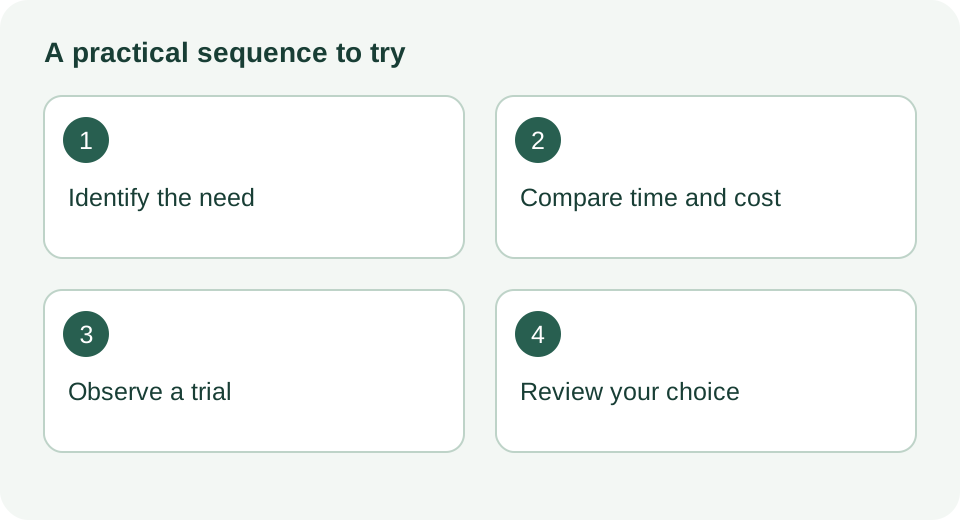
First, Check Whether Your Target Schools Even Interview
Interview preparation classes are built for schools that actually assess children through interviews or group activities — typically some Direct Subsidy Scheme and private schools. Many government and aided schools admit through the centralised Primary One Admission system and do not assess young children this way at all. Before comparing any course, list the schools you are realistically applying to and check each school's own current admission notice for how it selects students.
This single step saves more money than any price comparison. If two of your four target schools have no child interview, the question shrinks from 'how many lessons?' to 'what do these one or two schools actually do at interview?' — and that answer comes from the school, not a course brochure or chat forum.
- List your realistic school choices before reading any provider marketing.
- Check each school's own admission notice for its stated selection method.
- Do not assume a class is necessary just because other parents in your network have enrolled.
What Home Practice Can Genuinely Cover
The core interview skills for a five- or six-year-old are ordinary developmental skills: answering in a full sentence, describing a picture, giving a simple reason, following an instruction, and managing a turn in a group. None of this requires a curriculum — it requires a calm adult, short regular sessions, and real conversation. Home practice also has a structural advantage no class can copy: the material is your child's actual life. Children who already chat comfortably with unfamiliar adults are already rehearsing without knowing it.
The honest limitation is neutrality. Some children perform differently for parents — sillier, more resistant, or anxious when a parent becomes an examiner. If your child freezes specifically when a non-family adult asks questions, that is the one gap a class or structured group activity genuinely addresses.
A 15-Minute Home Routine You Can Rotate Through
Keep sessions short, playful and predictable — say, three rounds a week after dinner, never more than fifteen minutes. Rotate three zones. Zone one is conversation: 'What made you laugh today?', 'Why do you think the bus stopped?', with you modelling full-sentence answers first. Zone two is picture talk: pick any storybook illustration and ask what is happening, what might happen next, and how a character feels. Zone three is instruction-following games: a three-step command like 'put the red block in the box, close the lid, and bring it to me', then let your child command you.
One worked example, at a realistic K3 level. Ask 'What is your favourite animal?' and your child answers 'Dog'. Do not correct or push; try 'A dog — what does a dog do that makes you like it?' If the child says 'It runs with me', you have a two-sentence exchange. Over weeks the goal is not a script but a habit: your child expects to add a reason to an answer. That habit transfers to any question an interviewer invents, whereas memorised answers may not survive a follow-up.
What a Group Class Adds — and What It Cannot Fix
A group class may offer an unfamiliar adult in a teaching role, peers to practise turn-taking with, and a setting outside the home — some families can arrange these through trusted adults and community activities instead. Identify the experience your child would benefit from, then ask a provider how it supports that need. Check the minimum enrolment period and try a suitable trial lesson before committing to a block.
If your child finds conversation difficult across settings, discuss suitable support and expectations with their kindergarten teacher before buying lessons. Also ask directly how many minutes of individual speaking each child gets per lesson — treat a vague answer as information. And be clear-eyed about the reverse failure mode: a class teaching polished, identical answers. A rehearsed monologue leaves little room for a child to explain their own interests or handle a follow-up. Judge any programme by one standard — it should build thinking and expression, not scripts.
Signals a Group Class Is Worth Continuing
After two or three lessons, run this audit. Your child should be voluntarily speaking — anything, even short answers — not just sitting through activities. The teacher should be able to name one specific observation about your child's expression or participation, unprompted. By the third week the children should sound different from one another; if the whole class recites the same story opening, the course is manufacturing templates. And mood matters more than any observable 'progress': a child who says she does not want to go, week after week, is telling you something real, not lacking grit.
Further reading: www.kidemy.hk
Individual Coaching: A Precision Tool, Not a Default
One-to-one coaching is the most expensive format and the easiest to over-buy. Its genuine use cases are narrow: a specific identified gap (a child who answers well but speaks almost inaudibly to strangers), an imminent interview date with little time to build group familiarity, or a child who has tried a group setting and remains completely shut down. The last case carries a caution — if a child is overwhelmed by all unfamiliar settings, more one-to-one drilling is not obviously a solution. For some children the right intervention is more low-stakes group exposure: a new interest class, more playdates, library story time.
Individual coaching also cannot substitute for peer practice. Group scenarios — waiting, negotiating, cooperating — cannot be rehearsed alone with an adult. If you buy individual sessions, treat them as a short diagnostic-and-repair block with a defined endpoint, and ask the coach to state after two sessions what specific change they are working on.
Decision Matrix: Home Practice vs Group Class vs Individual Coaching
Use this matrix as a starting map, not a verdict. Read your child's current state first, then your goal, then the matching format. Most families' sensible answer is home practice as the base layer, a group class added only if the exposure gap is real, and individual coaching reserved for a named, specific problem.
| Dimension | Home practice | Group class | Individual coaching |
|---|---|---|---|
| Direct cost | Effectively zero; materials you likely own | Term-based fees; varies widely by provider and district | Highest per-hour cost of the three formats |
| Parent time required | High — you run the sessions | Low — transport and scheduling only | Low, plus time debriefing with the coach |
| Exposure to unfamiliar adults | Low unless deliberately engineered | High — the main structural benefit | High but with only one adult, one setting |
| Peer interaction and turn-taking | Depends on siblings or playdates | Built in | Not available |
| Individual attention | Total | Divided among all children | Total and professional |
| Risk of over-drilling | Low if you keep it playful | Real — depends on the provider's philosophy | Real — concentrated by design |
| Best matched to | Children who converse fine but lack structure; any family as the base layer | Children comfortable at home but quiet with strangers | A specific named gap or a very short runway |
| Poor match for | A child who already freezes with unfamiliar adults | A child who cannot yet answer two-sentence questions anywhere | Families buying it as a general 'boost' with no defined gap |
What Preparation Might Cost: A Clearly Hypothetical Worked Example
The following numbers are hypothetical arithmetic, not quoted prices for any provider. Request a written quotation covering teaching minutes, materials, registration, trial lessons and refund terms, add your own travel costs, and replace every figure below before comparing.
| Cost component | Home-only path (hypothetical) | Home + one group term (hypothetical) | Home + group term + 6 individual sessions (hypothetical) |
|---|---|---|---|
| Lessons | $0 | $300 per 1.5-hour lesson x 12 = $3,600 | $3,600 + $700 x 6 = $4,200; subtotal $7,800 |
| Trial lessons | $0 | 1 paid trial at $300 | 1 trial at $300 |
| Materials and books | $200 (storybook, picture cards, blocks) | $200 | $200 |
| Transport (approx. $20 per trip, child plus parent) | $0 | $20 x 2 people x 24 trips = $960 | $960 + $20 x 2 x 12 = $480; subtotal $1,440 |
| Illustrative total | $200 | $5,060 | $9,740 |
| What it buys | Habit of conversing and explaining at home | Above, plus weekly exposure to an unfamiliar teacher and peers | Above, plus targeted repair of one named gap |
Trial-Lesson Questions and Stop-and-Reassess Criteria
Go into every trial lesson with written questions and a quiet observation job. Your questions should force the provider to reveal their teaching philosophy, feedback practice and terms — where weak programmes hide. Your observation should focus on your child's reaction and on whether children in the room sound like individuals or copies of one script. Set your reassessment triggers before you enrol, when you are calm, and agree them with any co-parenting partner; review at the midpoint of any term, not the end, to keep your options open.
- "How many minutes does each child actually spend speaking in a typical lesson?"
- "What are your teachers' qualifications and experience with this age group?"
- "How do you handle a child who will not speak at all in the first lessons?"
- "How do you avoid children giving memorised, identical answers?"
- "What feedback will I receive after each lesson, and in what form?"
- "What exactly is included in the fee — and what costs extra?"
- "What are the terms if my child withdraws partway through the term?"
- "May I observe a lesson, or at least the last ten minutes, before deciding?"
- While observing: does the teacher ask follow-up questions that require thinking, or accept recited answers?
- While observing: how many children are in the room, and does the ratio match what was advertised?
- Stop-and-reassess trigger: your child consistently resists attending across three or more consecutive lessons.
- Stop-and-reassess trigger: after half a term, the teacher cannot name one specific strength or gap in your child's expression.
- Stop-and-reassess trigger: your child's answers are becoming more uniform and scripted, not more spontaneous.
- Stop-and-reassess trigger: you cannot identify what changed that home practice could not have produced.
- Stop-and-reassess trigger: the cumulative cost is crowding out things with clearer value — sleep, play, unhurried family time.
- Stop-and-reassess trigger: your target school list changed, and the remaining schools do not interview children at all.
- On any trigger: stop, spend nothing further, and return to the home routine while you reassess.
Before You Book: A Three-Scenario Unfamiliar-Adult Test You Can Run This Week
The decision matrix turns on one question: does your child already converse comfortably with adults outside the family? This worksheet turns that impression into evidence over one week, using three everyday scenarios that cost nothing and never use the word 'interview'. A gate first: this exercise only matters if at least one school on your list assesses children through interviews or group activities, confirmed on each school's own current admission notice. If every school admits through centralised allocation with no child assessment, stop here.
Run one scenario on three different days, each with a different unfamiliar adult, in a setting your child otherwise enjoys. Brief the adult in one sentence — 'just ask one friendly question and let it go' — and never frame the exercise as a test, reward or performance. Score each scenario 0–2 straight afterwards and record what happened in words. You are looking for a pattern across three strangers, not any single moment. The worked example below is hypothetical and deliberately ordinary — a K3 child who talks constantly at home. Note how generous the passing standard is: any relevant spoken answer counts, because the aim is willingness to engage a stranger at all, not eloquence.
- Total 5–6: no unfamiliar-adult gap is showing. Keep home practice as the base layer and re-run this worksheet in about eight weeks, or whenever your school list changes.
- Total 2–4: a partial gap. Repeat the worksheet once before spending anything; if the pattern holds, book one trial group lesson and judge it with the trial-lesson question list, not the brochure.
- Total 0–1: a genuine gap. A trial group lesson is now justified — but so are cheaper, lower-stakes exposures such as a new interest class or library story sessions, which build the same tolerance without interview branding. Re-test after a term.
| Scenario | No-cost setup | What counts as a pass | Worked example: what happened | Score (0–2) |
|---|---|---|---|---|
| Counter chat | Child hands over the money for one small item and the shopkeeper asks one simple question, such as whether a bag is wanted. | Any relevant spoken answer, even one or two words. | Said 'Yes, please' while looking at the floor. Quiet, but engaged. | 1 |
| Story-time question | A library or bookshop story session where the reader asks the group one easy question about the story. | Any answer related to the story, spoken to the adult. | Shook head and hid behind the parent's arm. No words. | 0 |
| Playdate conversation | A friend's parent, during a visit your child is enjoying, asks 'What do you like playing?' | A short answer with at least a hint of a reason. | Said 'I like cars' but did not continue when asked more. | 1 |
Two Cautions Before You Act on a Score
This measures an ordinary developmental skill, not interview performance, so a low score predicts nothing about any school's decision. And a child who refuses all three scenarios may be signalling that the exercise itself felt like pressure — re-run it more playfully, or later, rather than pushing through. A practical next action, in under an hour: write down your realistic school list; check each school's current admission notice for how it assesses applicants; run one fifteen-minute home session this week using the three-zone routine; only if unfamiliar-adult conversation is a genuine gap, shortlist two providers, book one trial lesson each, and walk in with the question list above; pre-agree your stop-and-reassess criteria with your partner before the term starts. Money spent on the right gap after a trial lesson is an investment; money spent on the wrong gap out of hallway anxiety is just the price of reassurance.
Frequently asked questions
Do all Hong Kong primary schools interview applicants?
No. Interview and group-assessment preparation is mainly relevant to schools that assess children individually — typically some Direct Subsidy Scheme and private schools. Many government and aided schools admit through the centralised Primary One Admission process without this kind of child assessment. Always check each school's own current admission notice for its actual method.
Can I prepare my child adequately at home without any class?
For many children, yes. Short, regular, playful conversation practice — full-sentence answers, picture description, following multi-step instructions, turn-taking — covers the main aims at this age if your target schools do assess children. The main gap is exposure to unfamiliar adults and peers, so the honest test is whether your child talks comfortably with non-family adults. If yes, home practice plus ordinary social activities is usually enough; if no, a trial group lesson is worth considering.
When should we start any formal preparation?
Base the timing on readiness, not other parents' timelines. A child who already chats comfortably needs at most a light home routine; a child still building basic sentence-answering is not helped by lessons pushed earlier. If you plan a class, a single trial lesson well before any commitment tells you far more than an age chart — and you can ask each provider what stage they expect children to be at.
How do I tell a good interview class from one that just drills scripts?
Ask how many minutes each child speaks per lesson, how they handle a child who will not talk, and how they avoid identical memorised answers. Then observe: in a genuine skills-based class, the teacher asks follow-up questions requiring thinking, children's answers differ from one another, and the teacher can describe your child's specific participation afterwards. If the room recites the same story opening in unison, walk away.
Is individual coaching ever worth the higher cost?
Only for a defined purpose: a specific identified gap, a very short runway before an interview, or a child who has already tried a group setting without progress. Buy it as a short block with a stated goal and endpoint, ask for a concrete focus after two sessions, and remember it cannot replace peer practice — group cooperation skills need other children, not a tutor.
Do I need a portfolio or recommendation letter for every school?
No — acceptance of supporting documents varies by school, so check each school's own current admission notice before building anything. If documents are invited, our free portfolio builder (16 styles, editable rows, photo uploads, PDF export after entering a parent email address — no login or verified email) and self-recommendation letter tool (100 combinations across 20 scenarios and 5 tones, in Chinese and English, editable with PDF export after entering a parent email address) let you prepare structured drafts to adapt in your own words. These tools help you present information tidily; they do not influence admissions on their own.
Put the preparation into practice
Find schools and official websites · Parent-child practice games · Editorial policy