
HK Primary Interview editorial content · Updated:
The examples and exercises below are illustrative material, not real student case studies or school test questions. Use them for family preparation; check each school’s current requirements before submitting documents.
What knock-door is, and what it is not
Knock-door is the period after central allocation results are announced and before the school year begins in September, when families whose child was not allocated a preferred government or aided primary school may apply directly to schools with unfilled places. Places are few, and each school decides its own application method, paperwork and shortlisting process.
Because every school writes its own rules, no article can tell you exactly what your target school wants this year. What this article can do is make you fast and accurate: which documents are almost always needed, which apply only in specific situations, how to track each school's requirements on one page, and how to prepare your child without turning a small child into a reciting machine. One caution: knock-door is discretionary. Some schools fill remaining seats without any interview. Treat everything here as preparation, not a promise of admission.
Further reading: www.edb.gov.hk
The registration safeguard: protect the seat you already hold
Every child who went through central allocation is offered one place, even if not the first choice. Before spending an evening on knock-door paperwork, complete registration at the allocated school within the window stated in the Education Bureau's current Primary One admission notice. If a family does not register, the system treats the child as having given up the place, and the seat is released. Registration does not lock you in against knock-door; it keeps one confirmed place open while you try for others. Families that skip registration and fail at every knock-door school can end the summer with no school at all. If a genuine emergency prevents registration, contact the allocated school directly and ask how to arrange an alternative, as the notice advises.
Practically, put the registration date and time in your calendar the moment the notice is published, and pack a simple folder in advance: the registration certificate or collection notification when it arrives, your identification, and the child's documents. Registration is the step where a mistake is hardest to undo.
Further reading: topschool.hket.com · www.hk01.com · iteda.org · www.edb.gov.hk
The document checklist: core, conditional, and situational
Most online lists present twelve or thirteen items as one flat pile. That is unhelpful: several do not exist yet, and others apply only to particular families or schools. Sort documents into three layers: core documents you photocopy once and reuse everywhere; conditional documents that exist only at certain moments; and situational documents that depend on your child's history or the school's character.
The biggest timing trap is the registration certificate, which only exists after you register at the allocated school — exactly when knock-door windows open. Prepare everything else in advance so adding the certificate is the only remaining task. Second trap: recommendation letters help most when the writer genuinely knows your child, so request one from a kindergarten principal or teacher well before results are released. Finally, treat each school's own notice as the authority. Some cap the portfolio, some say certificates are unnecessary, some ask for nothing beyond their own form. A few popular schools give some priority to families who placed the school first in earlier stages, but this is school-by-school and changes with the applicant pool; verify it on the notice.
- Core: birth certificate or right-to-stay copy, child photo, latest kindergarten report copy, both application stub copies, parent or guardian ID copies, stamped return envelopes
- Conditional: registration certificate copy after registration, baptismal certificate for religious schools, recommendation letter only if genuinely offered
- Situational: the school's own form, a short portfolio or letter if the notice invites one
- Always: one stuffed folder per school, built from that school's notice, never from a generic list
| Document | Layer | When available | Applies to |
|---|---|---|---|
| Birth certificate / right-to-stay copy | Core | Any time | Every family |
| Kindergarten report copy | Core | End of K3 | Every family |
| Application stubs (both stages) | Core | Kept from your applications | Every family |
| Registration certificate copy | Conditional | Only after registration | Every family |
| Baptismal certificate | Situational | Already exists, if at all | Religious-school applicants |
| Recommendation letter | Situational | Arrange weeks before results | Where a genuine writer exists |
| School's own form / upload | Situational | Per school notice | Varies by school |
Core documents: prepare once, reuse everywhere
Photocopy the following for every child, and keep originals flat in one labelled folder: a copy of the child's birth certificate or other proof of the right to stay in Hong Kong; one or two recent passport-style photographs; the most recent kindergarten report; copies of both parents' or the guardian's identity documents; and copies of the parent stubs from both the self-allocation and central allocation applications, which some schools ask to sight. Add several stamped, self-addressed envelopes, because many aided schools reply by post.
Conditional and situational documents
The registration certificate exists only after registration, so plan a photocopy session for that week. A baptismal certificate matters only for religious schools, and only if your family genuinely has one. Recommendation letters apply only if someone who knows your child well offers one; never buy one. Include certificates and awards only if the school's notice welcomes them, and only the few that say something real about your child. One letter tool mentioned later offers editable scenarios in Chinese and English precisely so families are not tempted to paste a stranger's template; a copied template says nothing true about your child.
Further reading: www.hk01.com · iteda.org · www.edb.gov.hk
Build a one-page requirement tracker for every target school
During knock-door week you will juggle three to five schools, each with its own submission method, priority rules and paperwork, while tired and distracted. A one-page tracker per school prevents the classic disasters: posting School A's letter to School B, or missing a school that accepts applications only at the office counter during limited hours. Below is a worked example using three invented schools; copy the structure, not the contents, and fill it in only from each school's current notice.
| Target school (hypothetical) | How to submit | Priority note from notice | Extras beyond core pack | Master files needed | Status |
|---|---|---|---|---|---|
| School A | In person, limited hours | Shortlisted families invited to interview | Own form; portfolio capped at 4 pages | ChanTM_Letter_SchoolA_v2.pdf, ChanTM_Portfolio_SchoolA_final.pdf | 2 printed sets done |
| School B | By post only | Silent on first-preference priority | None beyond core pack | ChanTM_Letter_Generic_v1.pdf | To photocopy and post |
| School C | Online form plus upload | Priority consideration for first-preference applicants | Registration certificate copy required | All core PDFs, ChanTM_RegCert.pdf | Waiting for registration cert |
File naming that works under pressure
Decide a naming convention before you scan or save anything, and write it atop your tracker. A workable pattern: child surname and initial, document type, school only where tailored, then version — for example: ChanTM_BirthCert.pdf; ChanTM_K3Report_June.pdf; ChanTM_Letter_SchoolA_v2.pdf; ChanTM_Portfolio_SchoolA_final.pdf. This matters because schools accepting email or uploads may misfile files named scan0042.pdf, and when stuffing five folders at eleven at night, consistently named PDFs print in the right order without thinking. Never keep a tailored letter under a generic name: if the letter names School A's open day, its file must contain SchoolA, and remove it from the shared folder once printed so it cannot be reprinted for School B by accident.
Further reading: www.hk01.com · iteda.org
Contingency timing: plan in phases, not in dates
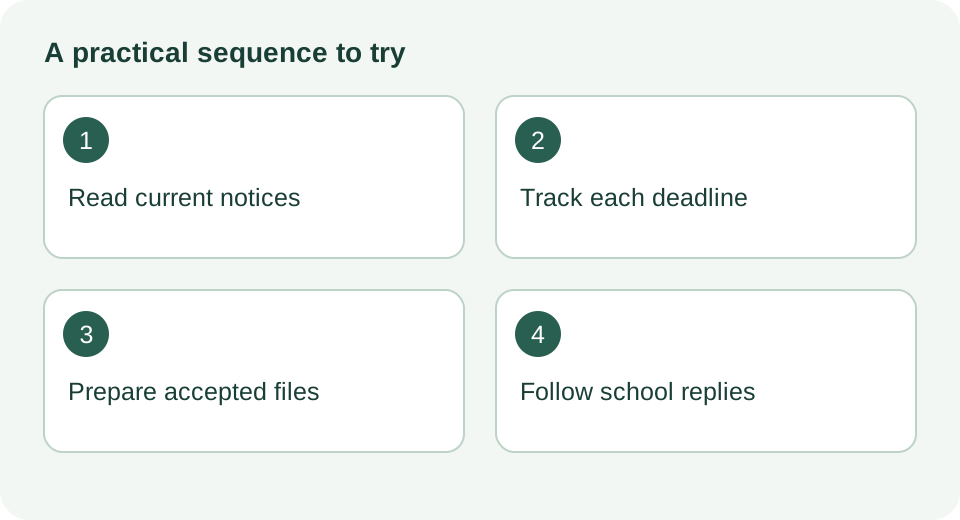
Official dates are set anew each year by the Education Bureau and individual schools, so structure preparation around four phases and slot official dates in as they are published. Phase zero, before results: collect and photocopy core documents, draft your generic letter, request any recommendation letter, and read target schools' notices. Phase one, results week: register at the allocated school, copy the registration certificate, finalise one folder per school, and submit as early as each notice allows. Phase two, the following weeks: log every submission with date and method, watch for interview invitations by phone, email and post, and run the 7-day practice plan the week before any confirmed interview. Phase three, until September: keep your phone audible and spam folder checked, respond to any offer the same day, and remember that accepting a new place usually means formally withdrawing the registered seat per that school's procedure.
Two habits beat any date table. Re-check each school's notice the day before you submit, since schools amend arrangements mid-process. For postal applications with a cutoff, post several working days early and keep a dated photocopy of everything. For in-person-only schools, go in the morning of an allowed day, in case documents are missing and you have time to return.
| What the school notice says | What you do |
|---|---|
| Shortlisted applicants invited to interview | Run the 7-day practice plan the week before; earlier tends to lose a young child's interest |
| No mention of interviews | Treat as document-only; do not drill the child for this school |
| In-person submission only | One stuffed folder per school; go in the morning; bring originals to sight |
| Postal applications | Post 2-3 working days before any cutoff; keep a dated photocopy |
| Online form with uploads | Use agreed file names; screenshot the confirmation page |
| Priority for first-preference (111 or 1-1-0) applicants | Check your stubs against the stated rule before investing effort; many schools use no such filter |
| Portfolio capped at a page count | Follow the cap exactly; it keeps the pack easy to file |
Further reading: iteda.org
Writing a one-page knock-door letter that reads as genuine
A knock-door letter has one job: make a tired reader want to meet your child. Failing letters are copied from templates many families may have sent, or padded with adjectives. Working letters are one page, in whatever language the family writes most naturally, and built on three concrete moves: a specific reason this school and not another; one true, small example of the child; and one line on how the family's habits fit the school's stated approach. Naming something genuinely observed at an open day shows you did the reading; a small true example gives your child something true to talk about if asked.
A worked example paragraph, and why each sentence earns its place
Worked example: Dear Principal Lam, we write on behalf of our son Chan Tai Ming, who is six and finishes K3 at Wai Yin Kindergarten this summer. At your November open day, what stayed with us was the Primary 6 guides patiently explaining their science corner to visitors; calm confidence in speaking is exactly what we hope school will build in Tai Ming. At home, he has rebuilt the same wooden train track five different ways rather than give up when pieces would not fit, and his kindergarten teacher describes him as a child who tries again quietly. Our family reads together for twenty minutes after dinner every evening, which is why your school's emphasis on daily reading spoke to us. We would be glad to bring Tai Ming to meet you, and can be reached at 9XXX XXXX.
Sentence one gives the facts a reader needs to file the letter. Sentence two names a specific observation, not a compliment. Sentence three offers a true behaviour a five-year-old actually has. Sentence four connects a real family habit to the school's stated approach. Sentence five makes the next step easy. No sentence claims Tai Ming is gifted or destined for anything. If the blank page is the hard part, our self-recommendation letter tool provides a starting scaffold rather than a finished product: twenty scenarios across five tones, Chinese or English, editable and exportable after free email registration — then replace every placeholder with your own true specifics.
Further reading: topschool.hket.com · iteda.org
The 7-day interview practice plan and interview day
This plan assumes a confirmed interview roughly a week away and a child of five or six, with sessions adapted to their attention and comfort. Every session is short, most happen inside ordinary family life, and none involves memorising a script. If a school's notice does not mention interviews, skip the plan for that school; if your child is already chatty and confident, run only days five and six.
- Day 1: Name, age, kindergarten. Build the four-sentence self-introduction together and say it during play, three or four times, never at a desk.
- Day 2: Family and daily life, folded into dinner chat: Who walks you to school? Who reads with you? Honest one-line answers are the right answers.
- Day 3: Numbers and time in real life. Count oranges at the market, name the days of the week, ask what season it is on the walk home. No worksheets.
- Day 4: Books. Have the child pick a favourite book and retell it in four sentences to a parent acting as a curious listener.
- Day 5: Mock interview with a friendly unfamiliar adult, such as an aunt or neighbour, at a table. Practise greeting, sitting, listening, answering briefly, saying thank you.
- Day 6: Dress rehearsal. Wear the actual interview clothes for an hour, travel the actual route at the actual time, and play a quiet waiting game at a cafe.
- Day 7: Rest. One playful run-through, an ordinary bedtime, and no new material whatsoever.
A worked self-introduction for a five-to-six-year-old
Worked example: My name is Chan Tai Ming. I am six years old. I go to Wai Yin Kindergarten. I like dinosaurs, and I can tell you which one has the longest neck. This ends with something the child enjoys and can discuss if the teacher follows up. A few familiar points leave room for conversation; a long memorised script makes an unexpected follow-up harder. Practise in silly voices, in the lift, at dinner, so it stays playful rather than examined. If the child stumbles, laugh and move on; the goal is that the sentences feel like facts about himself, not a performance he can drop.
Further reading: topschool.hket.com · www.hk01.com
Free tools that take the formatting work off your plate
Two tools on this site handle the mechanical work so your evenings go into the substance. The portfolio builder offers 16 styles with editable rows and photo uploads, an optional local draft save, and PDF export after free email registration. Because each school may want a different page count or emphasis, build one master portfolio, then use editable rows to produce a four-page version for a school that caps length, without rebuilding from zero.
The self-recommendation letter tool provides one hundred starting points, built from twenty scenarios across five tones, each in Chinese and English, editable and exportable as a PDF after free email registration. These are structured scaffolds to complete, not personalised essays, and no tool can supply the true specifics that make a letter land. Pick the scaffold closest to your situation, then rewrite every line with your own observed facts.
Further reading: topschool.hket.com
Frequently asked questions
How many schools should we approach at knock-door?
Approach the number your household can execute properly, not the largest number you can name. Each school has its own form, submission method and folder to stuff. For most families, three to five well-tracked schools is a realistic ceiling; put them in your tracker with per-school file names before results week so nothing depends on memory.
Do we need a thick portfolio to be taken seriously?
No. Some schools welcome a short portfolio, some cap its length, and some principals care more about whether the family's approach fits the school than about certificates. Follow any stated cap, include only items that genuinely describe your child, and treat a slim, accurate pack as stronger than a padded one. If a school's notice asks for nothing beyond its form and a letter, send exactly that.
What if we missed the registration window at the allocated school?
Act the same day. Unregistered places can be treated as given up, so contact the allocated school's office immediately to explain and ask what can be done, and check the Education Bureau's current Primary One admission notice for guidance. Do not let a missed registration silently cancel the safety net your whole knock-door plan sits on.
Should the knock-door letter be in Chinese or English?
Write in whichever language your family commands best, because clarity and sincerity survive translation while errors do not. An awkward English letter reads worse than a warm, tidy Chinese one, and vice versa. What matters is one page, three concrete moves specific to that school, and true details an interviewer could ask your child about.
My child is shy. Will that ruin the interview?
No. A shy child who greets, listens, and answers briefly and honestly is meeting exactly what this practice plan aims for. Do not force eye contact or rehearsed smiles, which can distress some children and add nothing. Practise the four-sentence self-introduction until it feels like facts, not a performance, and let the child's natural manner carry the rest.
Put the preparation into practice
Find schools and official websites · Parent-child practice games · Editorial policy