
HK Primary Interview editorial content · Updated:
The examples and exercises below are illustrative material, not real student case studies or school test questions. Use them for family preparation; check each school’s current requirements before submitting documents.
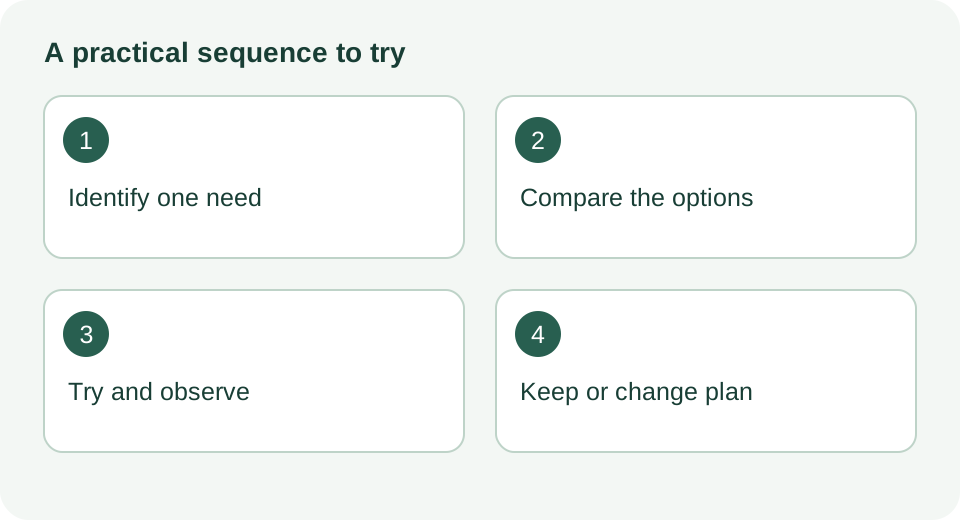
Start with your child's needs, not with course advertisements
Summer transition courses are marketed heavily between May and August, and the advertising tends to imply that every child is unprepared by default. In reality, children arrive at Primary 1 with very different starting points. A course is a tool for specific gaps, not a universal requirement.
Before looking at any programme, write down two or three concrete observations, such as 'can follow a two-step instruction but loses focus after about fifteen minutes of seated activity'. These become your comparison criteria; a course is worth considering only if it directly addresses something on your list. If your list is short, that is a valid result: a child who manages a full kindergarten day, eats independently and tolerates group settings may need nothing more than the school's orientation and a familiar home rhythm.
Signals that a structured programme may genuinely help
These are editorial observations about common situations, not a diagnostic checklist. Consider a structured programme, whether paid or home-made, if several of the following describe your child consistently over weeks rather than on one bad day. Look especially at sustained separation, transitions between activities, following group instructions in a noisy room, and stamina for a longer day.
- Your child becomes very distressed at unfamiliar venues even after several visits
- Your child cannot yet follow a two-step instruction from an unfamiliar adult
- Your child avoids all pencil-and-paper activity, or writing causes frustration or discomfort
- Your child struggles to wait for a turn in group games even with familiar adults present
- Your child's kindergarten teachers, at your request, have flagged specific areas worth extra practice
The three main options compared
Most families in Hong Kong choose some blend of three things: the primary school's own orientation arrangements, an optional paid transition class, and a home routine built around the summer. They are not mutually exclusive, and the first costs nothing but your attention. The table below is an editorial summary; every school and provider differs, so treat the rows as prompts for what to check and rely on your school's notices for what its orientation actually involves.
| Option | Typical shape | Main strengths | Main limitations | Best fit |
|---|---|---|---|---|
| School orientation and notices | Briefings, orientation days or adaptation activities arranged by the school | Information from your actual school; opportunity to see the setting; check any charges | Usually short; little individual practice; timing set by the school | Every family, as the baseline |
| Optional paid transition class | A block of group sessions covering routines, group skills and light academic practice | Repetition and fixed structure; a different adult gives instructions; peer setting | Cost and quality vary widely; content may not match your chosen school | Children with specific, identified gaps group practice can address |
| Home routine and play-based practice | Parent-led daily rhythm, short practice bursts, pretend play about school | Zero or near-zero cost; paced to your child; can be paused any day | Requires parental consistency; less exposure to unfamiliar peers | Families with summer time; children who settle best with a familiar adult |
What school orientation usually offers, and how to get the most from it
Hong Kong primary schools commonly arrange some form of adaptation activity before term, such as a parents' briefing, a day when new students visit, or a short orientation period in the first week. Arrangements differ from school to school, so your most reliable source is the notice your school sends you. Do not assume another school's schedule applies to yours, and do not assume your school will interview children or collect portfolios; if your school asks for anything, it will say so in its own communications.
Make orientation count by treating it as a fact-finding trip. Attend with your child, note practical details together, and talk about the visit afterwards in a light, positive way. Photograph, where permitted, places your child will need to find, such as the entrance, the classroom block and the washrooms, and use those photos in home practice later. Write down what the school expects of families, from stationery lists to arrival routines; reconstructing them in late August from memory is stressful and error-prone.
Questions worth asking at orientation
Most briefings leave a little time for questions. These are practical, neutral questions that apply to almost any school; pick the two or three that matter most for your child.
- What does a typical first-week timetable look like for new P1 students?
- How does the school handle a child who cries at the gate or cannot yet manage the full day?
- Is there a period of half-days or phased arrival for P1, and if so, how is it structured?
- Who should parents contact, and by what channel, about adjustment concerns in the first term?
- Are there school-arranged orientation sessions my child should attend, and what happens at each?
Comparing paid transition courses: what to look at beyond the brochure
Paid programmes differ enormously in group size, teacher qualifications, session length and how much is spent on marketing. A glossy brochure tells you almost nothing about whether actual sessions suit your child; judge providers against your written needs list, not promises of readiness in general. Above all, insist on a trial session before committing to a block. Many providers offer one; if a provider will not let you observe or try a session at all, treat that as significant information in itself.
Questions to ask at a trial session
Ask these directly and take notes. A confident provider answers them plainly; vague answers are a comparison point in themselves.
- Can I observe the session, or at least the first part, and what is the usual group size and age mix?
- Who leads the sessions, and what are their actual roles and relevant experience with this age group?
- Which specific skills do the sessions practise, and how do you adjust for a child who finds an activity difficult?
- What happens if my child cries, refuses to join, or needs the washroom mid-session?
- How do you tell parents after each session what was practised and how the child responded?
- What is the make-up and refund arrangement if we miss a session or stop early?
Red flags and honest limitations
Be cautious of providers who guarantee admission outcomes, claim to know the requirements of named schools, use fear-based language about children falling behind before they start, cannot describe a single concrete activity, or run very large groups where a quiet child could go unobserved.
Honest limitations matter too. A group class cannot replicate your child's actual school, cannot resolve deep-rooted separation anxiety on its own, and cannot replace the daily repetition a home routine provides. If a provider implies otherwise, discount that claim entirely.
A hypothetical cost comparison, including transport
The following arithmetic is entirely hypothetical, provided only to show how to structure your own comparison. Substitute current figures from providers you are actually considering; prices vary widely and change over time, so we do not quote any real provider's fees.
Example only: a paid course might be quoted at a hypothetical $280 per 90-minute session, so a six-session block costs 280 x 6 = $1,680 in fees. Suppose it runs twice weekly for three weeks: a hypothetical $8 each way per trip, six trips, one accompanying adult, is 8 x 2 x 6 = $96, giving a course-plus-transport total of $1,776. Add a hypothetical $120 for incidentals such as a water bottle and requested stationery, and the planning figure is $1,896.
Compare the home option: example only, the same six weeks of home practice might involve a hypothetical $60 in materials and a hypothetical $40 in transport to free venues such as a public library, for a planning figure of $100. A realistic middle path, school orientation plus a home routine plus a hypothetical $280 two-session taster with $16 transport, comes to about $396. Notice that the largest cost differences come from the number of sessions and the frequency of travel, not the headline per-session fee; a cheap-sounding course running daily can cost more in total than an expensive one running weekly.
| Hypothetical option | Hypothetical fees | Hypothetical transport | Hypothetical materials | Hypothetical total |
|---|---|---|---|---|
| Six-session paid course | $1,680 | $96 | $120 | $1,896 |
| Two-session taster plus home routine | $560 | $16 | $100 | $676 |
| School orientation plus home routine only | $0 | $40 | $60 | $100 |
How to use this comparison fairly
Cost alone should not decide the question. A $1,896 programme that directly addresses two written needs may be better value than a $396 one that does not; conversely, paying more does not by itself buy better fit. Build your own table with real quotes from two or three providers, always including transport time as well as money: a forty-five minute cross-district journey in July heat imposes a hidden cost on a tired five-year-old that no fee schedule reflects.
The home routine option: a flexible two-week starter plan
A home routine is not a lesser substitute; it is a practical option you can repeat in familiar surroundings at your child’s pace. The following plan is a flexible editorial example: adjust it freely, and change rather than enforce a plan that causes daily battles. Build each day around three short anchors: a morning routine rehearsal, one seated activity of roughly ten to fifteen minutes, and one play-based activity. Keep total adult-directed time well under an hour per day; the rest of a healthy summer is free play, rest and family time.
| Day | Morning anchor | Seated anchor | Play anchor |
|---|---|---|---|
| 1 | Wake, wash, dress and eat by a set time | Decorate a name card for the new classroom | Pretend play: pack a school bag together |
| 2 | Same routine; child checks a picture checklist | Ten minutes of pencil mazes or tracing | Walk or ride past the school entrance |
| 3 | Routine plus child packs own bag from a list | Copy own name and one short word | Play 'raise your hand to answer' during a story |
| 4 | Routine; practise opening lunchbox and bottle | Ten minutes of counting or sorting objects | Library trip; choose a school-themed picture book |
| 5 | Routine timed with a simple kitchen timer | Write or draw a card for the new teacher | Obstacle course practising line up, wait, go |
| 6 | Routine; lay out clothes the night before | Ten minutes following two-step instructions | Role-play: teacher takes the register, child answers |
| 7 | Rest day or family outing | Optional review only | Free play |
| 8 | Repeat week 1 routine, no reminders where possible | Ten minutes writing or drawing from a picture prompt | Rehearse the school run, including transport route |
| 9 | Routine plus child answers 'what's first, what's next?' | Ten minutes of phonics or word games | Playground game practising turn-taking |
| 10 | Routine; child prepares own water bottle and snack | Ten minutes of maths games with dice or cards | Role-play: asking a teacher for help with a problem |
| 11 | Routine as normal | Ten minutes copying a short sentence | Games day: rotate your child's favourites from weeks 1-2 |
| 12 | Routine plus full dress rehearsal of the morning | Ten minutes of any activity still feeling hard | Celebration: review the two weeks and note progress together |
| 13 | Rest or an ordinary family morning | No planned seated task | Choose free play |
| 14 | Choose one helpful routine to keep | Optional drawing of a question for the teacher | Review what your child wants to try next |
Two printable home worksheets with exact wording
Worksheet 1: Morning Checklist. Draw or paste five pictures down the left of an A4 page: toilet, wash hands and face, get dressed, eat breakfast, pack bag. Down the right, print this exact wording with a tick box beside each line: '1. I went to the toilet. 2. I washed my hands and face. 3. I got dressed by myself. 4. I ate my breakfast. 5. I packed my school bag.' Laminate it or use a plastic sleeve so a whiteboard marker wipes off daily.
Worksheet 2: My First Day Story. Create a four-frame comic on an A4 page divided into quarters, and print these exact sentence starters, one under each frame: 'Frame 1: In the morning I will... Frame 2: At the school gate I will... Frame 3: In the classroom I will... Frame 4: After school I will see...'. Complete it together about a week before term, then re-read it on the eve of the first day; it gives your child a chance to ask questions about the plan.
Exact sample wording for tricky moments
Sample separation wording at the school gate, said calmly and briefly: 'Mummy and Daddy will always come back. School finishes and I will be waiting right here at 3:15. You go in with Teacher, and we will talk about the best part at snack time.' Follow the handover plan agreed with staff and your child. If your child is highly distressed, do not force the handover: ask staff how they would prefer to handle it and agree a plan together. Replace 3:15 with your school's actual dismissal time, and agree the wording with your child in advance.
Sample wording for asking for help, rehearsed through role-play: 'Teacher, I need help, please.' Practise until your child can say it to an unfamiliar adult, then rehearse when to use it: something is lost, the child feels unwell, or an instruction was not understood. A rehearsed sentence is a concrete tool in the moment, rather than only a general instruction to 'be brave'.
Play-based practice and three fictional family examples
Many five-year-olds take to routines more willingly through play than through drills. Pretend school is among the most useful games: take turns being teacher and student, practising raising a hand, lining up, asking for the washroom, and unpacking and repacking a bag. Games with simple rules, such as board games, snap, card games and 'What's the time, Mr Wolf?', build waiting, losing gracefully and holding a rule in mind; short, frequent, cheerful sessions beat long serious ones. For more ideas, our /game/ section collects simple parent-child activities to adapt, not a curriculum, and you know your child's energy and interests best.
The following examples are entirely fictional and illustrate how a needs-led decision works, not what any family should copy. In each case the decision follows from written observations, not advertising or other families' choices. Fictional example 1, K1-to-P1, the confident child: the Cheung family's daughter eats independently, manages a full kindergarten day and separates easily, but has never followed a two-step instruction from an unfamiliar adult. They choose orientation plus the home routine only, with extra role-play in which a relative 'plays teacher', budgeting a hypothetical $100 and spending nothing on classes; the single gap is small and well suited to home practice.
Fictional example 2, the anxious separator: the Leung family's son cries at unfamiliar venues even after repeated visits, though he is otherwise capable. Judging that he needs repeated, low-pressure practice with a kind adult who is not a parent, in a small group, they trial two providers, choose one with a four-child group they observed, and book a hypothetical two-week, four-session block ($1,120 plus, hypothetically, $32 transport), paired with the home routine and daily rehearsal of the separation wording. If he is still highly distressed after four sessions, their pre-agreed pause criterion, described below, will trigger.
Fictional example 3, the child with fine-motor frustration: the Wong family's daughter avoids all pencil work and melts down when her letters look wrong. Reasoning that a generic routines-focused course would not address this, and that pushing harder at home has already failed, they look specifically for a small-group programme whose leader described at trial how they adapt writing tasks, booking a short hypothetical six-session block. They also lower home expectations: finger-strength play such as playdough and tweezers games, and pencil work capped at five joyful minutes. If the frustration persists once school begins, they plan to raise it with the class teacher through the school's normal channel rather than adding more summer pressure.
Pause criteria: when to stop or change course
Decide your exit criteria before you begin, and write them down; pre-agreed criteria remove the pressure of deciding mid-meltdown and stop sunk costs from keeping you in a programme that is not working. Pausing does not mean failure. Pause or stop, whether the activity is a paid course or your home plan, if any of the following happens.
A first approach that fails is information, not defeat. If a paid course leaves your child unmoved, ask why: was the group too large, the sessions too long, the content mismatched to your written needs, or a personality mismatch with the leader? Each answer points to a different next step. If the home routine stalls, shrink it rather than abandon it: cut the seated anchor to five minutes, move the play anchor to the weekend, or let your child design one morning anchor, since children who own part of a plan participate more willingly. If everything stalls at once, the summer is probably overloaded; remove activities before adding discipline.
If a specific difficulty, such as persistent separation distress, avoidance of all writing, or speech and communication concerns, continues well into the school term despite a changed approach, raise it with the class teacher through the school's usual channel. Teachers see many P1 children each September and can describe what is typical for the age and what the school can do in class. This guide does not offer treatment or diagnostic advice; a teacher's observation of your child in the actual classroom is a more reliable next step than any course brochure.
- Your child dreads the activity: persistent tears, refusals or physical complaints before sessions across two or more occasions
- No visible change in your written target area after a fair trial period, for example four to six sessions or three weeks of home practice
- Your child is more anxious, not less, after attending, or starts resisting school-related talk generally
- Your own evenings or family relationships are consistently damaged by the schedule
- The provider's conduct diverges from what was described at the trial, for example much larger groups or unexplained substitute leaders
Frequently asked questions
Will skipping a transition course put my child at a disadvantage in Primary 1?
Schools generally expect a wide range of starting points in September, which is one reason many arrange orientation activities for new P1 students; confirm the specifics with your own school, as requirements are school-specific. What matters most is knowing the practical routines: where the washroom is, how to ask for help, how to open a lunchbox and how the morning works. A paid course is one way to practise these; a home routine and the school's own orientation are equally legitimate. Transition courses are not part of central P1 admission arrangements, but always rely on your own school's notices rather than any general statement.
When should we book a paid course if we do decide to try one?
As a general timing consideration only: trial sessions are most useful a few months before term, so there is still room to adjust, but not so early that your child's readiness changes before the course begins. Always attend a trial before paying for a block, and confirm make-up and refund terms in writing before committing. This guide does not list current provider schedules or prices.
My child did not attend the same kindergarten as friends going to the school. Does that matter?
It matters far less than parents fear. Schools generally expect that many children will arrive without existing friendships, and early-term activities are often structured with that in mind; your school's own arrangements may differ. Help at home by rehearsing simple friendship openers through role-play, such as 'Can I play too?' and 'What's your name?', and by normalising that everyone in the class is new on the first day.
Does my child need a portfolio or to prepare for an interview before P1?
Admission arrangements for P1 are set out centrally and by individual schools, and requirements differ. Do not assume your school will interview your child or accept portfolios; check your school's own notices for exactly what it asks for. Nothing in this guide, and no transition course, can promise admission outcomes, and any provider claiming insider knowledge of a school's requirements should be treated with caution.
Put the preparation into practice
Find schools and official websites · Parent-child practice games · Editorial policy