
HK Primary Interview editorial content · Updated:
The examples and exercises below are illustrative material, not real student case studies or school test questions. Use them for family preparation; check each school’s current requirements before submitting documents.
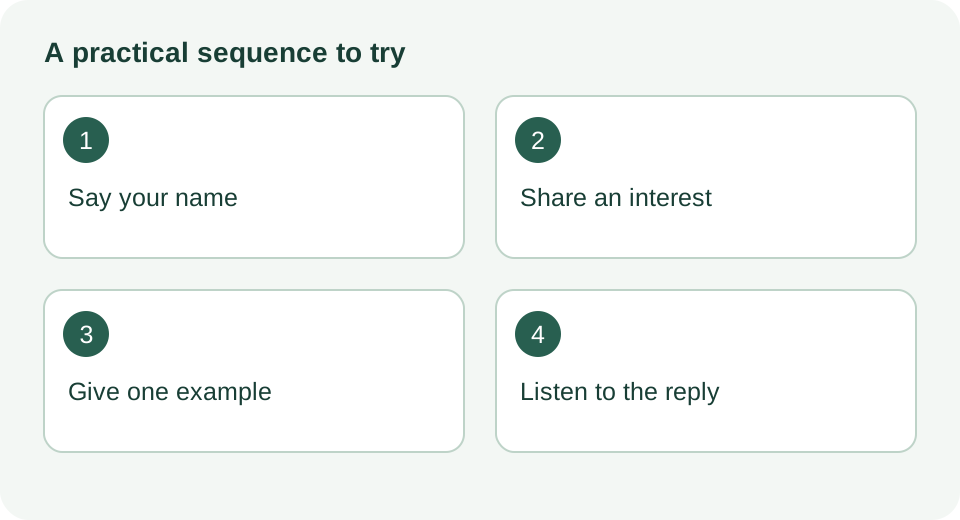
What to Aim For, and Which Length to Build First
When a five-year-old introduces themselves to a new adult, they are not auditioning as a public speaker. Home practice should aim for clear, simple sentences, answering a friendly adult they have just met, and recovering when something does not go to plan. A child who manages four short sentences and smiles afterwards is easier to build on than a child reciting a polished ninety-second speech that is not their own. Fluency in memorising is not the goal; comfort with the content is. If your child genuinely loves dinosaurs, a slightly wobbly sentence about dinosaurs serves them better than a flawless sentence about piano lessons they quietly resent. The scripts below are skeletons: the words only work once your child's real life is poured into them.
It is also worth knowing that arrangements differ widely between schools, and some use games, drawing or group activities instead of a formal spoken introduction, so always read each school's current admissions notice and prepare to its stated format. Schools commonly ask for anything from a brief greeting to around one minute, and three short ready versions are easier for a young child than one long one that must be cut on the spot. Build them like nesting boxes: the 15-second version sits inside the 30-second version, which sits inside the 60-second version. If your child forgets a line, they simply arrive at the next box early and finish calmly. If you only prepare one, prepare the 30-second version: long enough to show personality, short enough for most five-year-olds to hold comfortably.
- Clear simple sentences matter more than long vocabulary
- Real interests beat impressive-sounding ones
- Check each school's own notice for format, language and timing
- Some schools may not ask for a spoken introduction at all
| Situation | Best version to use | Why |
|---|---|---|
| School notice asks for about 30 seconds | 30-second script | Matches the request without padding |
| Very short greeting or a group setting | 15-second script | Easy to hold even when nervous |
| Around one minute requested, or many follow-ups expected | 60-second script | Extra sentences give the teacher things to ask about |
| Child is shy or new to practising | 15-second script first | Small success builds confidence before length is added |
| Unsure what the school wants | 30-second script | Safe middle length; confirm details from the school notice |
Further reading: hkkindergarten.com
The 15-Second Script (Chinese and English)
This version is four sentences, all within a typical five- to six-year-old's speaking ability. Practise it until your child can say it while doing something else, like walking to the kitchen, because that is the real test of whether it lives in them rather than in a memorised chant.
English version: Good morning! My name is Kelly Lam. I am six years old. I like drawing and swimming. Thank you!
Chinese version: 老師好!我叫林嘉欣。 我今年六歲。 我喜歡畫畫和游泳。 謝謝老師!
Fifteen seconds is roughly four short sentences at a relaxed pace. If your child's version takes half a minute, they are likely pausing a long time between sentences; slow down each sentence rather than speeding up the child.
The 30-Second Script (Chinese and English)
The 30-second version adds two things teachers often listen for: who is at home, and one specific detail that makes your child individual. 'I like drawing' is forgettable; 'I like drawing animals' invites a follow-up question and shows the teacher a real person.
English version: Good morning! My name is Kelly Lam. I am six years old. I live with my mummy, my daddy and my little brother. I go to Sunshine Kindergarten. I like drawing animals, and I swim on Sundays. My favourite book is The Very Hungry Caterpillar. Thank you!
Chinese version: 老師好!我叫林嘉欣,今年六歲。 我和爸爸、媽媽和弟弟一起住。 我在陽光幼稚園上學。 我喜歡畫動物,星期日會去游泳。 我最喜歡的書是《好餓的毛毛蟲》。 謝謝老師!
Swapping In Your Child's Real Details
Work through the slots one at a time with your child in the room, and let them choose the content. 'I live with my mummy, my daddy and my little brother' becomes 'I live with my mummy and my grandma' in a one-parent or three-generation household, and both answers are equally welcome. 'I like drawing animals' becomes 'I like building with blocks' or 'I like kicking a ball' depending on what your child actually does on a Saturday. The book line becomes any book genuinely on your shelf, or, if your child cannot name one, swap it for 'I like going to the playground with my grandpa.'
Two rules keep the swaps honest. First, never put anything in the script the child cannot talk about for one more sentence if asked, because the teacher may well ask. Second, keep names and ages simple to say; a child who stumbles over their Chinese name in English can use the romanised form they use at school, whichever feels natural.
Timing It Realistically
Read the script aloud at a relaxed pace and time it; most adults land between 25 and 35 seconds. If your child takes 45 seconds, shorten the sentences rather than asking the child to speak faster. Cut the book line first: it is the most expendable sentence, and its job is done if it triggers a friendly follow-up.
The 60-Second Script (Chinese and English)
The one-minute version adds a tiny story. One concrete memory, told in one or two sentences, is usually easier for a child to remember than an abstract claim, and it gives the listener something specific to ask about. The script stays within realistic sentence length for this age.
English version: Good morning! My name is Kelly Lam, and I am six years old. I live with my mummy, my daddy and my little brother, Matthew. He is four. I go to Sunshine Kindergarten. I love drawing animals. Last week I drew a whole family of pandas at the library. I also swim on Sunday mornings with my daddy. My favourite book is The Very Hungry Caterpillar, because the caterpillar eats so much! I would like to learn many new things and make new friends here. Thank you!
Chinese version: 老師好!我叫林嘉欣,今年六歲。 我和爸爸、媽媽和四歲的弟弟一起住。 我在陽光幼稚園上學。 我最喜歡畫動物,上星期我在圖書館畫了一整家熊貓。 星期日早上我還會和爸爸去游泳。 我最喜歡的書是《好餓的毛毛蟲》,因為毛毛蟲吃得好多! 我希望在這裡學到更多東西,認識新朋友。 謝謝老師!
The final line expresses interest in the school in simple, childlike terms rather than flattery. Avoid scripting sentences no five-year-old would naturally say, such as claims about a school's reputation or ranking; such lines place a memorisation burden that often collapses under pressure.
- Keep every sentence under roughly twelve words
- Include one real, recent memory your child can expand on
- End with a simple wish about learning or friends
- Practise the 30-second version to fluency before attempting this one
Follow-Up Questions: Practise the Four Variations
After the introduction, teachers very commonly pick one detail the child has just said and ask about it, so the introduction is really the first question of a conversation. Practising follow-ups is therefore more valuable than polishing the introduction further. Teach the pattern: repeat the key word in the question, answer in one short sentence, add one small detail if possible.
Variation one, on the hobby. Question: 'You said you like drawing. What do you like to draw?' Answer: 'I like drawing pandas. I drew a baby panda last week.' The child who prepared the panda story in the 60-second script already owns this answer, which is exactly why the story was put in.
Variation two, on family. Question: 'Tell me about your little brother.' Answer: 'His name is Matthew. He is four. He likes trains.' Keep the last sentence short and true; even 'He is funny' works, because the goal is one extra sentence, not an essay.
Variation three, on daily life. Question: 'What do you do after school?' Answer: 'I have a snack, then I play with my blocks.' Coach your child to name one real, ordinary thing rather than an impressive-sounding list; ordinary said confidently reads as secure.
Variation four, on wanting to join. Question: 'Why do you want to come to our school?' For a five-year-old the honest register is concrete: 'I want to learn to read more books and make new friends.' If your child has actually seen the school, one true observation ('I saw your playground from the bus') is even better. Practise these four variations in rotation; two per practice session is plenty.
Further reading: dictationeasy.com
Adapting for a Shy Child
Some children chat happily at home and go silent in front of a stranger, which is developmentally normal, not a defect to fix before September. The adaptation is not more drilling; it is more scaffolding and lower stakes. Have your child introduce themselves to toys lined up on a sofa, then to one familiar adult, then to a trusted adult outside the family such as an aunt on a video call. Each step changes only one variable: the audience. The words stay the same.
Give a shy child a physical anchor instead of pressure: holding a small familiar object, resting hands on the table, or taking one slow breath before starting are all legitimate strategies. Agree on a recovery plan: if a line is forgotten, the child pauses, breathes, and jumps to any sentence they remember, because the nested structure means every sentence is a valid ending. Rehearse the recovery itself once or twice, so forgetting is practised as a normal event with a known solution rather than a catastrophe.
Forcing sustained eye contact can be stressful for a young child and is unnecessary. A soft, occasional glance towards the teacher's face or badge is perfectly acceptable; what matters is that the child speaks audibly and appears at ease. If your child has particular support needs or communication differences, plan the introduction around their real strengths and never coach them to conceal those needs; a calm, supported child presenting authentically will usually cope better than a coached child masking discomfort.
A Three-Step Warm-Up Routine for Interview Day
One, on the way over, play a quick game of 'guess my favourite animal' so your child's voice is already warmed up; two, outside the venue, talk about something unrelated and pleasant, skipping last-minute reminders, which usually increase anxiety; three, agree that afterwards you will get a snack together whatever happens, so the event is framed as a visit, not a test. This takes no extra time and often helps anxious children stay settled.
Further reading: hkkindergarten.com
The 7-Day Practice Log
One week of short, playful practice beats one weekend of intensive drilling. The log assumes about five to ten minutes a day, and every session should end while your child is still enjoying it. Tick a day only if the session happened pleasantly; a skipped day is simply carried forward, not punished. The arc is deliberate: days one and two build the words, days three and four add length, days five and six add unpredictability, and day seven is a light rehearsal. By the end, your child has practised forgetting and recovering, which is the skill that actually carries them through the room.
| Day | Focus | What to do | Done |
|---|---|---|---|
| 1 | Build the words | Choose the real details together; child says only the 15-second version once | |
| 2 | Own the 15-second version | Say it at dinner and again while walking; no correction of small stumbles | |
| 3 | Grow to 30 seconds | Add the family and detail sentences; practise sitting down, hands resting | |
| 4 | First follow-up | Parent asks one follow-up after the introduction; swap roles so child asks you | |
| 5 | Grow to 60 seconds | Add the story sentence; parent plays teacher with a makeshift name card | |
| 6 | Surprise round | Roll a dice to pick version and follow-up; practise forgetting one line and recovering | |
| 7 | Light full run | One dress rehearsal in slightly smarter clothes, then praise one specific thing |
Common Mistakes, Next Steps and Checklist
The most frequent mistake is length inflation: adding certificates, awards, three languages and a travel history until the script is beyond a five-year-old's memory. Strip it back; two interests said with genuine enthusiasm outperform five recited flatly. The second mistake is over-drilling until the introduction sounds recorded. A useful self-check: if you close your eyes and cannot tell whether your own child or an announcement is speaking, it is over-rehearsed; bring the version back towards how your child actually talks. The third mistake is treating the introduction as a solo performance when it is really the opening of a conversation; if practice time is limited, spend the last half of it on follow-up questions rather than one more repetition of the opening.
Keep the language load honest. A child learning English at school but speaking Cantonese at home should not be pushed into an all-English 60-second version overnight; a shorter, solid English version paired with a comfortable Chinese version reflects reality. If a school requires a specific language or format, that will be stated in its own admissions notice, so verify before finalising which version to lead with.
Your next action: tonight, sit with your child for ten minutes, fill in the 15-second script with their real details, and say it once together at dinner. Everything else can be built from that single finished, spoken version. Once the scripts are settled, some families keep a simple printable record of their child's details, interests and favourite books for reuse across applications: our portfolio creator tool offers 16 styles with editable rows, photo uploads, an optional local draft save, and free PDF export after submitting a parent email address (no account login or verified email needed). If a school asks parents to write about their child, our bilingual letter editor tool provides 100 combinations of 20 scenarios by 5 tones, each in Chinese and English, editable with PDF export after providing a parent email address; the drafts are starting points you personalise, not finished submissions. Neither tool guarantees any admission result, and portfolio or letter requirements vary by school, so confirm what each school actually accepts before preparing anything beyond the spoken introduction.
- Read each target school's current admissions notice for format, language and length
- Build and time the 15-second script first, then nest up to 30 and 60 seconds
- Prepare answers for the four follow-up variations in rotation
- Agree on a recovery plan for forgotten lines, and rehearse it once
- No forced eye contact; a soft occasional glance is enough
- Keep practice sessions under ten minutes and always end on a good note
- Confirm separately whether the school asks for portfolios or parent letters at all
Frequently asked questions
Should my child prepare a Mandarin version as well as Cantonese and English?
It depends entirely on the target school, and the requirement is normally stated in that school's admissions notice or application material. If Mandarin is required, adapt the 15-second version first and keep it one or two sentences shorter than the Cantonese version if your child is less familiar with Putonghua. If nothing is stated, prepare Chinese and English and ask the school directly rather than guessing.
What should my child do if they forget a line in the middle?
Use the nested structure deliberately: build the 30- and 60-second versions from the 15-second version, so every sentence is a valid ending point. Teach your child to pause, take one breath, and continue from any sentence they remember, and rehearse this recovery at least once at home. A calm recovery is a more useful skill than an unbroken recitation.
Is it bad if my child's introduction sounds memorised?
Some memorisation is inevitable at this age, but the fix is more ownership, not more drilling. Let your child choose the details, practise in varied positions and settings, and vary the order of sentences occasionally. If it starts sounding recited, take two days off the script entirely and just chat about the topics in it.
How long should the introduction be?
Match whatever the school asks, which you should confirm from its current notice. As a practical default, the 30-second version suits most situations: substantial enough to include a personal detail, short enough for most five- and six-year-olds to hold. The 15-second version works for shy children or short greetings, and the 60-second version suits schools asking for around a minute or following up with many questions.
Do these scripts guarantee a better chance of admission?
No. They are practice illustrations written for a hypothetical child, Kelly Lam, and schools weigh many factors in their own ways, none of which a script can control. The realistic benefit is that a comfortable, honest introduction lets your child show their actual communication skills on the day without added anxiety.
What if the school we apply to has no interview or self-introduction at all?
Then the preparation is not wasted, just redirected. Speaking clearly about themselves and answering an adult's questions are useful life skills regardless of admissions, and the same content often reappears in the first weeks of Primary One when teachers ask children to share about themselves. Always check the school's own arrangements so you spend effort where it is actually asked for.
Put the preparation into practice
Find schools and official websites · Parent-child practice games · Editorial policy