
HK Primary Interview editorial content · Updated:
The examples and exercises below are illustrative material, not real student case studies or school test questions. Use them for family preparation; check each school’s current requirements before submitting documents.
What the task asks, and why observation comes before inference
A child in K3 or Primary 1 is doing three difficult things at once: studying unseen pictures, holding details in memory, and speaking in ordered sentences while a grown-up watches. When a story comes out fragmented or jumpy, the child may need more time or a simpler prompt for one of those steps. The task appears in two forms: a single picture where the child invents before and after, or a sequence of three or four pictures narrated in order. Language expectations vary too, so always check each school's current admissions notice rather than preparing for one imagined standard. The underlying skill is ordinary and trainable, the same one a child uses telling you about the playground.
Many children jump straight to inventing a plot and skip what is actually in the picture. The fix is to teach two kinds of statements and name them plainly. An observation is something your eyes can prove: 'The boy is holding a red kite.' An inference is a sensible guess your brain adds: 'The boy looks excited because he is smiling.' Play a two-minute game first: show one picture and say, 'Tell me something your eyes can see.' Test each answer: if your child says 'The dog is sad', respond, 'We can see his ears are down. Saying he is sad is a clever guess.' A useful rule: aim for two observations before allowing one inference. Observations are the story's bones; inferences are its feelings and reasons.
Quick parent script for the observation round
Keep prompts short and identical each time: 'Who do you see? What are they holding? Where are they? What just happened, do you think?' Four questions, one picture, two minutes. Resist correcting vocabulary mid-answer; note it and feed it back naturally next round: 'Yes, that's called a kite string.'
A four-step story frame that fits a five-year-old's memory
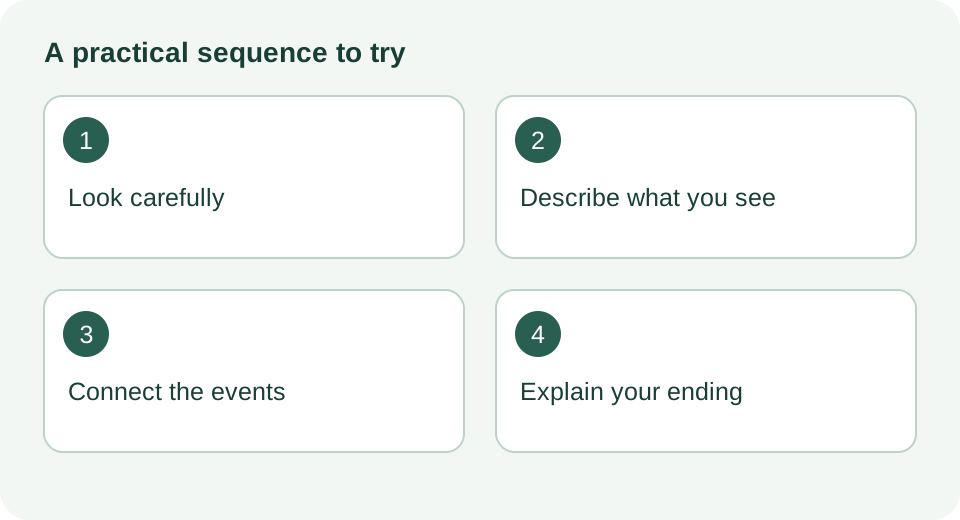
Rather than a ten-part framework, which overloads working memory at this age, teach a four-beat frame: Beginning (one day, who, where), Problem (what went wrong or what the character wanted), Fix (what someone did), Feeling (how it ended and how someone felt). This mirrors how your child already hears picture-book stories, so it feels familiar rather than like a test.
Practise the frame physically: put four fingers on the table, one per beat, and tap each finger as that part is spoken. The tapping gives children a visible place to return to when they lose their thread and discourages skipping between scenes. Connecting words like 'first', 'then' and 'in the end' attach to it naturally, one per finger. Also build the habit of naming characters early. Agree before starting: 'Let's call the girl May and the dog Lucky.' Named characters make the story clearer for the listener and easier for the speaker to track than vague 'he' and 'she'.
Further reading: www.hk01.com
Worked example 1: The Kite in the Tree (three-picture sequence)
Picture 1: On a windy Sunday afternoon, a girl and her father fly a bright red kite in a park. Picture 2: The wind tugs hard, the string slips, and the kite lands in a tall tree; the girl gasps. Picture 3: The father uses a long stick to lower the kite down; the girl reaches up with both arms, grinning.
Chinese story, realistic K3 level: 「星期日下午,小美和爸爸在公園放一隻紅色的風箏。忽然,風很大,風箏的線掉了,風箏飛到樹上。小美很着急。爸爸找來一根長長的棍子,輕輕把風箏勾下來。風箏回來了,小美開心地跳起來。我覺得爸爸很厲害,也很愛小美。」
English story, same level: "On a windy Sunday afternoon, May and her dad fly a red kite in the park. Suddenly the wind blows hard and the kite lands in a tall tree. May feels sad. Dad finds a long stick and brings the kite down carefully. May jumps and smiles. Dad is strong and kind."
The story stays inside the pictures: every beat maps to one image, and the only inventions are names, feeling words and the closing comment. If your child adds a wholly new event, such as an ice-cream stand appearing in picture three, welcome it once and steer back: 'That's a fun idea. Let's save it for another story and finish this one with the kite.'
Observation-versus-inference check for this sequence
Safe observations: a red kite, a park, a tall tree, a man holding a stick, a girl reaching up. Safe inferences: the wind is strong (the kite flew off), May is worried (her mouth is open), Dad helps because he loves her. If your child says 'Dad is angry', ask what in the picture shows anger; if nothing does, praise the guess and label it as a guess. This habit keeps retellings of unfamiliar pictures coherent.
Worked example 2: Sharing an Umbrella (three-picture sequence)
Picture 1: Heavy rain outside a school gate. A boy stands under a blue umbrella; the pavement is dotted with puddles. Picture 2: Another boy stands off to the side without an umbrella; his shoulders are dark with rain. Picture 3: The two boys walk away together under the one blue umbrella, both smiling.
Chinese story: 「放學的時候,下大雨了。小華打開自己的雨傘,看見同學小明沒有帶傘,肩膀都濕了。小華走過去說:『一起走吧!』他們兩個人在同一把傘下慢慢回家,一邊走一邊笑。小華覺得幫助朋友,心裏暖暖的。」
English story: "After school, it rains heavily. Tom has an umbrella, but his friend Ben has none. Ben's shoulders are wet. Tom walks over and says, 'Let's share!' The two boys walk home under one umbrella and laugh together. Helping a friend makes Tom feel warm inside."
This sequence is deliberately inference-heavy: picture two never states that Ben has no umbrella, so the child must work it out from the wet shoulders. Ask, 'How do we know Ben has no umbrella?' A child who answers 'because he is wet and Tom is not' has achieved the observation-to-inference step this guide is trying to build.
Stretch question for confident storytellers
If the four-beat story comes easily, add one extension: 'What do the boys say to each other under the umbrella?' Inventing a line of dialogue pushes able children from narrating events to imagining voices, and keeps the story inside the pictures. One extra sentence is enough; the aim is depth, not length.
Worked example 3: The Little Cat at the Gate (three-picture sequence)
Picture 1: A boy sits on a garden step eating a sandwich; a thin cat sits a little way off, watching him. Picture 2: The boy kneels beside a small bowl, putting some of his sandwich into it; the cat is eating. Picture 3: The next morning, the cat sits waiting at the gate; the boy walks up carrying food, and the cat rubs against his legs.
Chinese story: 「一天早上,小俊在花園吃三文治。一隻瘦瘦的小貓看着他,好像很想吃。小俊把一塊三文治放進小碗裏,小貓很快吃完了。第二天早上,小貓坐在門口等他。小俊又拿食物出來,小貓在他的腳邊磨蹭。小俊說:『以後我天天餵你!』」
English story: "One morning, Ken eats a sandwich in the garden. A thin little cat watches him. Ken puts some food in a bowl. The cat eats it all up. The next morning, the cat sits at the gate and waits. Ken brings more food. The cat rubs his legs. 'I will feed you every day,' Ken says."
Use this sequence to teach the hardest idea at this age: time passing between pictures. Ask, 'Look at the sky and the light. Is this the same day?' Children who mark time explicitly, with phrases like 'the next morning', produce stories that feel complete rather than like three unconnected scenes.
Fading your help over four weeks, and a two-minute home rubric
The goal is a child who can tell an unfamiliar story alone, so support must be designed to disappear. Run short five-to-ten-minute sessions over roughly four weeks. Week one, full support: you ask the four observation questions, and your child answers one sentence per picture while you hold the four-finger frame together. Week two, sentence starters: you say only 'First...' and wait; if your child stalls, repeat the starter rather than supplying words. Week three, keyword cards: write two or three words per picture, such as 「風箏」「樹」「棍子」, and let your child build sentences while you tap the frame silently. Week four, present the pictures cold and say, 'Tell me the story.' Ask exactly one follow-up question at the end.
Two rules keep fading honest. If a week feels shaky, repeat it rather than moving on. And never fade support and add difficulty at the same moment; if the pictures are new and harder, keep scaffolding longer. Success is not how fast support disappears but whether your child still enjoys the sessions. Alongside fading, score each rubric element below from 1 to 3 once or twice a week, keep scores on one page, and share progress simply: 'Last week the ending was new; this week you remembered it every time.' Steady twos with an occasional three is often a reasonable level for a five- or six-year-old; the rubric is a mirror for your teaching, not a scoreboard for your child.
| Element | 1 - Emerging | 2 - Developing | 3 - Confident |
|---|---|---|---|
| Opening | Names one thing in the picture | Says who and where, with some prompting | Gives time, person and place in one opening sentence |
| Order | Jumps between pictures | Follows the sequence with a prompt | Uses first, then and finally unprompted |
| Details | Only the biggest objects mentioned | One or two added details, such as colours | Details from every picture woven into the story |
| Inference and feeling | No feelings or reasons | One feeling word, sometimes prompted | Explains why a character feels a way, grounded in the picture |
| Ending | Stops mid-scene | Ends the event but no closing thought | Ends with a result and a simple feeling or comment |
Matching activities to problems, and interview-day manners
Match what you noticed in the last session to one activity below, and change only one thing at a time. If two rows apply, start with the higher one, since ordering problems usually sit underneath everything else.
| If your child... | Try this | Why it helps |
|---|---|---|
| Tells the story in one breathless rush | Tap the four-finger frame; one beat per breath | Physical pauses force sentence boundaries without constant correction |
| Says 'he' and 'she' vaguely | Agree on character names before starting | Names give the listener a track to follow and reduce pronoun tangles |
| Gives only two or three sentences | Ask one 'why' question about a feeling | One reason-and-feeling sentence adds substance to a short story naturally |
| Freezes when pictures are unfamiliar | Run the observation game first, story second | Observation gives something certain to say first, which can make invention feel less pressured |
| Mixes up the picture order | Practise ordering first: lay the cards out, then tell | Separating sequencing from speaking halves the memory load |
| Avoids speaking altogether | Let a puppet or toy 'tell' the story first | Speaking through a toy can reduce the feeling of being watched and tested |
On the day, and on children with different needs
Before the task, the practical basics matter most: a full-sentence greeting, pictures held where your child can see them, and permission to pause and think. Teach two honest recovery phrases, such as 'I need to think for a moment' in the interview language, and practise them at home so they become normal speech. Rehearse gentle follow-ups too: 'Why did the boy do that?' or 'What happened next?' Answering one calm follow-up matters more than a longer story; keep mock sessions light, around one to two minutes, and stop while your child is still enjoying it.
For children who are shy, or who have speech, language or attention support needs: prepare in the way that suits your child, and never coach forced eye contact as a trick. Where a school offers a chance to share relevant information, share it honestly, and if unsure what is welcome, ask the school directly. School formats, languages and whether an interview happens at all vary widely, and in the central allocation system many places are filled without any interview, so verify each school's current arrangements on its own admissions notice.
Further reading: dictationeasy.com · www.edb.gov.hk
Keeping a gentle record, tools, and your next action
Once a fortnight, write down the story exactly as told, date it, and read it back together. Children are usually delighted to hear their own words treated as a real story, and you get an honest record of growth without any test feeling. If a school's own notice invites optional supplementary materials, our portfolio builder offers 16 styles with editable rows, photo uploads, optional local draft saving and a free PDF export after entering a parent email address; no account login or verified email is required. Use it only where materials are welcome. Similarly, if a school's process invites a parent statement, the self-recommendation letter tool provides 100 combinations covering 20 scenarios in 5 tones, in Chinese and English, editable with PDF export after entering a parent email address; no account login or verified email is required. These are templates you edit yourself, so set aside time to make the letter genuinely about your child, and check whether the school accepts such letters at all first.
Your next action is deliberately small: tonight, draw or print three simple pictures of the kite sequence on scrap paper, run the observation game, and tap the four-finger frame once. Five minutes, no printing budget, no app. If it goes well, put the fading calendar on the fridge and begin week one tomorrow. Print the checklist below and keep it with your practice pictures; if three or more boxes stay unticked two sessions in a row, repeat the current fading stage.
- Pictures ready: one sequence of three simple pictures within reach
- Two observations named before any inference is allowed
- Character names agreed before the story starts
- Four-finger frame tapped: beginning, problem, fix, feeling
- Character names used instead of 'he' and 'she' throughout
- Story ends with a result and one feeling word
- Exactly one follow-up question asked and answered
- Session ended while the child was still enjoying it
- Rubric scored 1 to 3 and dated on one page
Frequently asked questions
How long should a five- or six-year-old's picture story be?
A realistic target is four to eight short sentences covering the four beats: beginning, problem, fix and feeling. Some children naturally add a little more, and that is fine, but length is not the goal. A clear sixty-second story with an ending beats a wandering three-minute one, and an interviewer can ask follow-up questions if they want more.
Should my child memorise a set of prepared stories?
No. Memorised stories fall apart the moment the pictures are unfamiliar, and they teach a child to perform rather than to think. Practise the method instead, the observation game, the four-beat frame and the connecting words, on many different pictures. The method transfers to any picture; a memorised story does not.
My child mixes Cantonese and English mid-story. Is that a problem?
At home, code-mixing is normal and not something to punish. For practice, agree on the language at the start of each session, and if your child slips, respond in the target language rather than correcting directly. Which language a school expects varies, so check each school's admissions notice and practise that language for that school in the weeks before.
Do all Primary 1 admissions involve picture storytelling interviews?
No. Picture storytelling is a common task where schools choose to interview, but many places, particularly in the central allocation stage of the Primary One Admission system, are offered without any interview at all. Schools also differ in format and language, so always confirm current arrangements on each school's own admissions notice.
What should I do if my child refuses to practise or gets upset?
Stop the session and shrink the task. Next time, use the observation game only, with no storytelling, or let a puppet tell the story first. Shorten sessions to three or four minutes and end on a success. If refusal persists for a couple of weeks, park the interview framing entirely and simply keep reading and chatting about picture books; the underlying language skills keep growing either way.
How often should we practise, and for how many weeks?
Two or three short sessions a week for four to six weeks is plenty for most children at this age. Follow the fading plan: full prompts in week one, sentence starters in week two, keyword cards in week three, and independent telling in week four. Repeat any stage where rubric scores stall, and stop entirely if practice stops being enjoyable.
Put the preparation into practice
Find schools and official websites · Parent-child practice games · Editorial policy