
HK Primary Interview editorial content · Updated:
The examples and exercises below are illustrative material, not real student case studies or school test questions. Use them for family preparation; check each school’s current requirements before submitting documents.
What actually sits in a first-year budget
The annual tuition is a useful starting figure, but it leaves out transport, meals and equipment. First-year purchases may cluster before term starts. Which item is largest and which year is most expensive depend on the school and your household; build the estimate from the actual charges.
A useful budget has six categories: tuition; the acceptance or registration deposit; one-off items such as books, uniforms and school bag; recurring daily costs such as lunch and transport; optional extras such as interest classes, camps and uniform extras; and small administrative charges that some schools itemise separately. Not every school charges every item, and the billing rhythm differs from school to school, which is exactly why a personal worksheet beats any generic rule of thumb.
By the end of this guide, you should be able to fill in one page of numbers drawn from the school's own documents and know roughly how much cash you need in month one, not just across the year.
Tuition instalments and the shape of the school year
Many schools quote tuition as an annual figure but collect it in instalments, and the number of instalments is not standard. A hypothetical school charging HK$60,000 a year might collect it in ten instalments of HK$6,000 across the school year, while another collects annually or termly. The annual cost is identical; your monthly cashflow is not.
Two details matter when you read the fee schedule. First, count the billing months rather than assuming twelve equal payments. If tuition runs across ten months of the school year, the calendar months with no instalment give you breathing room, but the months that coincide with books, uniform and a termly bus bill can pinch. Second, ask whether the deposit is deducted from tuition or held separately. A deposit credited to the first instalment should appear once in your total, not twice.
If the schedule is not published in full, that itself is a useful signal to ask the school office for the collection dates in writing before you accept an offer.
The upfront pile: what you pay before the first bell
The weeks between accepting a place and the first day of school are when several costs land at once. Grouping them helps you see the real demand on that month's cash.
The biggest unknown for many families is timing: some schools ask for the first instalment before term starts, others after. Until you have the dates, plan for the stricter case so you are never caught short.
Deposits and how they are credited
Ask separately whether a payment is credited against tuition and what happens if you withdraw. These are not alternatives: a deposit can be credited when the child enrols but non-refundable on withdrawal. In our hypothetical example, $1,000 already paid is credited against a $6,000 first instalment, leaving $5,000 to pay. Annual tuition remains $60,000. Check any separate notice requirement or further payment obligation in the actual terms.
Books, uniforms and one-off kit
Book lists and uniform fittings typically happen over the summer, which means these payments arrive in the same few weeks as the deposit and possibly the first instalment. Costs vary enormously by school and by how much you buy new, so treat any figure you hear second-hand as a rough guide and get the current book list price total from the school or its listed supplier. Add smaller items you may forget at first: sports kit, choir or recorder for music lessons, a rain cover for the school bag. Individually trivial, collectively noticeable.
A worked first-year budget, labelled hypothetical
The figures below are entirely illustrative and describe no real school. They exist so you can see how a worksheet fits together. Suppose a school charges HK$60,000 tuition collected in ten instalments, a school bus at HK$12,000 for the year, lunch at HK$6,000 across the year, HK$4,000 in books and uniform before term starts, and HK$3,000 of optional activities you choose yourself.
| Item | Basis (illustrative) | Year one |
|---|---|---|
| Tuition | 10 instalments of $6,000 | $60,000 |
| School bus | Annual fee | $12,000 |
| Lunch | Charged across the year | $6,000 |
| Books and uniform | One-off, before term | $4,000 |
| Optional activities | Your choice | $3,000 |
| Total | $85,000 |
When the cash actually leaves your account
The illustrative $85,000 total averages about $7,083 across twelve calendar months, but the assumed billing dates are uneven. Suppose the $1,000 deposit was paid earlier and credited against the first $6,000 tuition instalment. An opening-month subtotal of $5,000 remaining tuition, $4,000 termly bus charge and $4,000 books and uniform is $13,000. This subtotal excludes lunch and any activity payments due that month; add their actual collection amounts. Do not label the subtotal a complete opening-month budget.
Optional activities may be adjustable, but check their booking and cancellation terms. Delaying a payment changes timing; cancelling an optional purchase changes the annual total. Keep those effects separate in your worksheet.
Two children: combine two payment calendars
If two children have exactly the same hypothetical annual costs, with no discounts or shared purchases, the total is $170,000. Doubling the opening-month subtotal gives $26,000, still excluding lunch and activities due that month. The earlier deposits total $2,000. Children in different years may have different charges, so build one calendar per child before combining them.
If your children start in different years, the pattern eases but never disappears: one child's heavy month still collides with the other's instalments. Two practical habits help. First, build the calendar before the school year begins, writing each school's billing dates onto one household month-view so collisions are visible early. Second, check whether either school offers sibling arrangements on items such as bus routes or uniform reuse; policies differ and the only way to know is to ask. What you should not assume is any automatic discount, because sibling concessions are not universal and must come from the school's own written terms.
Fee remission and scholarships: what the official guidance covers
The Education Bureau's Direct Subsidy Scheme resources page links to fee-remission and scholarship information. Each DSS school sets its own scheme, with its own eligibility conditions, coverage, required documents and deadlines, and submitting an application is not the same as being approved. Source: www.edb.gov.hk
If remission affects whether you can accept a place, ask about eligibility, application timing, the decision date and payments required while waiting. Prepare both the full-fee case and the confirmed-reduction case. If full fees are unaffordable, resolve that uncertainty with the school before committing instead of assuming approval will arrive later.
A sensitivity check, not a forecast
Because your worksheet is built on estimates, it is worth testing how wrong you can afford to be. This next example is an assumption for practice, not a prediction about any school or about fee movements in general. Suppose optional activities double from HK$3,000 to HK$6,000 because your child takes to two clubs, and lunch runs HK$1,500 higher than your estimate. The year-one total rises from HK$85,000 to HK$89,500, and the even monthly average moves from about HK$7,083 to about HK$7,458, an increase of HK$375 a month.
Run the same test on the lines that worry you most, one at a time. If a twenty per cent overshoot on transport or books still fits your month-one buffer, your budget is sturdy. If it does not, the fix is not anxiety but structure: hold a slightly larger opening reserve, delay one optional item, or revisit the school choice with fuller numbers. The exercise takes fifteen minutes and replaces guesswork with a margin you have chosen deliberately.
Questions to put to the school before you commit
Most gaps in a first-year budget come from things the school simply has not been asked about. Before accepting any offer, send one consolidated email so the answers arrive together and in writing. Something like this works, with your details in brackets:
"Dear [school name] Admissions Office, we are considering the [year group] place offered to our child, [child's name]. To complete our family budgeting, could you kindly confirm: (1) the tuition instalment amounts and the months in which each falls due for [school year]; (2) whether the [amount] deposit is credited to tuition or held, and the written terms if we withdraw; (3) the estimated total for the current book list and uniform set; (4) the billing arrangements and indicative fees for the school bus route via [area], if available; (5) how and when to apply under the school's fee-remission or scholarship scheme. Thank you very much."
Where a school cannot yet confirm a figure, for example because next year's bus fees are not set, mark that line in your worksheet as unknown and carry your own conservative placeholder instead. Keep an eye on the school's official notices for updates rather than treating the placeholder as settled.
Your one-page action plan
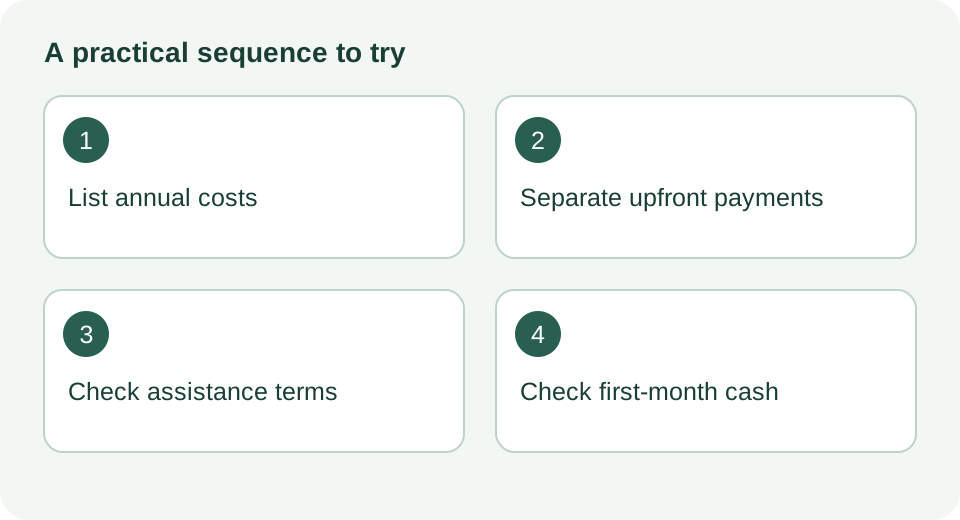
Set aside half an hour with the school's fee schedule and acceptance letter, then work through four steps in order. First, list every annual cost you can identify: tuition, transport, lunch, one-off kit and the activities you actually want, leaving genuinely unconfirmed items marked as unknown. Second, separate the one-time payments from the recurring ones and note which months each lands in, so the true shape of the year replaces the even average. Third, read the fee-remission and deposit-refund terms in the school's own documents, and if you plan to apply for assistance, submit early and track the stated timeline. Fourth, add up your first-month cash requirement, including the deposit and any double-up months if you have two children at fee-charging schools.
If the numbers hold together with a comfortable margin, you can accept the place with confidence. If they are tight, you now know exactly which line to negotiate, defer or re-examine, which is a far better position than discovering it in the first week of September.
Frequently asked questions
If we accept a place and then change our mind, do we lose the deposit?
It depends entirely on the school's written terms, which differ on whether a deposit is credited to tuition, held against withdrawal, or forfeited. Read the acceptance letter before paying, and if the wording is unclear, ask the school office to point you to the relevant clause so your decision is informed.
Why does my monthly average not match what I actually pay each month?
Because schools bill by their own calendar, often in instalments across the school year rather than twelve equal months, and the same term-start months tend to carry books, uniform and termly bus bills on top of instalments. Build a month-by-month calendar from the school's billing dates instead of dividing the annual total by twelve.
Do all DSS schools offer fee remission, and when should we apply?
The Education Bureau's DSS resources link to fee-remission and scholarship information, but each school sets its own scheme with its own eligibility, coverage, documents and deadlines, and applying does not guarantee approval. Check your school's scheme directly and apply as early as its stated window allows, planning your budget on full fees until any reduction is confirmed in writing.
Discussion background and sources
This topic was informed by search-index excerpts of the public discussion below; the complete thread could not be retrieved directly. Historical comments identify a parent question, not current admission rules or admission chances. Consult the official sources and the notice addressed to your family.
- Baby Kingdom: 有兩個小朋友,月入幾多先會考慮私校? (2019 discussion) — discussion background
- EDB: DSS school and fee-remission resources — official source
Sources checked:
Put the preparation into practice
Find schools and official websites · Parent-child practice games · Editorial policy