
HK Primary Interview editorial content · Updated:
The examples and exercises below are illustrative material, not real student case studies or school test questions. Use them for family preparation; check each school’s current requirements before submitting documents.
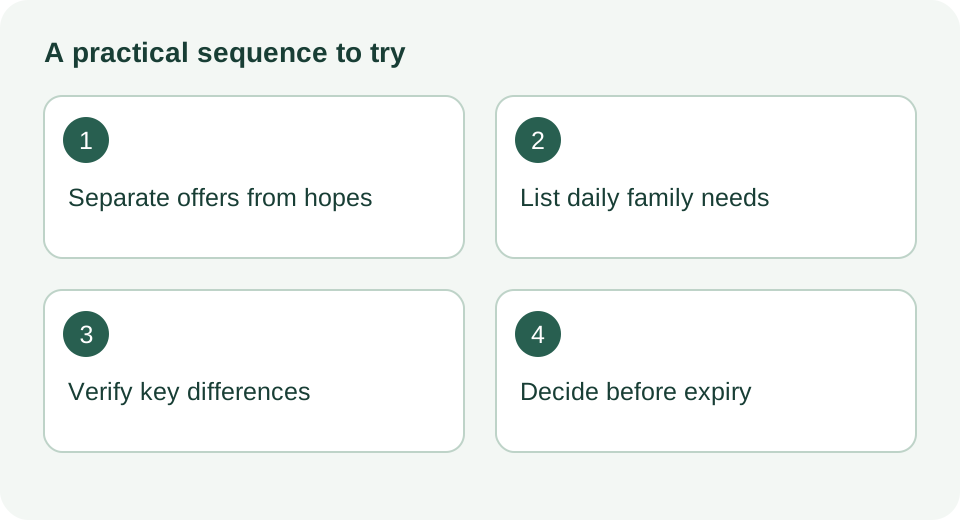
Start with what is actually on the table
Two written offers create a practical choice: which school’s daily arrangements fit your child and household? Reputation may help you decide what to investigate, but it does not tell you who will collect your child, how homework support works or what the total cost will be.
So set the question as: which of these two schools produces a better ordinary week for this particular child in this particular household? Everything in this guide is built to answer that in a few evenings, using a written ledger, a couple of targeted questions to each school, and one honest conversation with your child — who can share preferences but should not carry the responsibility for the choice.
One grounding note on evidence. The Committee on Home-School Co-operation (CHSC) publishes explanatory notes for its Primary School Profiles, explaining that schools self-report categories such as language of instruction, student support measures and school life. Those profiles are useful precisely because both schools fill in the same fields, so you can compare like with like — but they are school-provided descriptions, and neither a school's label nor any published progression figure guarantees an individual child a secondary place. Use them to shape questions, not as a final verdict.
Further reading: CHSC: Primary School Profiles 2026 explanatory notes
A written offer and a hoped-for place are different currencies
Before comparing anything, sort your options into two piles. Pile one: offers you hold in writing, with a name, a class place and an expiry date. Pile two: places you might still get — a waitlist call, a later round, or the colloquially named knock-door round (叩門). The timing and rules for any such later round vary from year to year and school to school, so verify the current year's official arrangements before counting on it as an option. Pile two items are hopes, not options, and hopes get exactly one line in your ledger each.
This matters because a common trap is comparing your confirmed offer against an imagined version of a school you have not secured. If the imagined school would need your child to pass an interview you have not yet attended, you are comparing a fact to a lottery ticket. Decide as though only pile one exists; if a hoped-for place materialises before your deadline, reopen the comparison then.
The mechanics of holding and releasing places — what a registration certificate does, whether deposits are refundable, how withdrawal works — are covered separately in our guide to P1 offer registration rules. Read that alongside this one before you sign or pay anything, because the order in which you confirm and withdraw matters.
Build an evidence ledger before you argue about it
The rule is simple: nothing goes into the decision that is not in the ledger, and nothing goes into the ledger that has no source and date. Rumours from group chats stay out unless a school confirms them. You will be surprised how often two confident parents discover they were arguing about two different unverified claims.
| Question | Status | Source | Date checked |
|---|---|---|---|
| What time does class end on a normal day? | Unknown | — | — |
| Is there a paid homework or tutorial class? What does it cost? | Unknown | — | — |
| Who runs afternoon collection, and until what time? | Unknown | — | — |
| What support exists if my child falls behind in Chinese? | Unknown | — | — |
| What happens at 3:45 pm if I am twenty minutes late? | Unknown | — | — |
Run the ordinary Tuesday test
Open days show you performances; what you need is a weekday. For each school, sketch your family's Tuesday from waking to bedtime, using only ledger-confirmed facts. Where the ledger says unknown, that becomes a question for the school (covered in the next section). Here is a fully worked sketch for two invented schools — Willow Primary and Harbour Primary. Every detail is illustrative only; these are not real institutions and none of it describes any school's actual rules.
Willow Primary on a Tuesday (illustrative)
Classes end at 3:00 pm. The school runs an optional homework club until 4:30 pm at a fee — say, in our example, HK$600 per month — run by the class teacher, so most homework is finished on site. Grandmother, who collects your child, walks twelve minutes from her flat. On paper, Willow gives you a day that ends with homework done and a short walk home, at the cost of the fee and a 3:00 pm pickup if you skip the club.
Harbour Primary on a Tuesday (illustrative)
Classes end at 3:30 pm. There is no school-run homework club, but a private tutorial centre two streets away collects children and holds them until 6:00 pm for a hypothetical HK$1,400 per month. Homework gets done, but under a third party's supervision, with a handover at a shopfront and a longer day for your child. Pickup by family members is harder because of timing, so the tutorial centre is effectively compulsory in this scenario.
Notice what this test surfaces that open-day brochures never mention: not which school is better, but whose afternoon is workable. Over six years of daily life, a routine your family can actually run, every week, without strain, usually matters more than any name.
Homework support and language: ask for specifics, not vibes
Broad descriptions of homework and language support need specific follow-up. Ask about ordinary P1 routines, the subjects taught in each language, how staff identify a child needing help, and what support is actually available. Record both the answer and its source rather than inferring provision from a slogan.
Your ledger gives you the gaps; the school office or class teacher can close them. When you ask, request specifics you could verify later — a document, a timetable slot, a named person responsible. Schools differ in what they can share and how; some will send documents by email, others will answer only by phone, and a few will invite you to ask again after registration. Treat an honest 'we cannot confirm that in writing' as information too, and record it as such in the ledger.
Questions that get answers instead of slogans
- "How much written homework is typical for a P1 student on a weeknight, and is there any on-site help to finish it?"
- "If a child has not settled into reading Chinese by mid-P1, who notices first, and what happens next?"
- "Which language does the class teacher use for non-Chinese-speaking or recently arrived families to communicate with parents?"
- "Is there a settling-in arrangement for the first month, and can you describe it in one sentence?"
Costs, commute and the secondary school question
Money and travel deserve short treatment here because they have their own guides. For the full arithmetic — uniforms, bus routes, snacks, the tutorial fees that appear after week two — see our first-year budget guide. For whether a commute is genuinely survivable in the rain at 7:30 am, our commute check walks you through a real trial run rather than a map estimate.
On secondary links, the honest summary fits in one line: many primary schools have relationships with particular secondary schools, and it is reasonable to ask each school what its stated links are — but no primary school affiliation guarantees your individual child a secondary place. Ask what the connection actually involves, note the answer in the ledger with its date, and then weight this factor for what it is: one useful signal among several, never the whole decision.
Dealbreakers first, scores second
Before any scoring, check for a dealbreaker: if either school fails a non-negotiable requirement for your family — say, no workable collection arrangement at all — remove it from the running, because no weighted total can rescue it. If both schools survive that check, the sample scorecard below is illustrative only, and the weights are this example's choices, not a scientific formula. In this invented example Willow wins, largely because a workable routine outweighs Harbour's longer, compulsory third-party afternoon. The point is not the number; it is that the number can only be as honest as the ledger beneath it. Fill a scorecard with rumours and you have simply dressed a guess in arithmetic.
| Factor | Weight | Willow (illustrative) | Harbour (illustrative) |
|---|---|---|---|
| Daily routine and collection | 30% | 4 → 1.20 | 2 → 0.60 |
| Homework and learning support | 25% | 3 → 0.75 | 5 → 1.25 |
| Language of instruction fit | 20% | 4 → 0.80 | 3 → 0.60 |
| Total cost to our family | 15% | 5 → 0.75 | 3 → 0.45 |
| Stated secondary links | 10% | 3 → 0.30 | 4 → 0.40 |
| Weighted total | — | 3.80 | 3.30 |
One question per unknown, in writing where possible
Combine the important unknowns into a short enquiry and mention your actual decision deadline. A delayed admissions reply does not establish how the school handles emergencies. If there is no answer in time, record the uncertainty and decide using the information available.
- "Subject: P1 enquiry — [child's name], offer received on [date]. Dear [title and name], We have received an offer of a P1 place for [child's name] and are finalising our family's arrangements before the registration deadline of [date as printed on the offer letter]. Could you kindly confirm: (1) the usual end-of-day time for P1 and whether any on-site homework supervision is available; (2) the arrangement for afternoon dismissal and who may collect a student. We are grateful for any written confirmation you can provide, and will complete registration by the stated deadline once our decision is made. With thanks, [name, phone number]."
When the two of you disagree, and when to tell your child
If the ledger is done and the two parents still differ, run this exercise before the next argument: each of you, separately, writes down (a) your single biggest worry about your preferred school, and (b) one compromise you would accept to settle it. A parent who fears the far school's commute might accept it if the school confirms a bus route to a trusted stop; a parent loyal to the near school might accept its higher fees if capped at a stated amount. Worries written down in advance tend to be addressable; worries raised mid-argument tend to be absolutes.
Work to the dates on the offer letters. If you need more time, ask whether an extension is possible, but treat the original deadline as binding unless a change is explicitly confirmed. Allow time for the required payment and document steps.
Finally, talk with your child — as a conversation, not a handover. Ask what they noticed at each open day, whether anything worried them, who they imagined sitting next to. Their answers sometimes surface a real factor (a fear about the long walk, a friend at one school) and sometimes surface pure nerves, which you can soothe without letting them decide. The message to give them is explicit: we, the adults, will choose; our job is to make the choice work, and your job is to tell us how it feels once you are there.
Confirm first, then withdraw politely
Before accepting the chosen place, read both sets of conditions and check the consequences for any existing place and POA eligibility. Accepting a DSS P1 place affects POA allocation, so completing two registrations first is not a universal holding strategy. Confirm the required sequence with the relevant school or EDB, then complete acceptance and withdrawal through the specified channels. See DSS and Private P1 Offers: What Signing Means for Your POA Place.
A short, gracious withdrawal is both courteous and practical; it keeps the relationship warm should circumstances change:
A withdrawal note you can adapt
- "Subject: Withdrawal of P1 place — [child's name]. Dear [title and name], Thank you for offering [child's name] a P1 place at [school name]. After careful consideration of our family's circumstances, we have decided not to take up the place, and we withdraw the application. We are grateful for the time your staff spent with us, and we wish the school every success. Yours sincerely, [name, contact number]."
Keep the decision record
Keep the final comparison, source dates and confirmation records. They explain what you knew when deciding and which uncertainties you accepted. Start with one useful row today: each school’s dismissal time, collection arrangements and anything still unconfirmed.
Frequently asked questions
Should we wait for a hoped-for place at a better-known school before registering at the one we hold?
Check the deadline and consequences of accepting the place you hold. A hoped-for offer is not a confirmed alternative, but accepting a current offer may affect other routes. Decide on the actual terms and available information; do not assume registration keeps every future option open.
The Primary School Profiles show one school has more support programmes. Does that settle it?
Those profiles are school-provided descriptions designed to be compared field by field, so treat a difference as a prompt to ask each school what the listed programmes involve in practice. They structure good questions; they do not rank schools, and no listed programme guarantees an outcome for an individual child.
What if the two schools are genuinely equal on every confirmed fact?
Check whether unknown details were accidentally scored as equal and whether small changes in your subjective weights reverse the result. If both remain acceptable, the daily routine and your child’s experience can help decide. A close score is a discussion aid, not a measured prediction.
Can we change our minds after registering and paying?
Check withdrawal procedures, refund and notice terms, and any effect on the existing place or POA status before acting. Receiving a new offer, accepting it and completing registration are distinct steps. Confirm the applicable sequence rather than assuming both places can be held throughout.
Discussion background and sources
This topic was informed by search-index excerpts of the public discussion below; the complete thread could not be retrieved directly. Historical comments identify a parent question, not current admission rules or admission chances. Consult the official sources and the notice addressed to your family.
- Education Kingdom: 聖津 vs 坑真 (2026 discussion) — discussion background
- CHSC: Primary School Profiles 2026 explanatory notes — official source
- EDB: POA 2027 application notes — official source
Sources checked:
Put the preparation into practice
Find schools and official websites · Parent-child practice games · Editorial policy