
HK Primary Interview editorial content · Updated:
The examples and exercises below are illustrative material, not real student case studies or school test questions. Use them for family preparation; check each school’s current requirements before submitting documents.
What the official notes actually say
The Education Bureau's notes for the 2027 Primary One Admission (POA, 小一入學統籌辦法) application set out the position in Part D(2) to (4). Direct Subsidy Scheme (DSS, 直資) schools and private schools admit pupils directly, outside POA. Once you accept a DSS Primary One place, no place will be allocated through POA, and any POA place that has already been allocated will be withdrawn. For private schools, if you have opted to remain in POA and are admitted, the EDB sends your child's name to that private school before central allocation results are released.
Use this rule to identify the question, then read your own offer conditions. A private school’s deadline for a firm commitment concerns that school’s place; do not interpret a non-refundable fee alone as withdrawal from POA. When either side is unclear, ask the school about its offer and the EDB about your allocation status.
Further reading: EDB: POA 2027 application notes
Five words that decide your position
Much of the confusion around this question comes from parents using one word, "have an offer", to describe five very different situations. Separate them in your own notes and you will find most decisions become clearer.
For your records, separate received, accepted, paid, registered and withdrawn. These are useful labels, not a universal sequence of five school procedures. Put the evidence beside each one: the offer, your acceptance reply, a receipt, registration confirmation or acknowledgement of withdrawal. Check which action the school regards as acceptance; do not assume that a signature, payment and registration always happen together.
An older forum reply saying a family “registered” leaves several questions unanswered. Did they return an acceptance form, pay a fee or finish registration? What did their letter require? Use your own documents to identify those actions rather than applying someone else’s shorthand to your case.
The three routes at a glance
The POA route also requires action: an allocation is not a substitute for completing registration. For a direct school offer, identify what must be accepted, paid or submitted and by when. Keep the allocation question and the private school’s contractual conditions in separate columns.
| Route | How the place arrives | Effect on POA |
|---|---|---|
| Government or aided school | POA: discretionary admission and central allocation | Follow the relevant application, result and registration instructions |
| DSS school offer | Direct application to the school, outside POA | Accepting ends POA allocation; an already allocated POA place is withdrawn |
| Private school offer | Direct application to the school, outside POA | Check POA status separately from the private school’s place-holding conditions |
Further reading: EDB: POA 2027 application notes
Reading the offer letter before you sign
Read the offer with a highlighter and a separate page for questions. Mark the action, its deadline and its stated consequence. If the letter has attachments, check those too: a short acceptance slip may refer to a longer fees or registration notice.
Phrases worth underlining
Illustrative phrases such as “refunded if the place is not taken up” and “offset against first-term fees” describe different arrangements. The first concerns a possible repayment; the second concerns credit towards a later bill. Neither phrase, by itself, answers the POA question. Underline each clause and record which question it actually answers.
Also underline anything you do not understand, rather than assuming. If the letter is silent on POA altogether, silence is not permission. It simply means you must ask.
Phrases that suggest a binding commitment
Words such as “non-refundable” tell you about repayment. “Payment constitutes acceptance” identifies an acceptance step. “Places will not be held pending other allocations” needs clarification about the school’s own place. Do not collapse all three into “POA ends”. Ask what the condition means, what action is required and whether any separate declaration is involved before deciding.
Questions to ask, and how to ask them
Before accepting any DSS or private offer, ask the school office three questions and keep their replies. First: if my child accepts this place, can we still participate in POA central allocation? Second: is the registration fee or deposit refundable if we later withdraw, and by what date? Third: what exactly counts as acceptance on your side, a signed form, a reply slip, or payment?
A short email creates a record you can refer back to. Something like this stays neutral and commits you to nothing: "Dear [school office], thank you for the P1 offer dated [date] for my child, [child's name], application number [number]. Before confirming, could you please confirm in writing whether accepting this offer affects participation in the EDB Primary One Admission system, and whether the registration fee of [$amount] is refundable if we withdraw before [date]? Thank you."
If the question concerns the POA side rather than the school side, put it to the EDB in writing, quoting your child's POA application number, and ask them to confirm the position for your case. A written reply from the EDB about your own circumstances is worth far more than second-hand advice, and it protects you if arrangements are later disputed.
Two letters, two very different positions
Both examples below are entirely hypothetical and illustrate how wording, not school reputation, determines your options. The amounts are invented for illustration only and are not any real school's rules.
Family A: a letter that leaves POA open
Family A receives a private school offer reading: "To accept, please return the reply slip with a registration fee of $2,000 by 30 June. Acceptance does not affect your child's participation in the Primary One Admission system; should your child be allocated an aided school place under POA, the registration fee will be refunded in full upon written notice by the stated date." They underline two things: the sentence naming POA, and the refund sentence. They email the school to confirm the refund deadline, receive a written reply saying refunds are processed if notice is given within two weeks of central allocation results, and then pay. Because the letter explicitly preserves POA participation, they can hold this place while waiting, and if central allocation later offers them a place they prefer, they withdraw from the private school within the window and recover the fee.
Note what made this work: the school stated the arrangement itself. Family A did not assume it from the school being private.
Family B: a letter that asks for everything now
Family B receives an offer reading: "Acceptance is confirmed upon payment of a non-refundable registration fee of $2,000. Fees for the first term are due by [date]. Places will not be held pending other allocations." There is no mention of POA anywhere. Family B asks the office whether the child can remain in POA after accepting, and receives a written reply saying the school requires committed pupils and does not coordinate with POA results.
That reply has not clearly answered the POA question. Family B should ask the school whether it requires a withdrawal declaration and what happens to its private-school offer if the family remains in POA. Any uncertainty about EDB allocation status should be put to the EDB. The family may choose to decline if it cannot accept the school’s conditions, but it should not record POA as closed merely because the fee is non-refundable.
If you accept a DSS place
When deciding on a DSS offer, put the published POA consequence beside the practical reasons for choosing the school. Identify which existing option you would give up and which conditions you would accept. Resolve those points before submitting an acceptance rather than assuming you can reverse the decision later.
One further caution. If you later withdraw from a DSS place, do not assume that POA eligibility simply switches back on. Whether any route back into the allocation system exists depends on your circumstances and timing, and this is precisely the kind of question to put to the EDB in writing for your individual case before you make any withdrawal decision. Ask specifically: "If my child withdraws from the DSS place on [date], what is the position regarding POA for [entry year]? Please confirm in writing." Act on the written reply, not on general reassurance.
Further reading: EDB: POA 2027 application notes
Deposits, fees and what you might actually lose
Separate a deposit from tuition, but check whether the deposit is credited towards tuition rather than an additional charge. Also record payment dates, withdrawal notice requirements and any further sum due if the child does not start. Do not assume that fees begin only after the first day of school, or that leaving before term automatically limits the loss to a deposit.
For illustration only, suppose a school requests HK$1,000 on acceptance and confirms that it is credited towards the first HK$6,000 tuition instalment. If the child starts, the remaining amount for that instalment is HK$5,000, not another HK$6,000. If the family withdraws, the question is different: is the HK$1,000 refundable, and do the written terms create any further payment obligation? Record the school’s answer rather than calculating a loss from the payment label alone.
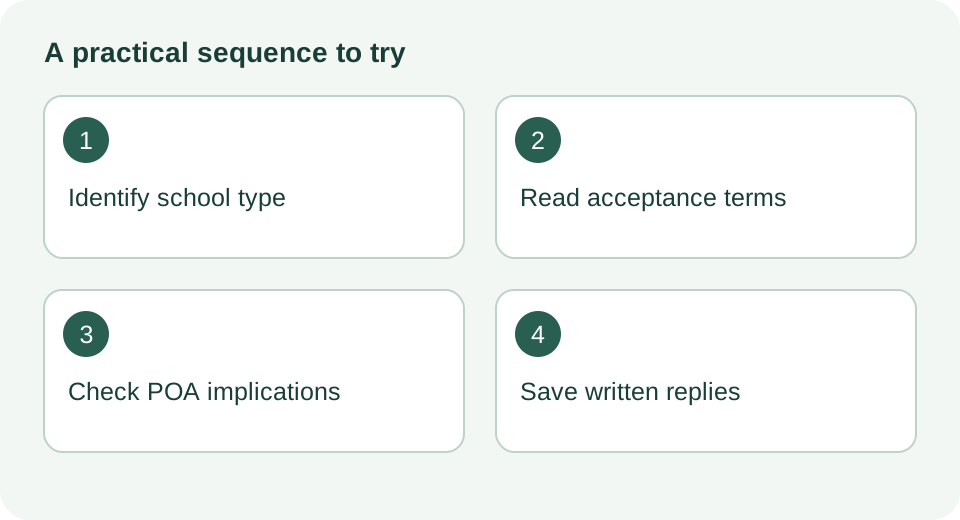
A short worksheet for this week
Before the earliest offer deadline, fill in these four items together. If a question remains unanswered, give it an owner and a follow-up date so it does not disappear between two parents’ inboxes.
- Identify the school type: is the offer from a government or aided school through POA, a DSS school, or a private school? Write the answer at the top of your notes.
- Read the acceptance terms: highlight every sentence about acceptance, payment, refund deadlines and POA. Mark anything silent or unclear as a question, not an assumption.
- Check the POA implications: for a DSS offer, plan on POA ending if you accept. For a private offer, confirm the school's conditions in writing, and if your case is unusual, ask the EDB in writing with your application number.
- Save the written replies: file the offer letter, your questions, and the school's or EDB's replies in one folder, digital or paper, with dates. If anything is disputed later, this folder is your evidence.
Frequently asked questions
My child already has an allocated POA place, but we prefer a private school offer. What happens to the allocated place?
It depends on the private school's conditions, which is why the offer letter and a written reply from the school matter so much. For a DSS acceptance the official rule is clear that an allocated POA place is withdrawn, so never confirm a DSS place while still wanting the allocated one. For private schools, ask both the school and, for your specific case, the EDB in writing before acting.
Does paying the registration fee count as accepting the offer?
Only the school's letter, or a written reply from the school office, can tell you. Payment may be treated as confirmation even without a signed form, which is why the worksheet asks what counts as acceptance on the school's side. If the letter is unclear, get the school's written answer before transferring any money.
If we withdraw from a DSS place later, can we rejoin POA allocation?
Do not assume so. The published notes state the consequence of accepting a DSS place, but they do not promise a route back into allocation after withdrawal, and whether one exists depends on timing and individual circumstances. Ask the EDB in writing, quoting your child's details and the entry year, and rely on their written reply for your case.
The offer letter never mentions POA at all. Can I keep both options?
Ask the private school what it requires to keep its own place, including any declaration, and ask the EDB if allocation status is uncertain. An unclear reply does not itself prove that POA participation ends. Resolve the uncertainty before accepting terms you do not understand.
Discussion background and sources
This topic was informed by search-index excerpts of the public discussion below; the complete thread could not be retrieved directly. Historical comments identify a parent question, not current admission rules or admission chances. Consult the official sources and the notice addressed to your family.
- Baby Kingdom: 小一私小註冊後轉津小一問 (2019 discussion) — discussion background
- EDB: POA 2027 application notes — official source
Sources checked:
Put the preparation into practice
Find schools and official websites · Parent-child practice games · Editorial policy