
HK Primary Interview editorial content · Updated:
The examples and exercises below are illustrative material, not real student case studies or school test questions. Use them for family preparation; check each school’s current requirements before submitting documents.
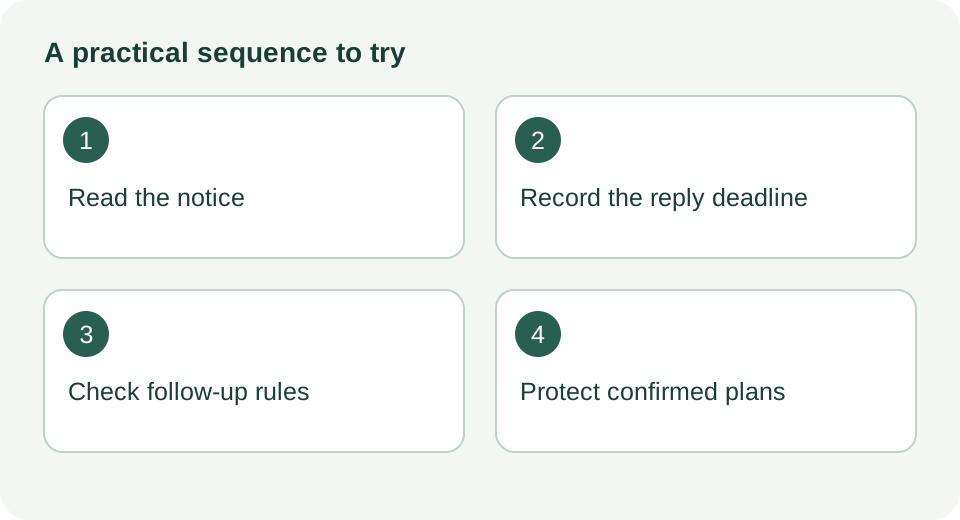
What the email actually tells you — and what it does not
When a P1 waiting-list email arrives, many parents scan it once, feel a mixture of relief and anxiety, and then start messaging other parents. Put the phone down for ten minutes first. The email itself usually contains three distinct pieces of information, and they are not equally important: your child's status (waiting, not admitted), a date or deadline, and instructions about how the school wants you to respond.
The status tells you where things stand today. The date tells you something you must act on — but only if you read exactly what the date attaches to. The instructions tell you how to keep your child's name alive on the list. Read the email twice, slowly, before you do anything else.
One useful habit: print the email or copy its full text into a note, including any small print below the signature. Deadlines and conditions are often stated in the footer or an attached PDF rather than the main body, and it is much easier to re-read a saved copy than to search your inbox in six weeks' time.
Two dates that look similar but mean different things
Waiting-list notices commonly contain one of two kinds of date. The first is a reply-by date: the school asks you to confirm, by a stated day, that you still want to be considered. The second is a result date: the day the school will announce outcomes or issue offers if places arise.
These are easy to conflate. A reply-by date is a task for you — miss it and, under the terms many notices state, your child may be removed from consideration, so check what your own email says on this point. A result date is an event for the school — it tells you when news may arrive, not whether news will arrive. Never treat a result date as a forecast of your chance.
An announcement date is not a vacancy forecast
PLK Camões Tan Siu Lin Primary School (保良局陳守仁小學, TSL) lists 19 January 2027 for its 2027/28 admission results and waiting-list announcement. That scheduled announcement does not predict when a later vacancy will arise. Our source check did not establish a conversion rate, an individual queue position or a policy on supplementary letters.
For every other school on your list, find the equivalent date on that school's own admissions page rather than relying on what happened last year. Schools adjust their calendars, and a date copied from an older discussion thread can be a full year out.
Further reading: PLK Camões Tan Siu Lin Primary School: 2027/28 admissions
A worked example: reading an ambiguous deadline
The following notice is an invented, illustrative example — it is not any real school's wording. Suppose it lands in your inbox on a Friday afternoon:
"Thank you for your application. Your child is currently on the waiting list for Primary One. Should a place become available, we will contact you by email. Please confirm your continued interest by 30 November. Applications not confirmed may not be carried forward."
The instruction in this invented example is to confirm interest by 30 November. What remains unclear is how long the list continues afterwards, and whether another reply will be needed. Separate the action you can complete now from the question that needs clarification.
Read the full notice for conditions, then use the specified reply channel before its deadline. In this hypothetical example the channel is email. Keep the sent message and any acknowledgement. If the later process is unclear, add one question: “Does the waiting list continue after this date, and will another confirmation be required?” Do not assume an expression of interest has no conditions just because it is short.
A model reply, with bracketed placeholders: "Dear Admissions Office, Thank you for your email dated [date]. We confirm our continued interest in a Primary One place for our child, [child's name], application number [number if given], and will keep our contact details unchanged. Could you kindly confirm whether the waiting list continues after [deadline date] and whether further confirmation will be needed? Yours sincerely, [parent's name], [phone number]."
Expression of interest versus acceptance: never confuse the two
Waiting-list replies usually ask you to confirm interest — a statement that you wish to remain under consideration. They do not ask you to accept a place, because there is no place yet. This distinction matters most when you hold an offer somewhere else at the same time.
Record the confirmed offer and the waiting-list notice separately, each with its own required action and deadline. Deal first with whichever deadline comes first; there is no universal rule to answer the waiting-list school before the school offering a place. Before accepting any place, check its effect on other applications and confirm that you are willing to meet its terms. A waiting-list reply should not be used as a reason to overlook a registration deadline.
If you eventually receive an offer from the waiting list while holding a confirmed place elsewhere, pause and compare before deciding — our related guide on comparing primary school offers walks through that decision. Do not let the excitement of the call push you into instant, irreversible steps.
Why other parents' phone calls tell you nothing about your chance
In every waiting-list season, stories circulate: a cousin's classmate got a call in March, someone's neighbour was number two on the list, a colleague rang the office and was told "quite a few people have declined". These accounts feel like data. They are not.
Waiting lists move in ways outsiders cannot see: families relocate mid-year, withdrawals arrive in clusters, and a single vacancy can trigger one call or several. These are illustrative possibilities, not verified patterns at any school. A call another parent made in a previous year reflects a different intake, a different number of vacancies and a different queue. Even a friendly-sounding remark from an office staff member this year — "we're working through the list now" — tells you the process is running, not where you stand in it.
Treat other parents’ accounts as questions to investigate, not a forecast for your child. If something in your own notice is unclear, ask through the school’s stated channel and record the answer. A reply about one family cannot tell you how the school will handle another application.
Following up: one channel, one enquiry, well timed
Before you follow up, check the email and the school's admissions page for the preferred contact method. Some schools answer waiting-list questions only by email; some have an online portal where status updates appear; some ask you not to call at all during the result period. Use the channel the school names. If none is stated, a written email to the admissions address in your original correspondence is the safest default — it is dated, searchable and does not interrupt a busy front desk.
Combine unanswered administrative questions into one concise enquiry. Timing should follow the notice: ask before a reply deadline if you do not understand what is required. If the school specifies a query period or a date for updates, use that information. You do not need to wait until a deadline has passed to clarify it.
Illustrative wording: “Dear Admissions Office, Our child, [name], application [number], received your waiting-list notice on [date]. Could you confirm whether [specific action] is required by [deadline]? Thank you. [Parent’s name], [phone].” Save the reply. Follow up when there is a concrete reason, such as an approaching deadline, corrected contact details or a response the school asked you to provide.
What not to send
Do not send certificates, photographs or recommendation letters simply because another family did. Check whether the school accepts supplementary material, when it accepts it and through which channel. If its instructions prohibit extra files, follow that instruction. If they are silent, ask before sending; silence does not establish either acceptance or a ranking benefit.
A contact update serves a different purpose from an appeal. If your phone number, email or other requested application details change, use the school’s prescribed update process. State the application reference and exactly what changed. Do not assume moving address improves a waiting-list position.
Protect the place you already hold
Record every deadline attached to an offer: acceptance, payment and registration may be separate tasks. Read the conditions before deciding which place to accept, including any effect on other applications. Choose an earlier personal reminder that leaves time to resolve a missing document; this is a planning margin, not an extension of the school’s deadline.
Keep offer letters, receipts and registration records in one folder. A receipt, an acceptance reply and a completed registration record prove different things, so label them separately. If another offer arrives, compare its written conditions with the arrangements already made before giving up a place.
Your follow-up log: a blank worksheet to copy
A simple log turns a stressful, scattered season into a manageable one. Copy this table into a notebook or spreadsheet — the first row is an illustrative example, the rest are blank for your own entries.
Fill it in after every contact with any school: each email sent, each reply received, each deadline. Its real value appears in week six, when you cannot remember whether you replied to School C or what School B said on the phone.
| Date | School and what happened | How contact was made | Next action and due date |
|---|---|---|---|
| e.g. 20 Jan | School X — sent interest confirmation | Email to admissions | Watch for status reply; log it when it comes |
If an unexpected offer call comes: five questions before you hang up
Waiting-list offers sometimes arrive by phone with very little warning, and a flustered parent can agree to, or miss, something important. Keep this list by the phone during the season. You are not demanding acceptance on the call — you are gathering the facts you need to decide.
Ask these five, in this order, and write the answers down as you hear them:
First, is this a firm offer of a Primary One place, and what is the exact acceptance deadline — date and time of day? Second, what documents and fees are needed to secure the place, and where and how must they be submitted? Third, if we need a few hours to confirm with my spouse, is that possible, and if not, what happens if we cannot respond before the deadline? Fourth, if we accept and later withdraw, what is the procedure and what, if anything, do we forfeit? Fifth, may I have your name and a number to call back once we have decided?
Read back the deadline, required documents and next step using the details just given. Ask for written confirmation and check that the contact method matches the school’s official details. These notes help your family decide with the same information; they are not a way to influence selection.
A realistic stopping point
Waiting has no finish line you control, so set one yourself. You can close this task for now once four things are true: you have replied to every waiting-list email that asked for a reply, before its deadline; you have logged every deadline and contact in your follow-up record; you have diarised the result dates for each school on your list, including 19 January 2027 for TSL's 2027/28 cycle if that school concerns you; and your confirmed place, if you hold one, is fully registered with receipts filed.
Choose a checking routine that matches the school’s contact method and response deadlines. For example, a daily email check may be manageable while keeping the telephone available; a school requiring a rapid response may need closer attention. Do not rely on a weekly inbox check during active offers. You can stop refreshing constantly without becoming unreachable.
Further reading: PLK Camões Tan Siu Lin Primary School: 2027/28 admissions
Frequently asked questions
If I never hear anything after the announcement date, is the waiting list finished?
An announcement date alone does not establish when the list closes. Read your notice for a closing point or ask the school if that detail affects your plans. Until you receive a definite offer, make decisions using your confirmed arrangements and their actual deadlines.
My child holds a confirmed place. Does joining or staying on another school's waiting list affect it?
Read both schools’ conditions. Confirming continued interest is different from accepting a place, but do not assume either action is unconditional. Before taking up a later offer, establish the effect on existing arrangements and the withdrawal procedure.
Should we submit another letter, updated certificates or photos to improve our position?
Check whether the school accepts additional material and follow its instructions. There is no verified basis here for saying extra letters improve your position. Keep necessary contact-detail updates separate from requests to reconsider the application.
Discussion background and sources
This topic was informed by search-index excerpts of the public discussion below; the complete thread could not be retrieved directly. Historical comments identify a parent question, not current admission rules or admission chances. Consult the official sources and the notice addressed to your family.
- Education Kingdom: 剛收到陳守仁waiting,但email有限期 (2025 discussion) — discussion background
- PLK Camões Tan Siu Lin Primary School: 2027/28 admissions — official source
Sources checked:
Put the preparation into practice
Find schools and official websites · Parent-child practice games · Editorial policy