
HK Primary Interview editorial content · Updated:
The examples and exercises below are illustrative material, not real student case studies or school test questions. Use them for family preparation; check each school’s current requirements before submitting documents.
Build a baseline for your own household
When parents compare offers in the summer, distance questions come up constantly: is forty minutes on the school bus reasonable, does the child need to wake before six thirty, how many stops are too many. The honest starting point is that this guide does not establish any universal maximum commute, and you should be sceptical of anyone who quotes one. What the official source here does tell you is narrower: the Committee on Home-School Co-operation's Primary School Profiles 2026 explanatory notes state that the information supplied by schools generally reflects the position in April 2026. Treat the profiles as a snapshot for comparing schools, not as a live bus route or timetable, and confirm transport details directly with the school or its operator.
Compare the proposed route with your family’s current morning. Record the departure time, handovers and return journey, then look at what changes. Another family’s acceptable journey length cannot settle whether your own arrangements work.
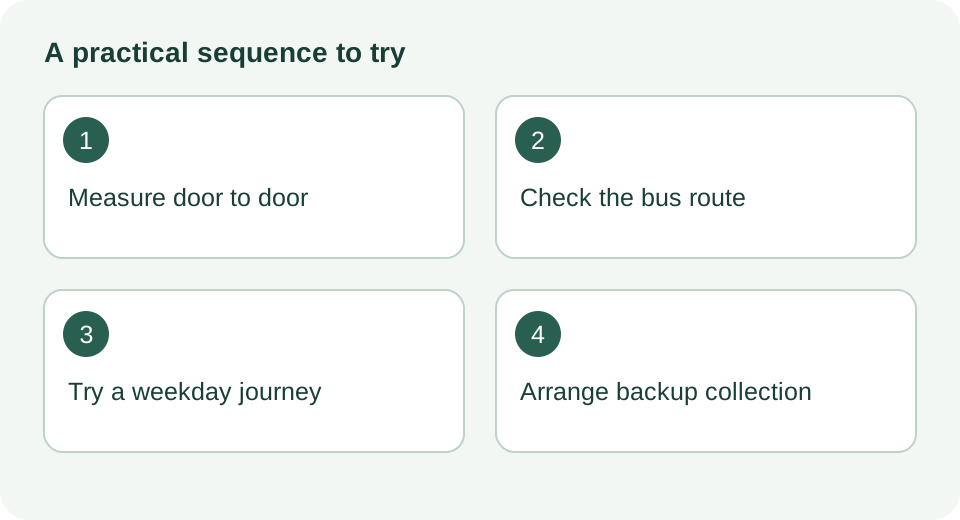
The rest of this guide gives you four steps: measure the door-to-door time on paper, check the bus route with the operator, try the journey on a real weekday, and arrange a backup for the day the plan fails. Everything in the worked examples below is illustrative and uses invented times and places; none of it describes a real school's rules.
Further reading: CHSC: Primary School Profiles 2026 explanatory notes
Step one: measure door to seat, not door to gate
The number that matters is not the distance on a map or the bus company's advertised journey time. It is the stretch from your front door to the moment your child is sitting in the classroom, and back again in the afternoon. That includes the walk from your flat to the pickup point, waiting even when the bus runs late, every intermediate stop where other children board, the walk from the school gate to the classroom, and the handover to a member of staff.
Here is a fully worked fictional example for an imaginary route from a residential estate to a school across the harbour. Suppose the school day starts at 8:10 and the bus is scheduled at 7:25. The arithmetic goes like this:
Door to classroom is 44 minutes, leaving 16 minutes before the assumed 8:10 start. For the return, suppose school ends at 15:00, boarding is at 15:15, the ride takes eight minutes plus two six-minute stops, and the final walk takes eight minutes. Home arrival is 15:43: a 43-minute afternoon, or 87 minutes of travel and waiting across the child’s day. These are invented timings to demonstrate the calculation.
| Step | Leave | Time taken | Arrive |
|---|---|---|---|
| Leave the flat | — | — | 7:10 |
| Walk to the pickup point downstairs | 7:10 | 7 minutes | 7:17 |
| Wait at the stop (scheduled 7:25) | 7:17 | 8 minutes | Boards 7:25 |
| Three intermediate stops, about 5 minutes each | 7:25 | 15 minutes | Departs last stop 7:40 |
| Ride to the school gate | 7:40 | 8 minutes | 7:48 |
| Walk to classroom, hand over to staff | 7:48 | 6 minutes | Seated 7:54 |
Step two: put the route questions to the operator in writing
The profiles snapshot will not tell you where the bus stops, and you should not assume the school's prospectus will either. The operator can. Before you weigh a far school at all, send a short message and get specifics: the pickup and drop-off points nearest your building, the order of stops on the route, how many children board after yours, whether an adult must be present at drop-off, and what happens if no one is home when the bus arrives. Ask how routes and timings have been adjusted in recent years and how families are informed, and whether any after-school session changes the return trip. You are gathering information, not claiming entitlements; operators set their own arrangements and they can change them.
A message you can adapt:
Dear [operator name], I am considering the school bus service for [school name] from September [year]. Could you kindly let me know: the pickup and drop-off points closest to [estate or street name]; the route order and roughly how many stops fall before and after ours; whether an adult must be present at drop-off, and your procedure if no one is at the point; whether the route or timings have changed in recent years and how families are notified of changes; and whether an after-school or later bus option exists. Thank you, [name], [phone number].
If the reply says pickup points are provisional until enrolment is confirmed, that is a real cost to carry into your decision rather than a detail to resolve later. You can build your trial around the furthest plausible pickup point and treat anything better as a bonus.
Step three: plan the afternoon, not just the morning
The handover chain
Mornings get the attention, but afternoons are where long journeys usually bite. A child who boards at 3:15 and reaches your building around 3:45 needs someone reliable at the pickup point then, every single day. Map the whole chain: who collects the child from the classroom or bus nanny, who meets the bus, and who takes over at home. If the answer is a helper who finishes at 6:00, or a grandparent who rests in the mid-afternoon, the arithmetic changes. Ask the school and operator explicitly whether an after-school service exists, what it costs in time and fees, and whether it shifts the bus route to a later run. An extra hour at school is sometimes the cheapest way to make a long route work; sometimes it is the straw that tires the child out. You will not know until you have the timetable in front of you.
The day the bus is missed
Plan for the day the call comes: the bus is running twenty minutes late, or your child has slept through the alarm and missed it entirely. Decide in advance what your family does. Is there a minibus or MTR alternative you have already walked yourself? Which adult can leave work, and how much notice does that realistically take? Is there a neighbour at the pickup point who could wait with your child? A long journey with a solid fallback is more liveable than a short one with none.
Step four: run the journey on an ordinary weekday
Try the accessible parts of the route on an ordinary school-term weekday. A public-transport trial cannot reproduce a school bus you are not authorised to board, so distinguish observed times from the operator’s estimates. An open day at a different time also cannot reproduce the normal school run.
Check shelter, crossings and alternative transport. Observe wet-weather conditions when practical and safe, following current school and weather instructions. Do not assume a fixed percentage delay; record what you can actually establish and leave untested parts marked as estimates.
For siblings, map both journeys together and check who can handle each handover. Any overlap needs an actual arrangement, not just two individually plausible timetables.
What to write down on the trial day
Write down departure, arrival, waiting and handover times, plus the date and conditions. Note which parts were observed and which remain estimates. Revisit a route if the pickup point or timetable changes materially.
The adult's day: your commute is part of the sum
Every worksheet for a child's journey has a second column for the escorting adult, and that column is where families most often underestimate. If door-to-seat is forty-four minutes and you escort, your working day starts earlier by whatever share of that journey falls to you, and ends later once the afternoon leg is counted too. Run the numbers against your real job: what time must you leave the office to reach the pickup point, does your employer allow that, and what does it cost in overtime, flexibility or goodwill? Whether shifting to an earlier train, negotiating one later morning a week, or handing the school run to another adult could absorb that time is a question only your household can answer, and it is worth answering before you accept an offer, not after.
Then build the backup before you need it. Arrange, in plain words, a second adult who can meet the bus when the first cannot, and tell the operator who that person is. If you have no second adult nearby, check what the school's own after-school hours could cover and at what cost. A backup that exists only in your head is not a backup.
Sleep and the shape of the whole day
A long route usually means an earlier alarm, and this is where parents ask how early is too early. Rather than quote any figure, look at your child's existing routine and extend it honestly. If your child currently wakes at 7:00 and is settled and even-tempered by evening, ask what waking at 6:30 would do to the same evening. You know your child's pace: the toddler who needs an hour to eat breakfast, the one who melts down when the routine shifts. The point is not to hit a target but to see, on paper, the whole arc of the day from waking to lights out, including the evening homework that an arrival home of around 3:45 squeezes.
Fatigue compounds quietly. Dozing on the morning bus is no substitute for a full night's sleep, and the afternoon ride home after a full school day is where long routes tend to show. Watch for it on your trial afternoon if the school allows you to observe dismissal.
Near school or far school: a worked comparison
Here is a comparison using the same fictional far-school route. Assume both children need to be seated at 7:54, and each needs 25 minutes between waking and leaving home. The near route takes 14 minutes to the classroom and 15 minutes home; the far route takes 44 and 43 minutes respectively.
The far route adds 58 minutes per day for the child, or 4 hours 50 minutes across five identical days. Adult time is a different calculation: a parent who walks to a bus stop does not necessarily ride the full route. Count each adult’s outward and return legs, waiting and work journey separately.
| Item | Near school (illustrative) | Far school (illustrative) | Difference |
|---|---|---|---|
| Child, morning | 14 minutes | 44 minutes | 30 minutes more |
| Child, afternoon | 15 minutes | 43 minutes | 28 minutes more |
| Wake-up time (before extra buffer) | 7:15 | 6:45 | 30 minutes earlier |
| Adult travel | Measure separately | Measure separately | Depends on escort and handover duties |
When the longer journey is still the right choice
A long route becomes genuinely sustainable when three things are true at once: the child's whole day still fits the sleep and downtime their existing routine shows they need; the escorting adult's work can absorb the shifted schedule without constant strain; and the backup plan for missed buses and wet days has been arranged, not merely imagined. If all three hold for your family, the far school may still be worth it because it fits your child in ways that matter more than an hour. If they do not, the same sums may point you to the nearer school. Either answer can be right; what separates a good decision from a hopeful one is that the numbers were counted first.
Giving your child a voice without giving away the decision
If your child is old enough, take them on the trial walk and ask afterwards what they noticed: was the wait boring, was the bus ride fun or tiring, would they rather walk to a nearby school with a neighbour. Listen seriously, then decide as the adult. A six-year-old can tell you a journey feels too long; a six-year-old cannot weigh it against six years of schooling. The responsibility for the choice, and for the routine that follows it, stays with you.
Frequently asked questions
My child could sleep on the school bus. Does that make a long route fine?
Dozing on the morning ride is a small comfort, but it does not shorten the wait at the stop, the walk in the rain, or the afternoon ride home when a child is genuinely tired after a full school day. Judge the route by the whole day, not the pleasantest segment of it.
The operator said pickup points might change before September. What should I do?
Ask when the final points are confirmed and how families are notified, then build your trial journey around the least convenient plausible pickup point. If the route later turns out better, you have gained margin rather than lost it.
Is there an official limit on how long a primary school journey should be?
No universal maximum is established in the official source used for this guide, and the school profile data is only an April 2026 snapshot rather than a live timetable. Your own measured door-to-door times, not a benchmark, are the standard that matters.
What actually happens if my child misses the school bus?
Follow the operator’s missed-bus procedure, tell the school if arrival will be affected, and use the alternative route and authorised adult you arranged. Afternoon supervision does not solve a missed morning bus; plan those two situations separately.
Discussion background and sources
This topic was informed by search-index excerpts of the public discussion below; the complete thread could not be retrieved directly. Historical comments identify a parent question, not current admission rules or admission chances. Consult the official sources and the notice addressed to your family.
- Baby Kingdom: 返小一,點至算遠? (2016 discussion) — discussion background
- CHSC: Primary School Profiles 2026 explanatory notes — official source
Sources checked:
Put the preparation into practice
Find schools and official websites · Parent-child practice games · Editorial policy