
HK Primary Interview editorial content · Updated:
The examples and exercises below are illustrative material, not real student case studies or school test questions. Use them for family preparation; check each school’s current requirements before submitting documents.
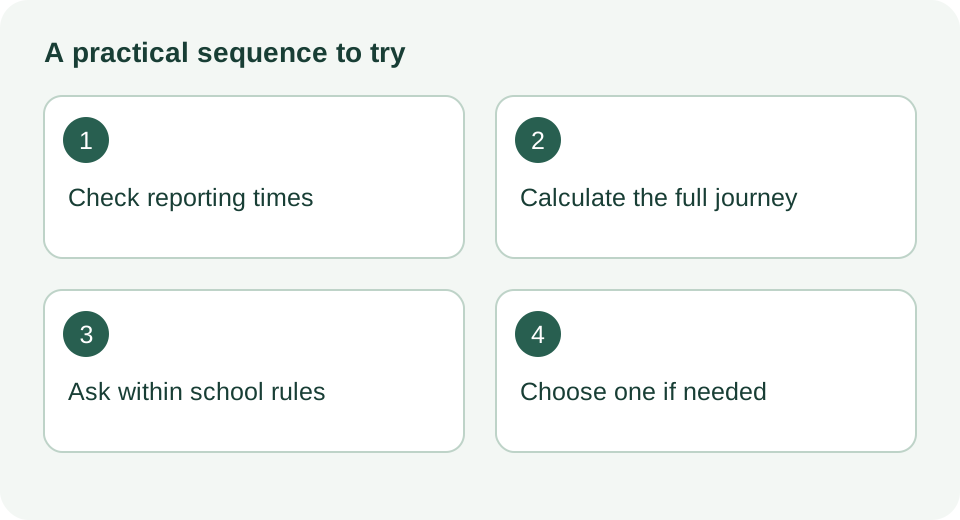
Four steps, in this order
Before you panic, or before you promise your child a morning out, work through four steps. First, check the exact reporting time for each interview, not just the date, because a 9:00 slot and an 11:30 slot on the same day are a different problem from two 10:00 slots. Second, calculate the complete journey for each leg, including waiting, walking and a sensible buffer for a small child. Third, if the times sit uncomfortably close, contact both schools and ask, within their stated procedures, whether any adjustment is possible. Fourth, if no change is available, choose one interview and give the other a respectful pass.
Keep the decisions separate: first establish the times you actually hold, then investigate any permitted change, then choose between the workable options. A requested change is still pending until the school confirms it. Record the revised time and recheck transport rather than relying on an informal possibility.
What to have in front of you before you contact anyone
Gather the notification letters, emails or portal messages from both schools, your application reference numbers, and a rough idea of how your child usually travels. Having the reference numbers to hand turns a tentative phone call into a quick, efficient one, and staff can find your record immediately.
- Both interview letters or notifications, with reporting times and venue addresses
- Application reference numbers for each school
- Your preferred route options between the two venues
- A shared calendar slot with the other parent to agree the decision
Put every published date in the same calendar
Separate application closing dates, interview booking windows and the interviews themselves. An available interview date is not necessarily your assigned slot. Mark it as provisional until you receive the notice addressed to your child, and record both the reporting time and any earlier arrival instruction.
Check the calendar whenever a new notice arrives. If a venue or time changes, update the existing event and tell the other caregiver; do not leave two competing versions in different calendars. This small administrative step can prevent a clash being discovered only when someone is printing the old email.
What schools actually say about fixed dates
Rules differ from school to school, and the only reliable source is each school's own admission notice. Two current 2027/28 examples illustrate the range: Sacred Heart Canossian School Private Section states that its 3 October 2026 interview date and time cannot be changed and that no make-up interview is offered, while Ying Wa Primary School's 2027/28 notice records an interview rescheduled by the school itself because of rainy weather. The second example shows that schools can move dates when they choose to, but it does not mean any individual family can request a personal change; treat each notice on its own terms and follow that school's stated procedure.
Further reading: Sacred Heart Canossian School Private Section: 2027/28 admissions · Ying Wa Primary School: 2027/28 admissions notice
The feasibility test: does the plan survive real numbers?
A map estimate is only part of the journey. Add the time needed to collect your child, leave the first venue, reach transport, enter the second venue and meet its reporting requirement. Include food, water or a toilet stop if the gap needs one. If the first school gives no finish time, mark that as unknown.
The principle is simple: work backwards from the second reporting time to find the latest moment you must leave the first school, then check whether the first interview can realistically finish by then. If it cannot, you have a genuine clash, whatever the map says.
Build the full journey, not the map time
For each leg of the morning, add these parts together. They are all illustrative figures in the example below, not real school rules, but the categories are universal.
- Travel between the venues by the route you would actually use
- Walking and waiting before and after the vehicle journey
- Reporting or early-arrival requirements stated by the second school
- An additional allowance for the delays you think plausible, labelled as an estimate
- Time for the child’s food, water, toilet and rest needs
A worked example that fails
Here is a hypothetical example, with no real schools or timetable claims. School A requires reporting at 10:00. School B reports at 11:30 but asks for arrival by 11:15. Suppose the first interview finishes at 10:45, followed by ten minutes to leave and find transport, thirty minutes travelling and ten minutes to reach the second reporting desk.
Those transitions total 50 minutes. Arrival at B would be 11:35, which is 20 minutes after its requested arrival and five minutes after reporting time. Working backwards, the child would need to finish at A by 10:25 to reach B at 11:15. If A has not supplied a finish time, you cannot assume it will finish within 25 minutes.
This calculation identifies the missing fact. Ask A about expected duration, but do not treat an estimate as a guaranteed finish. If both schools offer fixed slots and the plan depends on an unsupported early finish, decide which interview to keep rather than planning to arrive late.
| Step (hypothetical) | Duration | Clock time |
|---|---|---|
| Report at A | — | 10:00 |
| Assumed finish at A | 45 minutes | 10:45 |
| Exit and reach transport | 10 minutes | 10:55 |
| Travel | 30 minutes | 11:25 |
| Walk to B reporting desk | 10 minutes | 11:35 |
| B requested arrival / reporting | — | 11:15 / 11:30 |
Run the test both ways
Asking for a change, within the rules
If the notice permits rescheduling enquiries, use its specified channel and give the school enough information to identify the application. If it explicitly rules out changes, use the fixed time in your decision. Do not assume that asking creates an entitlement to another slot.
By email, a workable pattern looks like this:
Subject: P1 admission interview on [date] — scheduling query (Applicant: [child's name], ref [number]). Dear [school name] admissions team, my child [child's name], application reference [number], is scheduled for your P1 interview on [date]. Unfortunately the timing clashes with another school's interview the same day, and we would very much like to attend both. Could you kindly let us know whether an alternative time, or an earlier or later slot within the same session, might be possible? We fully understand if the published schedule is fixed and will arrange accordingly. Thank you for your time. Yours sincerely, [parent name], [phone number].
On the phone, three questions cover the useful ground: whether the reporting time is a fixed single slot or a window within a session; what time the session is expected to end; and whether the school can offer any flexibility when two interviews clash on the same day. Note the name of the person who answers and what they say, in case you need to follow up.
Reading the reply, and the silence
If the school offers an alternative, confirm it in writing and recheck the whole day's arithmetic, because a new time may simply move the clash elsewhere. If the school says the date and time are fixed, accept it gracefully and move to choosing. If you hear nothing by a few days before the interview, treat silence as a no and finalise your plan for the interview you can keep. Waiting until the morning itself to 'see what happens' puts your child, not the timetable, under pressure.
If nothing can move: choosing between the two
When both schools confirm fixed times, the honest question is this: if only one offered your child a place, which would you accept? That single question strips away most of the noise. An application fee already paid is a sunk cost — it bought you a chance to be assessed, and it does not become more valuable because attending is inconvenient. What does matter is whether you would genuinely take up the place, and what the school's location means for the next six years of your family's mornings, not for one Saturday.
Agree a decision deadline between the parents — for example, within two days of confirming the clash — so the choice is made while there is still time to prepare properly for whichever interview you keep, and to write a brief, polite withdrawal note to the other if the school asks. Decide together, before the day, who handles what: documents, the child's outfit, transport and the conversation with your child about where they are going and why. A calm handover between parents at home, with one clear plan, beats two adults improvising outside a school gate.
Four things that backfire
Keep the request honest and the arrangements realistic. An invented illness or emergency is unnecessary; state the clash and ask about the actual procedure. Do not assume that arriving late will be accepted.
Follow the school’s latest weather and safety notice, and check whether a changed date affects another booking. Finally, count travel, waiting, meals and rest when considering multiple interviews. A sequence that technically fits the clock may still be too demanding for your family. Choose the visits you would genuinely act on if offered a place.
If the numbers genuinely work: the two-interview day plan
Occasionally the feasibility test passes with room to spare — a morning slot and a mid-afternoon slot, for instance, or two schools within fifteen minutes of each other. In that case, plan the day like a small expedition rather than assuming goodwill will carry it through. Do a trial run of the between-schools route in the week before, at the same time of day, so you know the real timing rather than the map's version.
On the day itself, carry a small bag with snacks, water, a tissue pack and one quiet activity for the gaps; know where the toilets are at each venue; and tell your child the shape of the morning in simple terms — 'first we visit one school, then we have lunch, then we say hello at another school' — so the day feels planned rather than chaotic. Keep all documents, reference numbers and identification in a single folder that one named adult is responsible for. If one parent handles the first leg and the other the second, overlap for five minutes at the handover point so your child transitions calmly and nothing is forgotten.
Frequently asked questions
Neither school has replied and the interview is in two days. What now?
Finalise your plan for the interview you would keep, based on your feasibility calculation, and attend that one. Treat the lack of a reply as a fixed schedule, and let the other school know in advance that your child will be unable to attend, so the place can go to another family.
Can we attend the first interview and leave partway through to reach the second?
Only if the first school explicitly permits it. Some interviews are short individual sessions while others involve group activities with a fixed end time, and leaving mid-activity without prior agreement may count as an incomplete interview. Ask the school directly whether early exit is possible, and if the answer is no, keep whichever interview you can attend in full.
Rain or a typhoon postpones one interview after we have already planned around the clash. Does that fix things?
Often, yes. When a school postpones an interview on its own initiative, the new date may no longer overlap with the other school. Watch the school's official announcements closely, confirm the new reporting time, and rerun the full-day calculation rather than assuming the old plan still holds.
Do we have to tell the first school which other school we are attending?
No. Saying that the clash is with another school's interview is honest and sufficient; you are not obliged to name it. Keep the enquiry factual and brief, and answer any specific question the school asks accurately.
Discussion background and sources
This topic was informed by search-index excerpts of the public discussion below; the complete thread could not be retrieved directly. Historical comments identify a parent question, not current admission rules or admission chances. Consult the official sources and the notice addressed to your family.
- Education Kingdom: 面試撞期怎辦? (2011 discussion) — discussion background
- Sacred Heart Canossian School Private Section: 2027/28 admissions — official source
- Ying Wa Primary School: 2027/28 admissions notice — official source
Sources checked:
Put the preparation into practice
Find schools and official websites · Parent-child practice games · Editorial policy