
HK Primary Interview editorial content · Updated:
The examples and exercises below are illustrative material, not real student case studies or school test questions. Use them for family preparation; check each school’s current requirements before submitting documents.
Why there is no magic number
Parents asking how many schools to apply to usually want a formula: three is cautious, six is sensible, ten is safe. No such formula exists, because the right number depends on things only your family knows — how far you will travel, what you can pay each year, and whether you would genuinely walk through the gate in September if the offer came.
An additional application is useful only if the school is a possible choice and you can complete its process. More names also mean more fees, records and dates to manage. Estimate those costs before adding another school.
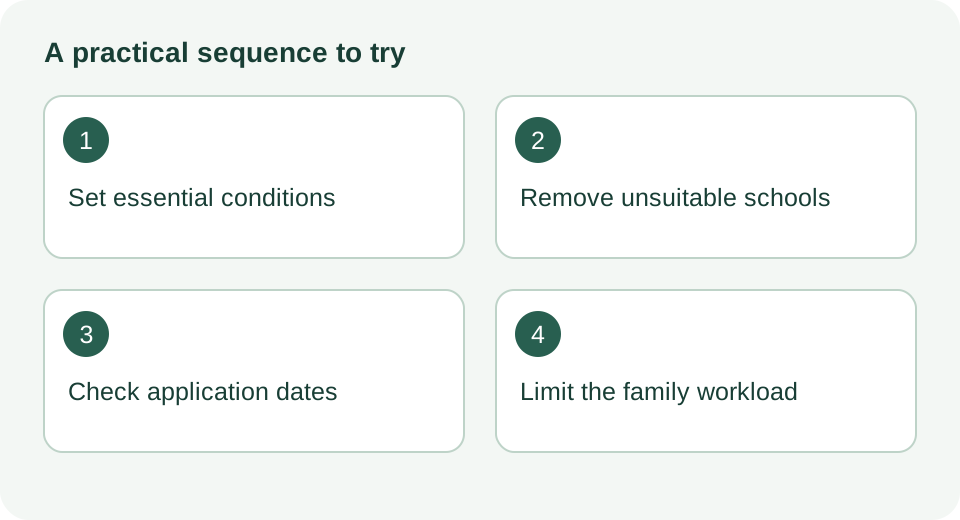
So the task in this guide is not to pick a number. It is to run a filter over a long list of schools, keep only the ones that survive, and stop adding when a new name brings nothing new. You should finish with a shortlist you could explain to a friend in one sentence per school.
One rule from the official system, and how it differs from this shortlist
Before planning direct applications, it helps to be clear about what the official Primary One Admission (POA) system allows. According to the Education Bureau's frequently asked questions for the 2027 entry cycle, each child may submit only one discretionary place application to a government or aided primary school; submitting more than one, whether on paper or through the electronic form, invalidates the application. Applications to Direct Subsidy Scheme and private schools are separate and are not covered by that cap.
That distinction matters. The shortlist in this article is entirely about direct applications to DSS and private schools, where families may approach several schools independently. The one-application rule for government and aided schools is a separate track with its own timeline, and a duplicate there carries a real penalty. Keep the two systems in separate mental boxes, and in separate rows of your tracker.
The Home-School Co-operation Committee publishes explanatory notes for the Primary School Profiles, which set out what each reported item means. When two schools describe their curriculum or support arrangements in similar words, the notes help you understand what schools are actually claiming, so you compare like with like.
Further reading: EDB: POA 2027 frequently asked questions · CHSC: Primary School Profiles 2026 explanatory notes
Start with your non-negotiables, not with school names
The most common mistake is starting from a list of well-known schools and trying to work backwards to eligibility. Reverse the order. Before writing down a single school name, agree as a household on the conditions any offer must satisfy for you to accept it. Write them down, because memory is generous under stress.
Useful conditions include a maximum one-way commute you would tolerate for six years, a total annual cost your budget survives without borrowing, a language of instruction and support environment that suits your child as they are today, and — the filter most families skip — an honest answer to whether you would enrol if offered. A school that fails your willingness test is not a backup. It is a place you would spend money, weekends and interview preparation to win, and then refuse.
Non-negotiables differ between families and there is no universal ranking. A family with two working parents may cap commute at thirty minutes; a family near a border crossing may prioritise a different set of hours and transport arrangements entirely. What matters is that your conditions are written, specific and agreed before any school's name excites or alarms you.
The willingness test
Ask whether you would seriously consider the school if offered a place. A clear no is a reason to remove it. “It depends” should become a named question about costs, support or daily arrangements, rather than an automatic rejection. Resolve what you can before paying the application fee.
This test is also what separates this exercise from a different decision — choosing between two offers already in hand. Comparing two confirmed offers is a later, happier problem with its own logic. The shortlist happens months earlier, with no offers on the table, and its only job is deciding where your application fee and preparation time go.
Check the facts each school publishes
Once your conditions are written, screen the long list against what schools themselves report. The Primary School Profiles, compiled with explanatory notes from the Home-School Co-operation Committee, let you see how each school describes its class structure, curriculum focus and support measures in its own words. Read those descriptions against your non-negotiables rather than against a ranking.
Practical checks that parents often leave too late: whether the school's published language of instruction and religious or cultural character fit your child; whether the total cost — fees plus fixed charges the school lists — fits your budget for the whole first year, not just month one; and whether the actual commute at school-run hours is survivable. Our guides on commuting and first-year budgeting cover those calculations in detail, so this article will not repeat them.
One caution: not every school publishes the same level of detail, and absence of information is not evidence of anything. Where a profile leaves a question open, that is a question to put to the school directly, not a gap to fill with forum rumours.
Further reading: CHSC: Primary School Profiles 2026 explanatory notes
A worked example: six schools down to three
The following example is entirely hypothetical and the school names are placeholders, not real institutions or real rules. Suppose a family starts with six direct applications: School A to School F. Their written conditions are a one-way commute under forty-five minutes, first-year total cost within a set figure, and a genuine willingness to enrol.
Running the filter, School A survives on every condition — close, affordable, and the family would accept without hesitation. School B survives too, though with a slightly longer commute they have checked at peak hours. School C fails on cost once fixed charges are added to the fee, so it goes despite a strong reputation. School D fails the willingness test: the family realises they were applying because friends were, not because they would enrol. School E fails on a factual point — the published timetable and travel time would put a five-year-old out of the house for over eleven hours a day. School F survives conditionally: it fits, but the family notes an application deadline earlier than the others, which they must diarise or drop.
Three schools survive, but the lesson is not that three is the ideal number. Another family running the same filter over the same six names might keep two, or five. The number is an output of your conditions, not an input. Note also that School F was kept because it fit — not kept as a so-called safety option. No school on a shortlist should be labelled a guarantee, because you do not control selection outcomes at any school.
| School | Decision | Reason (illustrative) |
|---|---|---|
| A | Keep | Fits commute, cost and willingness conditions |
| B | Keep | Longer but verified peak-hour commute is acceptable |
| C | Remove | Total first-year cost exceeds the family's ceiling |
| D | Remove | Would not accept the offer; applied only because friends were |
| E | Remove | Daily hours away from home are unworkable for a young child |
| F | Keep, flagged | Fits conditions; earliest deadline needs a diary entry |
What each application actually costs your family
Estimate the work for each application. In a hypothetical example, reading requirements takes 45 minutes, organising documents 20, submission and payment checks 30, a family planning conversation 30, and a school visit 90. That totals 215 minutes, or 3 hours 35 minutes, excluding travel. These are sample inputs, not recommended preparation times.
At that same illustrative workload, three applications take 10 hours 45 minutes and six take 21 hours 30 minutes. Actual requirements differ and some preparation can be reused. Put your estimate beside the time you really have, then decide whether to add or remove an application.
Check published dates together. Some interview slots are allocated only after applying, so mark those as unknown instead of assuming a clash or reusing last year’s dates. If a conflict becomes definite, consult the relevant school’s published rearrangement policy.
Why extra applications do not multiply your chances
Application counts are not personal admission probabilities. A school’s overall application and place numbers, where published, do not tell you your child’s chance of an offer. You also lack the information needed to treat applications as independent events and multiply probabilities.
Extra applications can create additional opportunities, but the useful question is whether each is a school you might accept and a process you can manage. There is no need to turn that planning choice into an unsupported percentage.
Keep genuinely acceptable alternatives. Two similar schools can both deserve a place on the shortlist; similarity alone does not make the second application pointless.
One shared tracker and a stop rule
Use one shared tracker: school, opening and closing dates, required documents, submission status, payment status, confirmation received, interview details and next action. Name the adult responsible for each outstanding item so that “I thought you had sent it” is easier to avoid.
Before adding a school, check willingness to enrol, practical fit and capacity for the extra work. It does not have to offer something unique. A similar but acceptable option can be useful, provided the family can manage the application.
If a school's website lacks a detail you need — say, whether the school accepts supplementary documents after the deadline, or how it confirms receipt — ask directly, using plain wording such as: 'Dear [school name] admissions office, could you confirm whether [specific document] may be submitted after the application deadline for [entry year] P1? Thank you.' A specific, polite question costs one email; assuming an answer costs a place.
What to do if the shortlist shrinks to one or two
If only one or two direct applications fit, first check whether there are other acceptable options you overlooked. Also confirm which POA stages your child is eligible for and complete the relevant procedure on time. Applying directly and accepting a place have different consequences: accepting a DSS P1 place affects POA allocation eligibility. Read the registration rules before accepting, rather than assuming all routes remain open.
Further reading: EDB: POA 2027 frequently asked questions
Your next action this week
Set aside forty minutes with the other adults in your household. Write down your non-negotiable conditions — commute ceiling, annual cost ceiling, and the willingness-to-enrol test — and then list every school you were considering. Delete the ones that fail before you look up a single application deadline. What survives is your starting shortlist, with reasons attached to each name, ready for the date checks and workload estimate described above. Ten minutes with a calendar for each surviving school will tell you whether the number you ended up with is one your family can genuinely carry.
Frequently asked questions
Does applying to many DSS and private schools affect my child's POA discretionary place application?
No. The Education Bureau's rule limiting each child to one discretionary place application applies to government and aided schools; it does not restrict separate direct applications to DSS and private schools. The two tracks run in parallel with their own timelines.
Is it wasteful to apply to only two or three schools?
Not if each one is a school you would accept and can prepare for properly. The value of an application lies in the fit and the preparation, not the count, and extra applications cannot be treated as independent increases in the chance of success because the same child attends every process.
Should we keep one 'safe' school on the list as a backup?
Keep any school you would genuinely enrol in and that fits your conditions, but avoid framing it as a safety guarantee. Selection outcomes at every school rest with the school, and a 'backup' you privately hope not to use usually fails the willingness test anyway.
A school's deadline has already passed — is it too late to apply?
Some schools accept late applications and some do not; there is no general rule. Contact the school directly and ask specifically whether late applications for the entry year are being accepted and what documents they require, rather than assuming either answer.
Discussion background and sources
This topic was informed by search-index excerpts of the public discussion below; the complete thread could not be retrieved directly. Historical comments identify a parent question, not current admission rules or admission chances. Consult the official sources and the notice addressed to your family.
- Education Kingdom: 小一考直私經驗分享 (2021 discussion) — discussion background
- EDB: POA 2027 frequently asked questions — official source
- CHSC: Primary School Profiles 2026 explanatory notes — official source
- EDB: POA 2027 application notes — official source
Sources checked:
Put the preparation into practice
Find schools and official websites · Parent-child practice games · Editorial policy