
HK Primary Interview editorial content · Updated:
The examples and exercises below are illustrative material, not real student case studies or school test questions. Use them for family preparation; check each school’s current requirements before submitting documents.
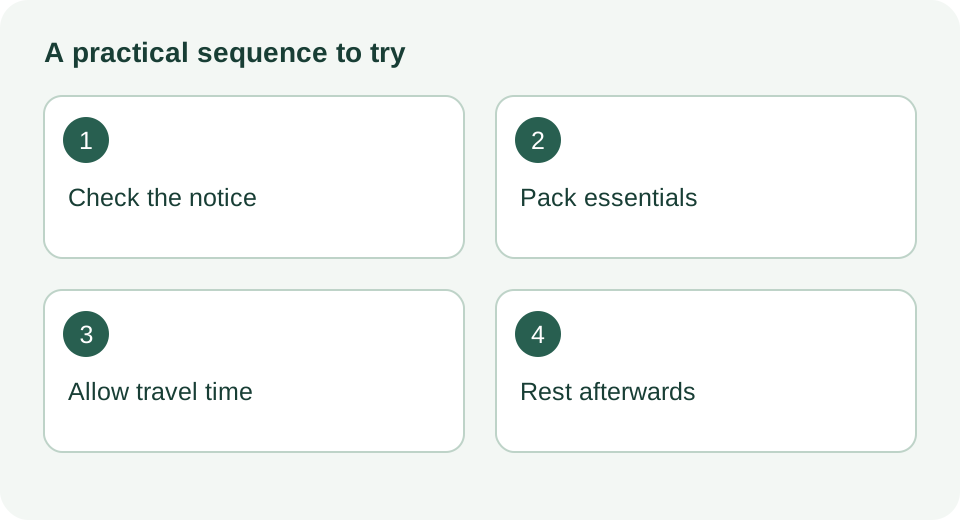
Start from your school's own notice, not from rumour
Before planning anything, reread the interview notice your school actually sent. Schools differ enormously: some run short individual sessions, some run group activities, some observe children through play, and not every school interviews at all. What to bring, how early to arrive, whether parents wait on site, and how long the visit takes are all decided by the individual school. Nothing in this guide overrides your notice — where they differ, the notice wins.
Be equally cautious about playground and chat-group advice. Claims about 'what schools look for', universal arrival times or must-bring portfolios are usually recycled guesses. If the notice is unclear, call the school office during office hours and ask plainly: what time should we arrive, where do we go, and what should we bring? The Education Bureau's Primary One admission pages are useful further official reading on how the overall system works, though they do not describe any individual school's interview arrangements.
Further reading: www.edb.gov.hk
Work backwards from your appointment time
The most reassuring thing you can do the night before is settle one question: what time do we leave home? Do not start from a rule of thumb like 'arrive an hour early'. Start from what your notice says, then subtract your real journey. Building the timeline backwards removes morning guesswork and gives everyone a calmer start.
| Step | Hypothetical time |
|---|---|
| Appointment time (example) | 10:00am |
| Arrive at school per notice (example: 15 minutes early) | 9:45am |
| Leave nearest station (example 35-minute journey) | 9:10am |
| Leave home with 20-minute buffer | 8:50am |
| Wake, breakfast, dress (example 30 minutes) | from 8:20am |
A hypothetical 10:00am appointment, worked backwards
The following numbers are purely illustrative. Suppose, hypothetically, a school notice asks families to arrive 15 minutes before the appointment time, and your family has a hypothetical 10:00am slot. Working backwards: arrival at the school by 9:45; a hypothetical door-to-door journey of 35 minutes by MTR plus a short walk, so 9:10 as the latest departure from the station; a buffer of 20 minutes for queues, rain or a slow bus, meaning 8:50 out the door; a relaxed 30 minutes for waking, breakfast and dressing, giving a hypothetical wake-up time of around 8:20 for a 10am slot.
Notice the tradeoff in that buffer. Twenty minutes of slack absorbs most ordinary delays without making you so early that a young child waits restless in a corridor. If your child wilts when kept waiting, a shorter buffer with a nearby fallback — a café or covered area within a few minutes of the school, identified the night before — often beats sitting in a lobby for 40 minutes. Adapt the plan to your child, not the other way round.
The night before: routine beats revision
A Primary 1 interview is not an examination a six-year-old can study for overnight, and trying to cram one turns a normal school visit into something frightening. The evening is better spent on the ordinary things that make mornings work: clothes laid out, bag packed, dinner and bedtime at the usual time or slightly earlier. A rested child who walks in curious is better prepared than an over-drilled child who walks in tired and rehearsed.
What to rehearse — lightly, and with the right goal
Some familiarisation helps: children who have never been asked 'tell me about yourself' by a friendly adult may freeze simply because the format is new. A few minutes of playful practice — answering simple questions about favourite foods, siblings, or what they like to draw — removes that novelty. But heavy drilling produces word-perfect, flat answers that collapse under a follow-up question, and it can teach your child that you are anxious. If practice sessions end in tears or stonewalling, stop; a game at the kitchen table teaches the same skill more gently.
Clothes, sleep and screens
Choose clothes your child can already manage alone and let them try everything on the night before rather than discovering a broken zip at 8am. Keep the evening low-stimulation: a familiar dinner, the usual routine, and screens off early enough that settling is easy. Do not announce that tomorrow is 'very important'. Children take their emotional cues from your tone, and a calm 'we're visiting a school tomorrow, it should be interesting' sets a far better one.
One bag: the packing checklist
Pack everything the night before so the morning contains no searches. The list below is a general starting point; your notice may add or remove items, so tick against it, not against this list. If your school asks for documents such as a birth certificate, ID photographs or specified forms, put them in a labelled folder at the top of the bag — and only bring a portfolio or certificates if your school has actually asked for them, since many do not.
- The interview notice or appointment slip, plus the school's address and office phone number written down or saved offline
- The documents your own notice specifies, in one labelled folder — and nothing extra unless requested
- Your child's HKID or travel document if the notice asks for identification
- A named water bottle and a small, non-messy snack for the wait
- One quiet activity for waiting time, such as a small book or sticker set — nothing with loud sounds
- A spare top and a small pack of tissues or wet wipes
- An umbrella or light rain shell in shoulder season, checked against the forecast
- A favourite small comfort object in your own bag, for before and after rather than during
- Confirmed transport plan and fare card, plus the offline map location of the school entrance you will actually use
The morning: food, travel and the waiting room
Keep breakfast familiar and filling — a new or rushed meal is a poor experiment on an important morning. Follow the timeline you built the night before, and let your child carry the small bag so the visit feels like their outing rather than your errand. On the way, talk about anything except the interview: the bus number, the trees, what snack to have afterwards. Arriving on the early side of your buffer is fine; arriving so early that your child sits idle for an hour usually is not.
In the waiting area, follow the school's instructions about where parents and children wait. Keep your voice at a normal volume, let your child use the toilet before the session if facilities are available, and resist delivering last-minute instructions at the door — 'remember to speak up, remember to say thank you' communicates that you expect failure. If you prepared lightly the night before, there is nothing left to say except something warm.
When things go wrong: a decision table
Most interviews proceed unremarkably, but it is worth deciding in advance what you would do about the five most common disruptions, so you are problem-solving rather than panicking on the day. The table below offers a first step and a fallback for each; in every case, the phone number on your notice is more authoritative than any general advice, including ours.
| Situation | First response | If that does not help |
|---|---|---|
| Heavy rain or black rain signal | Check the notice for bad-weather arrangements before leaving; many schools state their policy. Leave earlier with rain gear and a dry folder for documents. | If arrangements are unclear, call the office number on the notice before travelling rather than arriving unannounced. |
| Transport delay on the day | Call the school office immediately with an honest revised arrival time; a family that phones ahead is in a very different position from one that simply appears late. | If you will miss the slot entirely, ask politely whether a rescheduled time or waiting list arrangement exists — outcomes vary by school, so ask rather than assume. |
| Child wakes genuinely unwell | Prioritise your child's health; do not bring a sick child to sit through a session. Contact the school as early as possible using the notice's stated channel to explain and ask about options. | If the school offers no guidance, ask what they would suggest in writing so you have a record, then follow medical advice for your child. |
| Forgotten document | If you discover it en route or on arrival, explain calmly at reception and ask whether a photo of the document sent that day, or delivery later, is acceptable. | Many schools can collect documents another way, but this is entirely the school's call — ask, apologise once, and do not let it become a family drama in front of your child. |
| Child refuses to go in | Do not force a distressed child through the door. Ask a staff member whether you can wait a few minutes at the edge of the room, or whether a shorter warm-up is possible. | If your child still says no, thank the staff and ask what options exist. A bad experience forced on a frightened child costs more than a missed session. |
The calm handover
The moment of separation sets the tone for the whole session. Schools that interview young children are used to hesitant ones, and staff normally have their own gentle ways of drawing a child in. Your job is to be the calm base your child leaves and returns to: hand over at a natural pace, keep your body language relaxed, and let the teacher lead. Avoid whispering final instructions, and avoid hovering at the door after the handover — both signal that there is something to fear.
Sample wording you can adapt
Simple, concrete sentences work best. For example: 'Chloe, this is Miss Lam, one of the teachers here. She's going to show you some interesting things and play a little. I'll be waiting right here, and I'll see you when it's finished.' Then a hug, a smile, and step back. The two promises — where you will be, and that you will return — are what a nervous child needs to hear. Adapt the words to your family's natural speech; a script that sounds unlike you will sound unlike you to your child too.
If your child clings or freezes
Clinging is common and not a sign of failure. Kneel to your child's height, acknowledge the feeling ('new places can feel a bit scary at first'), restate your two promises, and offer to walk in together to the door of the room if staff allow. Give the teacher a chance to engage — many children transfer their attention within a minute or two once a friendly adult offers something to do. If your child remains genuinely distressed, do not push and do not apologise repeatedly to staff in front of them; calmly ask what the school would like to do. Some children who need more time, or who communicate or engage differently, may simply need a different pace — raising this with the school respectfully is always appropriate. Never force eye contact or demand a greeting as a condition of entry; a child who nods silently at the door has not failed anything.
After the interview: the debrief and the days after
When your child comes out, greet them first and question them later — ideally not in the first five minutes, and never in front of staff. The goal of a debrief for a six-year-old is not intelligence-gathering; it is helping your child file the experience as ordinary, interesting and survivable. Whatever they say, your first response should be warm and unhurried.
In the days afterwards, unless your school's notice invites it, skip the thank-you letter and the results chase: your notice states when and how outcomes are communicated, and that timetable belongs to the school. If a school specifically invites questions or additional documents, respond through the channel it names, by its stated date, with exactly what was asked for and no more. Between now and any result, the most useful thing you can do is return life to normal: ordinary bedtimes, ordinary weekends, and a child who remembers the morning as the day you went somewhere interesting together.
A three-question debrief worksheet
Use the same three questions every time, at home, over a snack. Write nothing down in front of your child; this is a conversation, not an interrogation. The questions are: first, 'What was the most interesting or fun thing in there?' second, 'Was anything tricky or strange?' and third, 'If you ever visit a school again, what's one thing you'd want to remember?' The third only applies if there is a next stage, which you will know from your school's notice, not from guessing.
Exact wording that works
If your child answers 'I don't know' or 'nothing happened', a useful follow-up is: 'That's fine. If you close your eyes, can you see one picture from in there — what's in it?' Concrete sensory prompts can help a young child recall a moment where an abstract question draws a blank. If your child says the teacher asked something they could not answer, resist correcting the answer now; instead say, 'Everyone gets questions they're not sure about. What did you do instead?' — which teaches recovery, not performance. End with something forward-looking that has nothing to do with the school: 'What should we have for dinner?'
If the interview went badly in your child's eyes
Some children come out in tears, convinced they 'did it wrong'. Do not contradict them with 'no it was fine' — that dismisses the feeling. Try: 'It sounds like some of it was hard. Hard things feel bad while they're happening, and they get smaller after. I'm proud of you for going in at all.' Then change the scene completely — a playground, a bus ride, a treat that was never framed as a reward. If your child mentions something that genuinely concerned you, such as not being able to hear instructions, note it factually and, if a further stage exists, raise it calmly with the school through its stated channel so factual feedback is on record rather than left as a guess.
If you were asked to submit or update documents, our portfolio creator tool lets you combine pages in a browser and download the finished PDF via a parent email — handy for assembling exactly what a notice requests. For understanding individual schools' backgrounds and locations, the /school/ directory is a neutral starting point. If another stage lies ahead and you want conversation and activity prompts, /interview/ offers practice prompts, and /game/ collects parent-child activities for practising listening, describing and taking turns at home, without drilling.
Frequently asked questions
Our child is very shy. Will a quiet child fail the interview?
Schools that interview young children meet quiet children constantly, and staff typically use their own gentle methods to help a child settle. What matters more is that you do not turn shyness into a crisis at the door: keep the handover warm and short, avoid demanding greetings or eye contact, and give the teacher a minute or two to engage your child. If your child communicates or engages differently, mention it briefly and respectfully to staff so they can adjust their approach.
Should we rehearse answers the night before?
A few minutes of playful, familiar practice is enough — the aim is that the format (a friendly adult asking simple questions) is not scary and new. Heavy drilling tends to backfire: answers come out flat and tense, and a heavily drilled child has had little practice handling an unexpected follow-up. If a practice session ends in frustration, switch to a normal game; the skills being tested at this age are mostly ordinary conversation and play, not memorised lines.
What if we are late or miss the slot entirely?
Call the school office immediately using the number on your notice, give an honest revised arrival time, and ask what is possible. Schools handle latecomers differently, so ask rather than assume either that the slot is lost or that lateness carries no consequence. If rain or a transport strike is likely, check the notice for bad-weather arrangements before you leave home, and build a buffer into your journey.
Do we need to bring a portfolio or extra certificates?
Only if your school's notice asks for them. Schools differ in what they accept, and your notice is the only reliable guide: prepare exactly what it lists, in one labelled folder, and do not treat its silence about optional documents as an invitation to bring them. If you are asked later to submit digital documents, a browser-based tool such as /portfolio-builder/ can combine the required pages into a single PDF for download.
Put the preparation into practice
Find schools and official websites · Parent-child practice games · Editorial policy