
HK Primary Interview editorial content · Updated:
The examples and exercises below are illustrative material, not real student case studies or school test questions. Use them for family preparation; check each school’s current requirements before submitting documents.
Why Interview Pressure Feels So Big to Young Children
An interview compresses several hard things into one room: a stranger asking questions, a parent stepping back, an unfamiliar setting, and the sense that the outcome matters. A child may say they feel worried, go quiet, seek closeness, or decline to join in. Ask what they need without assuming a cause. Reading these as communication rather than misbehaviour changes how you respond.
Drop the instinctive promise "Don't worry, you won't cry." It sets your child up to fail, because the feeling may still arrive. A more honest frame is "If you feel like crying, that's okay. I'll be nearby, and we have a plan." Emotional regulation is generally built gradually through many small experiences, so treat practice as low-stakes play. Finally, check your own calendar assumptions against reality: not every school interviews children or accepts portfolios, and formats differ widely. Use the school's current notice and direct replies to check the stated arrangements.
The Before-During-After Plan
A predictable structure reduces the number of surprises your child has to absorb. This plan is a flexible editorial example; adapt timing to your child's age, temperament, and the school's own instructions. The aim across all three stages is the same: keep the day ordinary enough that the interview is one event in it, not the whole day.
Before: Keep the Week Ordinary
Mention the interview briefly and neutrally, the way you would a dentist visit: "On Thursday we're visiting a school and someone will chat with you." Avoid repeated rehearsals, countdown charts, or rewards tied to performance, because these raise the stakes. Build comfort with the shape of the experience through play: role-play a hello and a question or two with a puppet, letting your child be the interviewer as often as the interviewee. Light activity the evening before, a normal bedtime, and — if the school allows — a quiet drive or walk past the building can all help.
During: Your Job Is to Be a Steady Base
Keep your own voice and pace unhurried; children often pick up on adult calm. Arrive with a small familiar object if permitted, and follow the school's instructions about where parents wait. When your child looks back at you, offer a small, warm pre-agreed signal, such as a thumbs-up, rather than mouthing answers. If your child becomes visibly distressed and the setting allows, quietly ask a staff member what support is possible; schools can only work with what they are told.
After: Close the Loop Gently
Lead with connection, not analysis: "You went into a new room and met someone new. That was brave" is usually more useful than "How did it go?" Let your child decompress with food, movement, or quiet time. If you want to reflect together, wait until later and ask open, low-pressure questions: "What was the room like? Was there anything funny or strange about it?" Save your own debrief for another adult, so your child does not inherit your evaluation of their performance.
Five Scenario Dialogues You Can Adapt
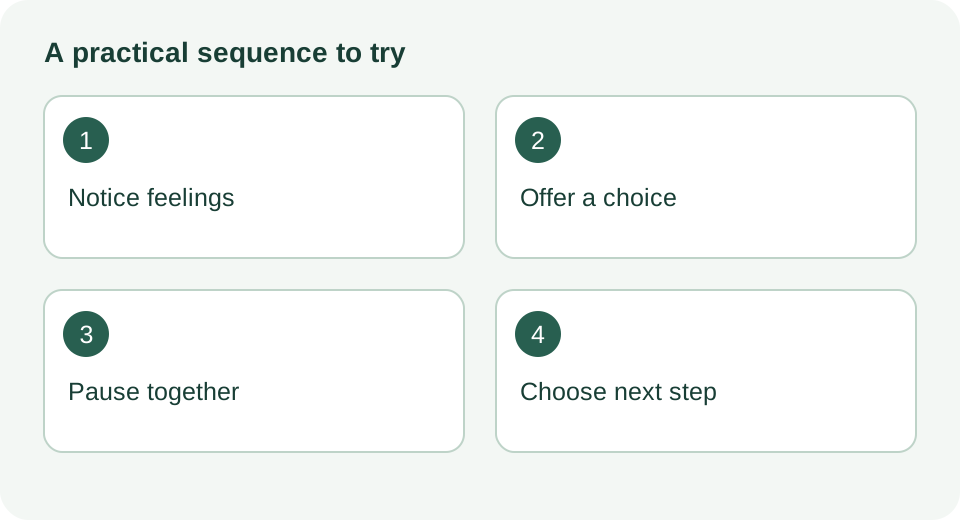
Each dialogue is a hypothetical worked example showing one possible exchange. Use your child's own words and your own tone; the structure to copy is "name the feeling, offer a choice, keep the exit open." Forcing eye contact, requiring instant answers, or bargaining away feelings tends to backfire.
Scenario 1: The Waiting Room Wobble
Situation (hypothetical): Waiting in the school hall, your five-year-old grips your arm and says, "I don't want to do this."
Instead of "You'll be fine, stop worrying," try: "You're holding my arm very tight. Waiting is the hard part for lots of people. Would you like to look at this book with me, or count the fish in that picture?" After a minute, add: "When it's your turn, you'll walk in with the teacher, and I'll be right here when you come out. If it feels too big inside, you can tell the teacher you need me." Naming the hard part, offering two small choices, and confirming your location restore the predictability, control, and visible parent that anxious waiting takes away.
Scenario 2: Separation at the Door
Situation (hypothetical): A staff member invites your child in alone. Your child clings to your leg and starts to cry.
Kneel to your child's height: "You wish I could come too. It's okay to feel sad about that." Give a concrete bridge: "I will sit on this bench. When you come out, we'll get a snack." If the school permits it, hand your child a small object of yours and say, "Keep this safe for me until you're back." Then let the staff member take over, but stay where you said you would be. A brief goodbye suits some children; others need a slower parting, so follow your child rather than a fixed rule. If distress escalates rather than settling, it is reasonable to pause and try again another time, or to ask politely whether a parent can accompany the child for the first minute — schools handle this differently, and asking costs nothing.
Scenario 3: The Unknown Question
Situation (hypothetical): Afterwards, your child says, "She asked me something and I didn't know what to say and I just stood there."
Resist correcting or coaching. Try: "That happens to grown-ups in interviews too. What did you do?" If the child says nothing, offer two pocket sentences: "You can always say, 'Can you say that again, please?' or 'I'm not sure yet.'" Practise them at home in a silly voice so they feel like tools, not homework. The message to leave: not knowing an answer is a normal event with a normal response, not a failure that ended the interview.
Scenario 4: A Group Activity That Goes Badly
Situation (hypothetical): Your child loses a game or cannot finish a puzzle while others watch, and comes out upset: "I'm the worst. Everyone saw."
Try: "Losing in front of people stings. I'd feel that too." Let the feeling land for a few seconds, then add perspective: "Do you remember the part you liked?" or "What would you do differently next time?" Avoid "It doesn't matter" (it clearly did) and "You were actually the best" (children know when adults inflate). If losing games is a repeated trigger at home, build tolerance through short, quick games where the adult models losing cheerfully: "Ugh, I lost again! Rematch?" For many children, small, frequent, playful losses seem to build recovery better than a speech would.
Scenario 5: The Cancelled or Changed Plan
Situation (hypothetical): A relaxed playground visit or home role-play session the day before is cancelled, or the school changes the reporting time, and your child melts down because the plan was the safety blanket.
Try: "You were really looking forward to that. Plans changing is disappointing." Then offer a replacement, not a substitute promise: "The park is closed, so we can do the puzzle by the window or kick a ball downstairs. Which one?" The skill being taught is flexibility, which is exactly what the interview will demand. A visual trick helps some children: draw the day's plan on paper and amend it together, so changes are made on the plan rather than in the air. Practise one deliberate small change on an ordinary day, such as swapping snack time, so a changed plan has already been survived once.
Stop Signals: Agree on a Way to Pause
Before the interview, agree on one or two simple signals your child can use, with you or with staff, to ask for a pause; this sense of control often reduces the need to use it. Keep signals concrete: a flat raised hand means "I need a minute"; squeezing your hand twice means "I'm okay, stay close." Tell your child what a pause will look like: "If you show me the stop hand, I will say, 'Let's take a little rest,' and we'll breathe together." Reassure your child that asking for a pause is never naughty. If staff will be supervising rather than you, mention the signal politely; schools can only accommodate what they know about.
Observation Worksheet: Track Patterns, Not Perfection
Rather than scoring your child, keep brief notes across a few ordinary situations to see what actually helps. Copy the editorial example below into a notebook; two or three entries are usually enough to reveal a pattern, such as "transitions without warning are the trigger" or "having a job to do helps." Bring the pattern, not the worksheet, to any conversation with the school, and focus on what works rather than on labels.
| Date (example) | Situation (example) | What my child did | What I tried | What seemed to help |
|---|---|---|---|---|
| e.g. Sat morning | First time at a new indoor play area | Hid behind me for about ten minutes, then joined a puzzle table | Gave a choice of two areas to start in; stayed seated nearby | Choosing the activity herself; me not hovering |
| e.g. Tue evening | Family board game, lost twice | Swept pieces off the table | Named the feeling, offered a rematch with simpler rules | Shorter game; being allowed to be cross for a moment first |
Emailing the School: Sample Wording for Support
If you know in advance that your child finds new settings difficult, a short, matter-of-fact email can open the door to accommodations. Keep it specific, brief, and free of diagnoses or dramatic language; you are sharing useful information, not making a case. Check the school notice for the correct contact address and any required format, and remember that arrangements vary by school, so treat any reply as the definitive answer.
Sample wording: "Dear [name or Admissions Office], Thank you for the arrangements for [child's name]'s visit on [date]. I wanted to mention that [child's name] sometimes feels nervous in new settings and takes a little while to warm up. It helps when instructions are given one at a time and when there is a moment to look around before starting. If it would be possible for [him/her/them] to have a short pause if needed, that would be much appreciated. Please let me know if you need any further information. Thank you for your time."
If the school cannot adjust anything, that is still useful information: it tells you to invest your energy in preparing your child with the dialogues and signals above rather than in negotiating the format.
Further reading: developingchild.harvard.edu
If the First Approach Does Not Help, and Practice at Home
No single strategy works for every child, so plan for iteration. If naming feelings makes your child more upset, some children do better with distraction and quiet company first. If choices overwhelm, offer one option and a routine instead. If a stop signal is never used, practise it in games where you use it too. Give any approach a few low-stakes outings before judging it, and change one variable at a time. If distress is intense across many settings, is not easing over weeks, or is affecting sleep, eating, or friendships, consider raising it with a healthcare professional or your child's teacher; that step is outside the scope of this guide, which offers no diagnostic or treatment advice.
Practice at home works best when it does not look like practice. On our /game/ pages you will find parent-child early-years practice activities that you can choose according to your child’s interests. Our original /interview/ prompts can be used purely as conversation starters at dinner: pick two or three, answer them yourself first, and keep the tone playful. Avoid simulating a full interview in the final days, as this often raises anxiety. Our /school/ directory can help you shortlist schools to research further, though it does not replace each school's own notice for actual requirements. If a school invites families to share materials, portfolio creator is a browser-based tool for assembling pages into a PDF downloaded after entering a parent email address; no account or login is required and the email is not verified. Keep any contents honest and child-made, and only bring materials if the school's notice requests them.
Frequently asked questions
Should I tell my child not to cry before the interview?
No. Promising no tears sets a standard your child may not meet and can add shame to the anxiety. Instead, agree on a plan for what to do if tears come: a stop signal, a pause request, and knowing where you are waiting. Tears in a new setting are a normal response, not a failure.
How many days before the interview should we start preparing?
There is no evidence-based number, so treat timing as a flexible choice. A light mention a few days ahead plus relaxed play-based practice works better for many children than a week of intensive rehearsal. Avoid ramping up preparation in the last day or two, when it tends to raise rather than lower anxiety.
What if my child refuses to go into the room at all?
Stay calm, follow the staff members' lead, and ask politely whether a parent can accompany the child briefly or whether a short break is possible, since arrangements vary by school. Do not push or carry a genuinely distressed child in. If it does not work out, treat it as information: use the observation worksheet to understand the trigger and raise it with the school, rather than treating it as the end of the road.
Does my child need a portfolio or to prepare answers for specific questions?
It depends entirely on the school; practices differ, and not all schools interview children or accept portfolios. Check the school's own notice or contact them for the actual requirements. If materials are invited, keep them genuine and child-made, and if specific preparation is requested, keep it light and framed as play rather than drilling.
Put the preparation into practice
Find schools and official websites · Parent-child practice games · Editorial policy