
HK Primary Interview editorial content · Updated:
The examples and exercises below are illustrative material, not real student case studies or school test questions. Use them for family preparation; check each school’s current requirements before submitting documents.
What makes a P1 question useful rather than drill
A useful question is one your child can start without you explaining it twice, but cannot finish on autopilot. It invites a reason, a comparison or a sentence — not a memorised reply. Drill, by contrast, is the same question repeated until the answer becomes automatic; for most children entering P1, this tends to build resistance faster than skill.
The prompts in this guide are original and written for home use. They are not past school questions, and using them is not a way to predict what any particular school will ask. Their purpose is to strengthen everyday thinking and talking.
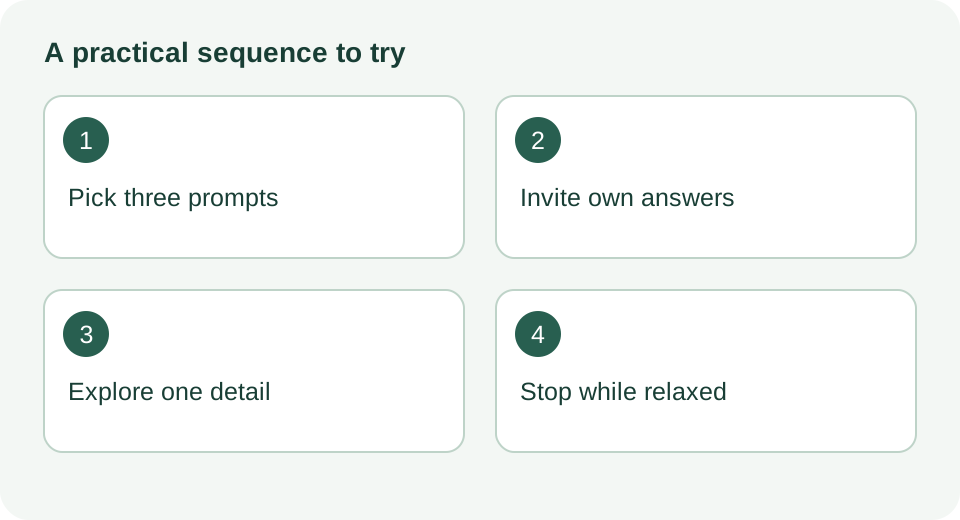
Sample only three to five at a time
Resist working through a long list. Choose three to five prompts per session, mixed across groups — for example, two number prompts, two language prompts and one conversation prompt. Sampling keeps each question fresh, gives you room to swap out anything that flops, and leaves your child curious about next time. A long pile of questions turns a conversation into an assessment, which is exactly the feeling most parents want to avoid.
Choosing the right difficulty
A quick editorial rule of thumb, not a research claim: your child should succeed roughly four times out of five. If every answer is instant, the question is too easy — make the number bigger, add a step, or ask 'why?'. If there are two failures in a row with frustration, drop a step, shrink the quantity, or answer the first part together and let your child finish. Difficulty is something you adjust on the spot; a question is a starting point, not a fixed test.
Further reading: developingchild.harvard.edu
Group 1: Number sense and counting
Use small objects your child can touch — blocks, buttons, pasta. Many children find touchable numbers easier to reason about than numbers on a page.
- Line up 8 blocks. Count them forwards, then count them backwards. Illustrative answer: 1 to 8, then 8 to 1. Follow-up: cover two blocks and ask how many are hiding.
- Which is more — 6 apples or 9 apples? How do you know? Illustrative answer: 9, either by counting or by seeing which row is longer. Follow-up: how could we make the two groups equal?
- I am a number between 3 and 6, and I come right after 4. What am I? Illustrative answer: 5. Follow-up: let your child invent one for you — inventing is harder and more revealing than answering.
- Draw 10 circles and cross out 3. How many are left? Illustrative answer: 7. Follow-up: say the matching sentence aloud: '10 take away 3 is 7.'
- Sort a small handful of buttons first by size, then by colour. Which sorting made two groups? Which made three? Adaptation: if sorting by two rules is tiring, use just six buttons and one rule, and build up over the week.
Group 2: Language and storytelling
These prompts build sentence length and memory for sequence — useful for reading readiness and for talking with teachers.
- Open a picture book to any page. Describe everything you can see, starting from the top-left corner and moving across like reading. Worked example: a child might say, 'A boy in a red hat is feeding a dog. Behind them is a small house with a chimney. The sky looks grey and rainy.' Follow-up: ask what might happen on the next page. Adaptation: if full sentences are hard, let your child point at items while you name them, then swap roles.
- Retell a story you both know — for example, The Three Little Pigs — in three sentences: one for the beginning, one for the middle, one for the end. Illustrative answer: 'Three pigs built houses. A wolf blew two down but not the brick one. The pigs were safe in the brick house.'
- What would you do if your umbrella blew away in the rain? There is no single right answer. Follow-up: model a full-sentence reply first — 'I would chase it and hold it tightly' — then let your child try.
- Pick five household objects and invent one silly sentence that uses all of them. Illustrative answer (hypothetical): 'The spoon sat on the sock under the lamp beside the cup and the shoe.'
- Finish this aloud: 'The door opened slowly and…' Follow-up: ask 'and then what happened?' twice more to stretch the story.
Group 3: Observation and logical thinking
These prompts reward explaining, not just answering. Accept any choice your child can defend with a reason.
- Which does not belong — spoon, fork, cup, plate — and why? Illustrative answer: a cup, because it holds drinks while the others are for food; but any answer with a sensible reason counts. Follow-up: is there a different answer that also works?
- Look at a fruit bowl. Tell me one way an apple and an orange are the same and one way they are different. Follow-up: repeat with two items your child chooses.
- I am thinking of an animal. Ask me questions I can answer with yes or no. Follow-up: model narrowing down — 'Is it bigger than a cat? Does it live in water?'
- Line up a spoon, a cup and a plate. Which is first if we count from the left? From the right? Follow-up: swap two objects and ask again.
- Guess how many steps it is from the sofa to the kitchen, then count as we walk. Follow-up: talk about whether the guess was close, without calling any guess wrong.
Group 4: Everyday maths at home
Kitchen and mealtime maths feels like helping, not practising — which is why it lasts longer than a worksheet.
- Set the table for four people. How many chopsticks do we need altogether? Illustrative answer: 8. Adaptation: start with two people, then let your child predict before counting a bigger number.
- Pretend shop: one crackers box costs 5 coins. You have 12 coins. How many boxes can you buy? Illustrative answer: 2 boxes, with 2 coins left over. Follow-up: what if each box cost 4 coins?
- Cut a sandwich into 4 equal pieces. Which pieces together make the same amount as half? Illustrative answer: any two of the four pieces. Follow-up: what about three pieces — is that more or less than half?
- Hold one fruit in each hand. Which feels heavier? Then check with a kitchen scale. Follow-up: was your guess right? Heavier or lighter than you thought?
- Our pretend bus ride took 15 minutes going and 15 minutes coming back. How long were we riding altogether? Illustrative answer: 30 minutes. Follow-up: act it out with a toy bus so the two legs of the trip are visible.
Group 5: Listening and following instructions
Two-step listening is one of the most practical P1-readiness skills, and it can be practised in under five minutes anywhere.
- Two-step instruction: put the pencil in the drawer, then close the drawer. Follow-up: let your child give you a two-step instruction next.
- Draw a house with a triangle roof and exactly three windows. Illustrative answer: any drawing meeting all three conditions. Follow-up: count the windows together and let your child check their own work.
- Clap once when you hear a word that rhymes with cat: hat, dog, sun, mat. Illustrative answer: clap on 'hat' and 'mat'. Follow-up: your child supplies a new rhyming word.
- Listen to this short list — apple, banana, grape — and say it backwards. Illustrative answer: grape, banana, apple. Adaptation: begin with just two items, and add a third only when two feel easy.
- Follow our treasure map: walk around the chair, past the door, and stop at the rug. Follow-up: draw the next map yourself and send your parent on the hunt.
Group 6: Talking about feelings and opinions
These prompts practise giving a reason for a preference — a skill children will use often at school, and one that is generally easier to model than to drill.
- Tell me two things that made you smile today, each in its own sentence. Worked example (hypothetical family): a parent asks at dinner, and the child says, 'I smiled when I fed the fish. I smiled at Jason's funny hat.' Follow-up: 'Which one made you smile more — why?'
- If you could change one thing about our walk to school, what would it be, and why? There is no wrong answer; the reason is the point.
- Show me a face for 'proud'. Tell me about a time you felt proud. Follow-up: share one of your own first, so the conversation is two-way.
- Of the two books we read this week, which would you give to a friend? Give me one reason. Follow-up: ask for a second reason, or a reason someone might disagree.
- Imagine a classmate's toy breaks and nobody saw how. What would you do? Worked example: a child might say, 'I would tell the teacher with him so he is not alone.' Follow-up: 'What could you say to him first?' Adaptation: some children answer this better through toys — act it out with two figures instead of asking directly.
Noticing willingness and knowing when to stop
Willingness is your best quality-control tool. The following signals are practical editorial guidance, not research findings — every child differs, so treat them as starting observations of your own child.
- Good signs to continue: your child adds their own example, asks a question back, or asks for 'one more'.
- Signals to pause: repeated looking away while you are mid-question, answers getting noticeably shorter, a slumped or turned-away body, or frustration after two tries at the same prompt.
- Signals to stop for the day: asking whether it is finished, or tears. Stopping here is not failure — it protects the next session.
Tradeoffs, and what to do if the first approach does not help
There is a real tradeoff between coverage and willingness. Covering more prompts per session feels productive, but a reluctant child retains less and starts refusing; three prompts enjoyed will usually beat ten endured. Another tradeoff is between prompting and correcting — quick corrections keep answers accurate but can silence a child who was mid-thought. When in doubt, let the thought finish before tidying the sentence.
If prompts in one group are not landing after two or three sessions, do not push harder. Move to a different group, change the setting (mealtime instead of a table session, or a walk), switch who answers — you answer, your child judges — or pause that group for a week. If a particular prompt consistently frustrates, retire it permanently; the list is a menu, not a checklist. If your child is consistently unwilling across all groups for several weeks, consider whether the timing, tiredness or pressure around practice — rather than the questions themselves — needs adjusting, and consult your child's teacher if the concern continues.
A flexible one-week example planner
The planner below is one hypothetical arrangement, not a prescription. Swap days freely, and skip days without guilt — the goal is a rhythm your family can keep, not a completed grid.
| Day | Session focus (3–5 prompts) | Practical worksheet idea |
|---|---|---|
| Day 1 | Two number prompts + one listening prompt | One page: the 10-circle drawing from Group 1 and the house-drawing task from Group 5 |
| Day 2 | Two language prompts during dinner talk | No sheet — conversation only |
| Day 3 | Two observation prompts + one feelings prompt | One page: the odd-one-out list written out, with space for your child's reasons |
| Day 4 | Rest, or a self-chosen prompt repeated | None |
| Day 5 | Two everyday-maths prompts while cooking | One page: the pretend-shop coin problem drawn as circles to colour |
| Day 6 | One storytelling prompt + one movement prompt (treasure map) | Your child's hand-drawn map |
| Day 7 | Child's choice from any group | Child designs the sheet |
How this connects to interviews and school preparation
Not all schools interview children or families, and requirements vary widely. Do not prepare from rumours — check your school's own notice for what, if anything, is required, and use the /school/ directory to find school information generally.
If your target school does hold an interview, the prompts in this guide build the underlying habits — talking in sentences, explaining a reason, following two-step instructions — rather than rehearsing any particular format. For conversation-style practice specifically, /interview/ offers a separate original question bank written in the same spirit as this guide; it is a practice resource, not a record of what any school asks. For broader parent-child activities beyond question prompts, see /game/. If your family chooses to prepare a portfolio for schools that welcome one, portfolio creator lets you edit and export a PDF in the browser and download it via a parent's email; whether a portfolio helps is entirely school-specific, so confirm with the school first.
Finally, keep the framing light. Children entering P1 are learning to enjoy thinking out loud. A few good questions, asked with genuine curiosity, teach more than any pile of worksheets — and they teach your child that their ideas are worth hearing.
Frequently asked questions
How often should we do P1 practice questions?
There is no required frequency. Many families find that three to five short sessions a week, a few minutes each, is easier to sustain than daily drilling — but the right rhythm is whichever one your child stays willing to join.
What if my child refuses to answer altogether?
Stop the session calmly rather than persuading. Try again later in a different setting, let your child pick the topic, or switch roles so they ask and you answer. If refusal continues for weeks, talk with your child's teacher rather than increasing pressure at home.
Do all primary schools interview children or require portfolios?
No. Requirements differ between schools and between admission stages, so rely on your target school's own notice for what is actually needed, rather than general assumptions or second-hand accounts.
Should we use these prompts in English or our home language?
Both can work. Thinking skills practised through these prompts can carry over between languages, and a child who explains reasons confidently in one language often finds it easier to do so in another. Many families mix: reasoning at home in the home language, with English prompts added gradually at your child's pace.
Put the preparation into practice
Find schools and official websites · Parent-child practice games · Editorial policy