
HK Primary Interview editorial content · Updated:
The examples and exercises below are illustrative material, not real student case studies or school test questions. Use them for family preparation; check each school’s current requirements before submitting documents.
What Each of the Six Observation Categories Means
The six categories below were written for this guide as a practical checklist for parents. They are not official assessment domains, they do not come from any school's admissions criteria, and they are not meant to be ranked or scored. Think of them as six lenses you can pick up one at a time. The point of observation is description, not judgement: a useful note sounds like "used three describing words for the apple" rather than "good" or "needs work".
- Expression: putting ideas into spoken words, including describing, sequencing and answering with more than one or two words.
- Listening: holding an instruction in mind and carrying it out, including knowing when to ask for a repeat.
- Everyday number sense: counting real objects one at a time, comparing quantities and using words like more, fewer and enough.
- Noticing details: spotting what is the same, what is different and what has changed in a small set of familiar items.
- Cooperation: taking turns, sharing materials and responding to another person's suggestion during a shared task.
- Asking for help: trying first, recognising when something is genuinely stuck and requesting help with words or a clear gesture.
Further reading: developingchild.harvard.edu
Activities One and Two: Expression and Listening
Activity One: Expression with a Four-Picture Story. Draw four simple pictures in a row on one sheet of paper — for example, a child waking up, eating breakfast, putting on a school bag and waving at the door. Stick figures are fine because your child supplies the words.
- Materials: one sheet of paper, a pencil, a quiet table.
- Prompts: "Tell me what is happening in each picture." Then "What happens next?" and "How do you think the child feels in this one?"
- Easier option: use only two pictures, or let your child point while you narrate and then repeat one part back.
- Stopping point: end after one telling, or sooner if attention fades. Stop while it still feels like a game.
- Observation: note the longest sentence produced, whether events were told in order, and whether feelings or reasons appeared on their own.
- Activity Two: Listening with Two-Step Instructions. Movement and real objects make listening visible. This uses things already in your kitchen cupboard.
- Materials: any three or four safe household items, such as a cup, a spoon, a small box and a folded cloth.
- Prompts: give one complete instruction before your child moves — "Put the spoon in the cup, then bring the cloth to me." Then ask "What was the first thing I asked for?" as a check.
- Easier option: one-step instructions only, building to two steps over separate sessions.
- Stopping point: three or four rounds. If both steps are missed twice in a row, switch to one-step instructions.
- Observation: note whether your child waits for the whole instruction before moving, completes the steps in order, and what they do when they forget, such as asking you to say it again.
Activities Three and Four: Number Sense and Noticing Details
Activity Three: Everyday Number Sense with Snack Sharing. Number sense grows when the maths does a real job, and snack time does the job of being fair. The numbers stay small.
- Materials: one type of small snack, such as crackers or grapes, and two small bowls.
- Prompts: "There are six crackers. Can we share them so we each get the same?" Then "How many do you have? How many do I have? Are they the same?" Later add one cracker and ask "Now is it still fair? What should we do?"
- Easier option: start with four items and let your child move items one at a time while counting aloud.
- Stopping point: one fair share plus one change. Food games lose their fun if they become a test.
- Observation: note whether each item is counted once, whether comparison words like more, fewer or same appear unprompted, and how the unfair share is solved.
- Activity Four: Noticing Details with Spot the Change. The classic tray game, kept small so it fits in ten minutes. Children often ask to play again, making it a good early choice.
- Materials: a tray and five or six small familiar objects, such as a key, a coin, a hair clip, a bottle cap, an eraser and a spoon.
- Prompts: "Look carefully and try to remember everything." Your child closes their eyes, you remove one item or swap two positions, then ask "What changed?"
- Easier option: three objects only, with one large obvious change such as removing the spoon.
- Stopping point: two or three rounds, then let your child make the change while you guess — being the changer is often the favourite part and lets you model careful looking aloud.
- Observation: note how many changes are spotted, whether position is described in words like next to or under, and whether checking is systematic or random.
Activities Five and Six: Cooperation and Asking for Help
Activity Five: Cooperation with a Two-Person Tower Build. Cooperation only shows up when the task genuinely needs two people, so this is built around a shared structure neither of you could manage alone. It works with anything stackable and needs no preparation.
- Materials: building blocks, or small boxes, plastic cups or folded cardboard tubes.
- Prompts: "Let's build one tower together that uses every block. I'll put some on and you put some on." Midway, ask "What should we add next?" and try your child's suggestion even if it wobbles.
- Easier option: two separate towers side by side, connected with a bridge block, allowing parallel work before true turn-taking.
- Stopping point: when the tower falls for the second time, or when laughter turns to frustration. Collapsing towers are part of the game, not a failure.
- Observation: note whether your child waits for their turn, responds to your suggestion or insists on their own, and what they say when the tower falls.
- Activity Six: Asking for Help with the Sealed Container. Help-seeking is easy to overlook because a child who struggles silently looks like a child who is coping. This creates a genuine, low-stakes reason to ask for help.
- Materials: a snack sealed in a container your child cannot open alone, such as a tightly screwed plastic jar, placed within sight but reachable by walking rather than climbing.
- Prompts: say nothing at first and give time to try. If they go quiet or walk away, ask "What's the matter? What could you do?" If they still cannot start, model the words: "You can say: Mummy, please help me open this."
- Easier option: stay at arm's reach so asking requires only a short sentence rather than crossing a barrier.
- Stopping point: end the moment help is asked for and given, with warm acknowledgement like "You asked me with your words. That was a good idea." Do not add a second container.
- Observation: note whether your child tries at least one approach before asking, uses words or gestures, and names the problem, for example "the lid is too tight". Never force eye contact; a request made while looking at the jar is a perfectly good request.
A Filled Example Log and a Choose-Two Weekly Plan
A log works best when it is short enough to actually fill in: one or two descriptive lines and one idea for next time. No scores, no ratings. The table below uses an invented family, written purely to show the useful level of detail — it is an illustration, not a record of a real child.
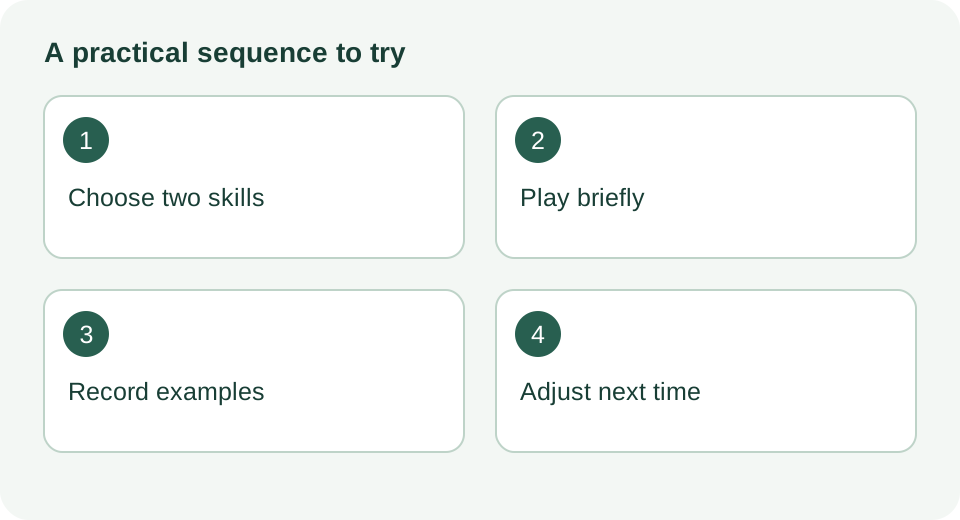
- Session length: roughly ten to fifteen minutes per activity; stopping early is always allowed.
- Frequency: two activities a week — for example listening instructions on a weekday evening and snack sharing at the weekend.
- Rotation: swap in a different pair each week, so all six categories get covered across three weeks without any single week feeling heavy.
- The drop rule: if a week gets busy, run one activity or none and continue the rotation afterwards. A missed week costs nothing.
- Write one log line after each session, because patterns only become visible across several entries.
| Date | Activity | What I noticed | Possible next try |
|---|---|---|---|
| Week 1, Tuesday | Two-step instructions | Waited for the whole sentence before moving. Repeated the steps back to herself quietly before starting. | Try a three-step instruction once, but have her repeat it back first. |
| Week 1, Saturday | Snack sharing | Counted each cracker once without skipping. Used the word fair on her own when one side had more. | Let her set the table for three and work out whether it is fair. |
| Week 2, Thursday | Spot the change | Spotted the first change quickly but pointed randomly on the second round. Said next to correctly once. | Next time, ask her to look from left to right before answering. |
| Week 2, Sunday | Sealed container | Tried the lid twice, then said the lid is too tight and asked for help with words. | Practise the same words at the supermarket with a heavy bag. |
| Week 3, Wednesday | Tower build | Went first twice without waiting. Accepted my idea for a wider base after the tower fell. | Take turns putting blocks on in strict order and swap who goes first. |
| Week 3, Friday | Four-picture story | Told the pictures in order. Longest sentence was about eight words. Added that the child felt happy. | Ask one how do you know question to draw out a reason. |
If an Activity Flops: Adjustments and Tradeoffs
Every activity here will flop for some child on some day, and a flop tells you something useful. The subsections below cover the most common situations.
When your child refuses to start
Refusal usually means the activity feels like a test. First, play it with a sibling, cousin or toy as the third participant so your child watches before joining. Second, reverse roles and let your child give instructions while you guess, sometimes badly. The tradeoff: role-reversed rounds are harder to observe, so treat them as warm-ups and return to the original format a week later.
When your child gives short or silent answers
Quiet is not a deficit; some children express themselves best through pointing, drawing or short phrases. Accept pointing during the story activity but model the sentence aloud — "Oh, he's putting on his school bag, isn't he?" — and see whether any of it is echoed. If spoken answers stay brief for weeks, let your child draw their own pictures first so there is something concrete to describe. If speech concerns persist, raise them with your child's kindergarten teacher or a relevant professional rather than drawing conclusions from home observations.
When a sibling wants to join
A second child changes the activity but does not ruin it. In the tower build and snack sharing, an extra participant strengthens the cooperation and fairness elements. In the listening and detail games, give the sibling a parallel role, such as making the changes while the P1-aged child guesses. The tradeoff: your observations of the older child become harder to isolate, so note only what you can clearly attribute.
When nothing seems to improve
Progress is uneven and often invisible for weeks. Before concluding an approach is not working, check three things in your log: whether sessions have actually been regular, whether the easier option has been used, and whether your notes are specific enough to compare. If the same category shows no change after several genuine attempts, shift to a different category for a while rather than repeating the same activity with more pressure — your child may find the format boring rather than the skill difficult.
Where This Fits in Actual P1 Preparation
The skills above are everyday capabilities, not a syllabus, and the only reliable way to know what any particular school asks for is to read that school's own notice. Not all schools interview children or request portfolios, and practices differ between school types, so never build your preparation around assumptions. Treat your log as a private family record, not a document produced for anyone else.
For structured material alongside these activities, the /interview/ section offers original practice prompts you can adapt, the /game/ section collects parent-child activity ideas in the same spirit, and the /school/ directory lets you look up individual schools rather than relying on hearsay. If your chosen school does ask for a portfolio, the portfolio creator tool lets you edit and arrange pages in a browser and download the finished PDF after entering a parent email; no verified-email check or account login is required for the download itself. What goes into a portfolio, if one is requested at all, should always follow the school's own instructions.
Frequently asked questions
Should I score my child on the six categories?
No. The log is deliberately descriptive: write what you saw, such as the longest sentence your child produced or how they solved an unfair share. Scores invite comparison and turn a game into a test, a common reason children refuse to play. If a note cannot be phrased as something you actually observed, leave it out.
My child never asks for help and just gives up quietly. Does that mean something is wrong?
Quiet giving-up is common and is precisely why the sealed-container activity exists. Try staying within arm's reach and model the request words yourself several times: please help me open this. Praise any attempt to communicate, including gestures and leading you by the hand. If the pattern worries you across many weeks and settings, discuss it with your child's kindergarten teacher or an appropriate professional rather than drawing conclusions from home games alone.
Do Primary 1 schools test exactly these six skills?
There is no fixed list that applies to all schools. Some schools meet incoming children and some do not, and portfolio requirements also vary. The six categories here are an editorial framework for parents, not an official assessment domain, so the only dependable source of requirements is your chosen school's own notice — use the /school/ directory to check its published information directly.
How long and how often should we do these activities?
The choose-two plan is a flexible editorial suggestion, not a prescription: roughly ten to fifteen minutes per activity, twice a week, swapping in a different pair each week so all six categories come up within three weeks. Shorter, happier sessions usually beat longer ones, and the drop rule applies always. If an activity consistently runs past twenty minutes or ends in tears, shorten it rather than pushing through.
Put the preparation into practice
Find schools and official websites · Parent-child practice games · Editorial policy