
HK Primary Interview editorial content · Updated:
The examples and exercises below are illustrative material, not real student case studies or school test questions. Use them for family preparation; check each school’s current requirements before submitting documents.
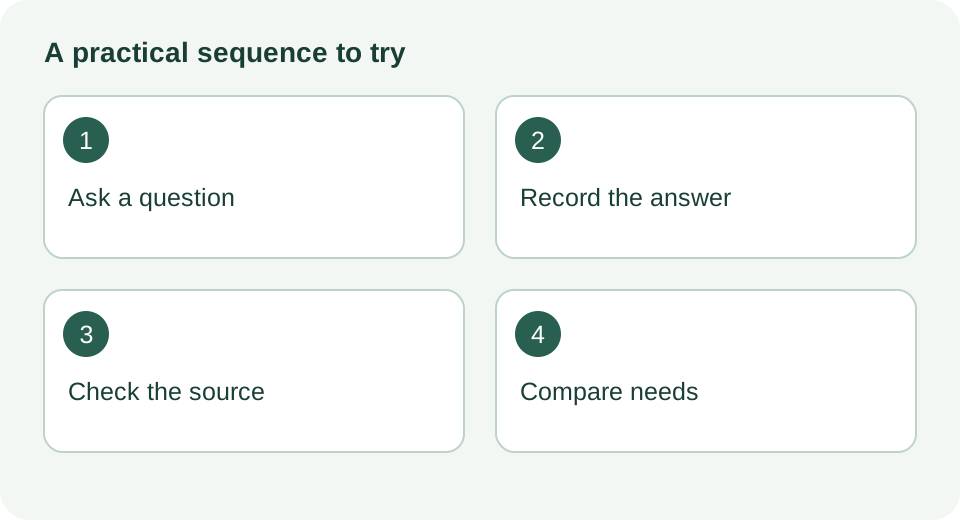
Why a written plan beats a good memory
Open days in Hong Kong are crowded, time-limited and partly led by student ambassadors who answer helpfully but not always accurately. Details blur within a day, especially after visiting two or three schools in one weekend. Writing questions down beforehand and recording answers during or immediately after the visit turns a pleasant tour into usable evidence. One discipline runs through this guide: never infer an answer from what you happened to see. A quiet corridor does not prove the school is calm; a wall of artwork does not prove art is taught weekly. Tours are samples, not audits. Before you go, check the school's own notice for what the day includes; your list should flex, but the ten core questions stay the same.
The Open Day Question Log worksheet
Prepare a one-page worksheet per school with four columns: Question asked; Who answered and their role; Exact reply in brief; Still unclear or to verify. Leave two blank rows for surprises. On the back, note your child's reactions to the classrooms, playground, toilets and library — their comfort is data too, and it fades fastest. Fill 'Exact reply in brief' as close to verbatim as possible, ideally within minutes of each conversation. Later, the difference between 'support exists' and 'the SEN coordinator said a support plan is usually set within the first term after assessment' matters enormously.
Bringing your child along
If your child attends, give them a small job: noticing one thing they liked and one thing that worried them. Do not quiz them during the tour; afterwards, over a snack, ask open questions such as 'Which room could you see yourself sitting in?' Some children, including those who are shy, autistic, or new to group settings, may not want to comment on demand; revisit gently a day later. Never coach a child to perform familiarity, such as answering greetings in a rehearsed way or holding eye contact they find uncomfortable. Treat the open day as a visit, not an assessment.
Photographs, privacy and courtesy
Ask permission before photographing anything, and never photograph other people's children or work showing a name and face. A respectful phrasing: 'May I take a photo of this display for our family notes, with no people in it?' If staff say no, accept gracefully and write notes. Treat no-photo boundaries as a sign a school takes privacy seriously.
Questions 1 and 2: teaching and how learning actually works
Displays tell you what a school is proud of; only staff can tell you how lessons run day to day. These two questions aim at the ordinary Tuesday, not the open-day performance.
Question 1: How is a typical lesson structured?
Ask a teaching staff member, if possible: 'In a typical lesson, how much time is teacher talk, group work, and individual practice?' Follow up: 'How do teachers check that quieter children have understood before moving on?' Record the structure described and who described it. Do not infer from a glimpsed classroom — grouped children may reflect an open-day activity, not a normal lesson.
Question 2: How does the school handle different learning paces?
Phrase it neutrally so it covers struggling and advanced learners: 'My child might find some things harder and other things easier. How do teachers adjust?' Follow up: 'Is that adjustment decided by the class teacher, or is there a formal process?' Vague reassurance ('every child is different') and a concrete reply ('class teachers plan tiered tasks weekly and refer to the support team when needed') are not the same; your log should capture which you received.
What to record and what not to conclude
Record the answerer's role, whether the answer named a specific routine (small-group time, reading levels, in-class support) or stayed general, and whether replies differed between staff. Do not conclude that a confident talk equals good teaching. Tours flatter; conversations inform; time in the school over years is the real test.
Question 3: support for children who need adaptations
Every family should ask this, not only families who already know their child needs support, because circumstances change and the answer reveals how a school communicates under pressure.
Question 3, asked in full
Ask: 'If a child needed extra help, for example with reading, attention, or a physical accessibility need, who would we speak to first, and what would happen next?' Then: 'Are classrooms, toilets and activity areas reachable by lift or ramp, and how are school outings planned so every child can take part?' Accessibility covers low stamina, sensory needs and temporary injuries, not only wheelchair use.
Respecting adaptations in how you observe
If you see children using learning tools, movement breaks or communication supports, do not stare, comment aloud, or photograph them. If your child asks about a classmate's differences, a calm answer such as 'everyone learns in their own way, and this school helps each child in the way that suits them' models respect. Never suggest your child must copy others' behaviour, including eye contact; forcing it teaches the wrong lesson.
Follow-up and the record you keep
Ask: 'Who is the named contact for parents with support questions, and can we arrange a separate conversation before we decide?' Record the name and role, or note honestly if none was given. A school that says 'come and talk to us properly' is often more reassuring than one improvising a detailed answer on the spot.
Question 4: the language environment, asked precisely
Language of instruction is one of the most discussed and most misunderstood topics in Hong Kong primary education, and 'we use English a lot' can mean many different things.
Question 4 and its follow-ups
Ask: 'Which subjects are taught in which language of instruction?' Follow up separately: 'Which language is used in the playground, in assemblies, and in notices to parents?' and 'How does the school support children whose home language differs from the language of instruction?' Ask how Putonghua fits into the week if that matters to your family, and what support exists for children adjusting to the medium of instruction. Do not assume playground language is classroom language; they often differ.
Matching answers to your family reality
Editorial example, hypothetical family: a household speaking Cantonese at home with limited English may prefer a school where Chinese subjects are taught in Cantonese and English is built up steadily, over one claiming full immersion without describing support for new learners. Neither choice is universally better; what matters is that the recorded answer describes a real structure, not a slogan. Note which language the open-day materials and parent notices use, since this often predicts how homework instructions reach you.
If the answer is unclear
If staff give contradictory answers, write both down and verify through official channels or a call to the office on a normal school day. Language policy can change over time, so confirm the current situation rather than relying on older information from other parents or online forums.
Question 5: homework, workload and evenings at home
Homework shapes your family's evenings for six years, yet many parents leave the question unasked because it feels awkward. It is not awkward; school offices hear it routinely.
Question 5 and the timing follow-up
Ask: 'Roughly how much homework is set on a typical weekday, and how long does the school expect it to take in Primary One?' Follow up: 'What happens if a child regularly takes much longer than expected?' — the revealing question, showing whether the school treats struggle as a signal to adjust or as the child's problem. Treat any quantity as editorial information, not a guarantee; workloads vary by teacher, term and child, so plan to monitor your own child's experience.
The Homework Timing Trial worksheet
After enrolment, or now with current schoolwork, run a two-week trial with columns: Date, Task, Start time, Finish time, Where the time went, Child's mood at the end. Note whether long stretches came from the child's own difficulty, distractions, or unclear instructions. If homework consistently takes far longer than the school suggested, take the worksheet to the teacher and ask for adjustments. Accept the tradeoff: doing homework for the child hides the problem but teaches nothing. If shorter, timed sittings with breaks do not help after a fair trial, the next step is a conversation with the teacher, not more pressure.
Homework questions for working parents
If your family uses after-school care or tutors, ask: 'Are there structured homework sessions on site, and is a teacher available to help, or only to supervise?' Supervision without help can mean errors go home uncorrected and frustrations resurface at bedtime.
Questions 6 and 7: the school day, transport and getting there
Logistics decide whether a good school is actually good for your family. A school that adds a long daily travel round for a six-year-old may cost more than it gives.
Question 6: the shape of the day
Ask: 'What are the usual arrival and dismissal times, and is there flexibility for early drop-off or late pickup if parents work?' Also ask about lunch: whether meals are provided, how dietary needs are handled, and who supervises lunchtime. Sketch the day as a timeline from waking to pickup, including travel, and look at it honestly before deciding.
Question 7: transport, asked concretely
Ask: 'Do school bus or nanny van services run from our area, who operates them, and what are the supervision arrangements on board and at pickup?' Follow up: 'What happens if a bus is delayed or we are late?' Do not infer safety from a glimpsed vehicle; record operator names so you can contact them separately. Travel-time worked example, entirely hypothetical: Family A lives forty minutes from School A by school bus and five minutes' walk from School B. If both schools answer the teaching questions similarly, transport may correctly become the deciding factor, because forty minutes twice daily for a tired seven-year-old is a real cost. This is an illustration, not a rule.
Rehearse the route before you rely on it
Whatever the school says, make the journey yourself at the actual travel time, both directions, once on a weekday. Note real duration, crowding and weather exposure. This is one situation where your own observation is genuinely reliable evidence.
Questions 8, 9 and 10: costs, communication and the paper trail
These three questions concern money, information flow and admission paperwork. Each should ultimately be verified through official channels rather than tour-day conversations.
Question 8: costs beyond the basics
Tuition-related figures change and are set out in official notices, so ask which questions matter rather than collecting amounts. Ask: 'Which costs are charged under which official notices, and where can we see the current approved fee items?' Follow up: 'Besides the main fee items, what regular expenses should a family budget for, such as uniforms, bus services, activities, or class materials?' Record categories, not just numbers. Editorial example, hypothetical: one school might bundle materials into its main fees while another lists activities, outings and uniforms separately, making its apparent total grow; compare like with like. If you may need fee assistance, ask plainly: 'What assistance schemes apply, and who helps parents apply?' Record the named contact for private follow-up. Confirm all money matters through official fee notices and government channels before deciding.
Question 9: communication between school and home
Ask: 'How does the school communicate routine information to parents?' Follow up with all three: 'What language are parent notices in?' 'How are parents informed if something concerning happens during the school day?' and 'How often are formal parent meetings, and can parents request an extra conversation when worried?' A school answering 'the class teacher will call the same day if something important happens, notices go out monthly, and meetings are twice a term' has given you something checkable; 'we are always available' is a feeling, not a procedure. If volunteering matters to you, ask what parent involvement looks like in practice. After admission, send one ordinary written question through the stated channel and note the reply time; if there is no response, try the alternative channel once, then raise the pattern politely at a meeting.
Question 10: admissions, interviews and documents
Ask: 'For admission, which official notices and documents apply to our family, and which school office contact should we use for application questions?' Write down exactly which documents they direct you to and where they are officially published. Do not accept a whispered summary at a booth as final; verify against the Education Bureau's official Primary One admission information at www.edb.gov.hk read together with the specific school's own notice. This guide cannot restate current deadlines, criteria or procedures, because they change and vary by family circumstances, and the EDB does not endorse any particular preparation materials. Not all schools hold interviews or request portfolios — never assume either; ask the office what its current notice states. If a school does invite a portfolio, our portfolio creator tool assembles a simple PDF in the browser, delivered by parent email without login; our /interview/ pages offer conversation prompts building comfort with new questions, not rehearsed answers. Treat all of this as optional only where a particular school's own notice calls for it. Also ask how the school helps new Primary One children settle in during the first weeks, and note whatever is described as a promise to check; our /game/ pages collect light home activities such as practising opening lunch boxes and walking through a morning routine.
A documents checklist to start now
Whatever each school's official notice ultimately requires, keep one home folder with sections for: the child's identification documents, proof of address, immunisation and health records, previous school or kindergarten reports, and dated copies of every form you submit. Starting before open days means application season finds you organised rather than searching drawers.
Further reading: www.edb.gov.hk
Comparing two schools and deciding: a worked example
The comparison below uses two entirely hypothetical schools, School A and School B, invented for illustration only; they refer to no real school, and the figures are editorial examples without evidential weight. The purpose is to show how recorded answers, not tour impressions, drive a fair comparison. You can also browse our /school/ directory to check which schools hold open days and keep contact details alongside your worksheets.
| Worksheet column | What to write | Example entry (hypothetical) |
|---|---|---|
| Question asked | The question in your own words | How long is homework meant to take in P1? |
| Who answered and their role | Name or description and role | Ms Chan, class teacher (example only) |
| Exact reply in brief | Close to verbatim, with hedges noted | About 30 minutes, 'usually', in P1 |
| Still unclear or to verify | Gaps and follow-up actions | No figure given for P2; call office |
Setting up the comparison
Place the two Question Logs side by side. Cross out every row answered by inference rather than staff reply. Star the rows that matter most to your family; most families find three to five questions decisive. Mark vague or contradictory rows 'to verify', and plan short follow-up calls before comparing anything else.
The worked comparison, row by row
Suppose, hypothetically, School A's log records: homework described as a small daily amount with a named contact if it runs long; language of instruction given specifically by subject; a named support coordinator; and a bus stop a short walk from the family's hypothetical building with supervision described. Suppose School B's log records: an inspiring talk but homework described only as 'reasonable'; language of instruction unverified; support described warmly but no named person; and no bus route, requiring a parent escort both ways. On impressions, School B, perhaps with newer facilities glimpsed that day, might feel more attractive. On recorded evidence, School A answers four decisive questions concretely while School B answers none yet. The correct next step is not to enrol anywhere but to make two short follow-up contacts: one to School B's office with the unverified questions, and one to both schools' transport contacts to confirm arrangements in writing.
Decision rules that respect uncertainty
Prefer a concrete, checkable answer to an impressive one. Weight the questions your family uniquely cares about, such as accessibility or language support, rather than a generic score. Accept that some uncertainty will remain; choosing a school is choosing a partner for six years of ongoing conversation, not a solved puzzle.
After the open day
Within two days, read the worksheets aloud with everyone involved in the decision, adding your child's feelings column weighted for age and temperament. For unclear items, a short message works: 'Thank you for the open day. We had two questions we did not manage to ask clearly: could we confirm whom to contact about homework expectations, and where the current fee notices are published?' The reply's speed and clarity is itself a fair sample of the communication you are buying into. If the decision is close, look for a second, quieter visit, such as a weekday office appointment, since open days show a school at its most polished. Finally, hold the exercise lightly: a thorough worksheet improves a decision but guarantees nothing, and children thrive in many different schools when home and school communicate well.
Frequently asked questions
Can we rely on what we see during the open day tour itself?
Only for facts about the premises, such as the size of the hall or the presence of a library. For everything concerning daily practice — teaching routines, homework, support and communication — ask staff directly and record their answers. A tour is a curated sample of a single day and can mislead in both directions.
Should we bring our child to the open day?
If the school welcomes children and your child is comfortable attending, yes; their reactions to the spaces are genuinely useful. Keep their role light, ask open questions afterwards rather than during, and never require them to perform, greet on cue, or hold eye contact they find uncomfortable. If they would find the crowds distressing, an open day is not a suitable test of them.
Do all Hong Kong primary schools hold interviews or ask for portfolios?
No. Requirements differ between schools and under different admission arrangements, and they can change. Do not assume either applies. Check the school's own official notice and the Education Bureau's official Primary One admission information, and contact the school office for anything unclear.
How soon after the open day should we compare our notes?
Within two days, while the recorded answers still connect to real memories. Compare only staff-given answers, mark anything vague as to-verify, make short follow-up contacts for those items, and involve your child's feelings about the spaces without letting one impression decide the whole question.
Put the preparation into practice
Find schools and official websites · Parent-child practice games · Editorial policy