
HK Primary Interview editorial content · Updated:
The examples and exercises below are illustrative material, not real student case studies or school test questions. Use them for family preparation; check each school’s current requirements before submitting documents.
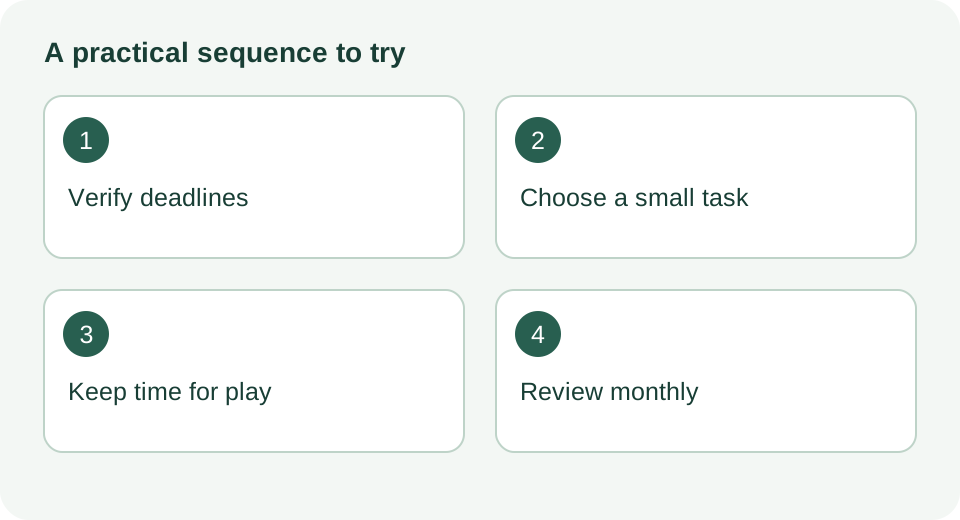
Three kinds of preparation, and why confusing them causes overload
Much K2 stress comes from mixing up three different kinds of work. The first is administrative: forms, registration windows, document checks, and school visits, all with dates set by outside bodies. The second is school-specific requirements: whatever your particular schools state about readiness, orientation activities, what to bring, and how they communicate with new parents. The third is family preparation: routines, self-care skills, and confidence your child builds at home, which follow no calendar at all.
Overload happens when families treat all three as urgent at once. Organising documents in the evening is necessary work; drilling a tired five-year-old with flashcards in the same hour usually responds to imagined pressure, not real requirements. This guide keeps the three categories visibly separate so you can see what genuinely has a deadline, what depends on your school's notice, and what belongs to ordinary family life.
Twelve flexible planning blocks: an editorial framework, not a calendar
The twelve blocks below are a way of thinking across the K2 year, not twelve real months with fixed dates. Start whenever you like, run several in one week if your child is keen, or pause during a busy stretch. A block is complete when the family habit feels normal — not when a page is filled. If you prefer real months, imagine a hypothetical Chan family starting Block 1 in a hypothetical September, reaching Block 6 by a hypothetical February, pausing during a trip, and resuming in a hypothetical April. That pacing is invented purely for illustration; your pace can be faster, slower, or non-linear with no disadvantage to your child.
Blocks 1 to 4: rhythms before skills
The first four blocks contain no academics. Their purpose is to make daily life predictable enough that later learning has somewhere to land. Block 1 is a consistent wake-and-breakfast rhythm matched roughly to the school morning you expect. Block 2 is independent self-care: toilet routines, shoes, opening a lunchbox, packing a small bag with parental help fading week by week. Block 3 is a ten-minute daily sit-down habit at a table — drawing, sticker books, anything calm — because sustained sitting is a genuine adjustment for many children. Block 4 is separation practice in low-stakes settings, such as a supervised playgroup hour or a grandparent's care, always scaled to what your child can actually manage.
- Block 1: morning rhythm — fixed wake-up, breakfast, dressing without negotiation.
- Block 2: self-care — shoes, toilet, lunchbox opening, tidying one's own things.
- Block 3: table time — ten calm minutes daily at a chair and table, any quiet activity.
- Block 4: gentle separations — short, supported times away from parents, never forced.
Blocks 5 to 8: learning through ordinary play
The middle four blocks introduce skills embedded in play rather than lessons. Block 5 is conversation stamina: holding a back-and-forth chat, asking a question, listening to an answer. Block 6 is fine-motor strength through cutting, threading, playdough, and crayon work. Block 7 is early number and language awareness from daily life — counting stairs, spotting familiar characters on signs, noticing rhymes. Block 8 is following multi-step instructions through games like 'fetch two things and then we'll start'. If your child attends kindergarten, much of this already happens there; the home role is not to duplicate the curriculum but to let these skills surface in unstructured moments. In our editorial view, ten minutes of genuine play at this age is worth more than an hour of seatwork, and a child who resists seatwork is communicating something worth listening to.
Blocks 9 to 12: settling in and looking ahead
The final blocks prepare the family, more than the child, for transition. Block 9 is familiarity: passing the school, talking about its name and gate, so the building is not a stranger on day one. Block 10 is logistics rehearsal — a trial run of the actual morning route, timed at the real departure hour. Block 11 is emotional preparation: picture books about starting school, naming feelings, letting your child ask questions. Block 12 is parent admin only, kept away from the child: final document checks, uniform and bag purchases, and reading your school's start-of-term notices. Notice that Blocks 9 to 12 ask nothing new of the child academically — by this stage the earlier blocks have done their quiet work, and the biggest gift for a rising P1 student is an organised, unhurried parent.
Two lists and your school-requirements tracker
A simple anti-overload measure is separating your deadline list from your routine list. Deadlines are external, finite, and non-negotiable; routines are internal, repeatable, and forgiving. When the two share one to-do list, parents feel everything is urgent, and children feel that anxiety in the room. Your deadline list holds only three things: dates from official admission channels such as the Education Bureau's arrangements, dates in a specific school's own notice, and personal document deadlines like 'photocopy the proof of address by Sunday'. Nothing else has a real deadline, even when a tutor's flyer insists otherwise; verify any untraceable date against the official source rather than chat-group rumours.
Everything in the twelve blocks, plus the menu below, belongs on the routine list, phrased as 'when we can' rather than 'by March'. This is not lowering standards; young children absorb habits through repetition over months, not completion by a date.
Because requirements genuinely differ between schools, a tracker prevents both over-preparation and last-minute scrambling. Make one row per school, one column per question, and fill in answers only from that school's official notice, website, or office. Never fill a cell from what other parents say; write 'unconfirmed'. The table below shows the tracker structure with one explicitly hypothetical row using invented details purely to demonstrate how a completed row might look.
- If a school's materials say nothing about interviews, portfolios, or preparation classes, record 'not stated' and confirm with the school's office before preparing anything; silence does not confirm an item is or is not needed.
- One page is enough for the whole tracker; if it grows beyond a page, you are probably recording rumours rather than requirements.
| Tracker column | What to record | Hypothetical filled example (invented for illustration) |
|---|---|---|
| School name | The school as officially named | Sample Primary School (fictional name) |
| Source of information | Which official document you used | School's own P1 information notice, dated in the hypothetical example as 3 October |
| Orientation or admission activities | Any activity the school itself states it holds | Notice mentions one optional meet-the-teacher session; nothing else stated |
| Documents requested | Exactly what the notice lists | Birth certificate copy, two photos, immunisation record (hypothetical) |
| Portfolio or other materials | Only if the school's own notice mentions them | Not mentioned in the hypothetical notice, so: 'not stated — do not assume' |
| Contact for questions | Office phone or email from the official notice | [email protected] (fictional) |
| Our follow-up | One concrete next action and its owner | Parent A to call the office to confirm the session date (hypothetical) |
The weekly ten-minute menu
Rather than a timetable, use a menu: a short list of activities from which you and your child pick a few each week. Nothing was supposed to happen on a particular day, so an unfilled schedule carries no guilt. Ten minutes is the whole dose; more is a bonus, and ten minutes still keeps a skill warm. The sample menu is an editorial example — swap in your child's interests freely, since the structure matters more than the content: short, playful, chosen together, and ended while it is still fun.
| Menu item | What it practises | How ten minutes might look |
|---|---|---|
| Back-and-forth chat | Conversation stamina, listening | Ask 'what made you laugh today?' and take turns answering, each adding one detail |
| Snip and stick | Fine-motor control | Cut one strip of paper into pieces and glue them into a picture |
| Counting hunt | Number awareness | Count the cups, the shoes by the door, then guess and check the stairs |
| Two-step mission | Following instructions | 'Bring the red block and put it in the box' — then your child gives you a mission |
| Story swap | Language and narrative | You start a story with one sentence; your child adds the next; alternate to five |
| Lunchbox rehearsal | Self-care for school days | Child opens, eats from, and repacks a real lunchbox at a relaxed pace |
A realistic parent-time budget
Preparation fails most often not because children cannot cope but because parents run out of hours. A written time budget, like a money budget, shows the tradeoffs before you commit. The figures here are an explicitly hypothetical illustration for a two-working-parent household; write your own version using your real week. In this example, the family protects about fifty-five minutes per week: three ten-minute menu sessions, one fifteen-minute weekend admin check, and ten minutes of informal chatting on the commute or at dinner. A separate fifteen-minute tracker review happens monthly and is not part of the weekly total.
Notice what is absent: travel time and fees for preparatory classes. For this hypothetical family the budget simply does not fit a weekly class, and nothing in a typical child's readiness requires that it fit. If a class genuinely reduces your stress, that is a legitimate personal choice; if it is bought out of fear, it usually adds pressure without adding readiness.
- Write your budget as three numbers: weekly minutes for activities, weekly minutes for admin, and a monthly total you will not exceed.
- When a new demand appears — a talk, a workbook, a class — check it against the budget before saying yes.
- If the budget keeps overflowing, cut activities before cutting sleep, meals, or free play; those three do more for readiness than any scheduled extra.
Starting late: a four-week catch-up option
If you are reading this in the final stretch before P1, do not compress twelve blocks into four weeks — that is precisely how overload happens. Instead, run a deliberately minimal four-week version covering only what cannot be done later. This is an editorial framework, not a remedial programme; children who begin school without any of it still settle in, since every cohort of new P1 children arrives from a wide range of home experiences. Week 1 is the admin sweep: read every official notice, complete the tracker, list missing documents. Week 2 is logistics: walk or ride the real route at the real hour twice, and practise the lunchbox and school bag. Week 3 is emotional groundwork: borrow books about starting school, talk through one worry, visit the school gate if practical. Week 4 is rest and rhythm: fix the wake-up time, run two familiar menu items, and stop all new preparations by the weekend before school starts. Everything not covered — fine-motor strength, conversation stamina, number awareness — can continue to build during P1 itself.
- Week 1: paperwork and the tracker, nothing with the child.
- Week 2: route rehearsal and self-care practice.
- Week 3: feelings, books about school, and a gate visit if easy.
- Week 4: sleep rhythm and two familiar, fun activities — then stop.
Tradeoffs, and what to do when your first approach is not working
Every choice has a cost, and honest planning names it. A relaxed, play-based approach trades measurable, photographable progress for a child who stays curious and unanxious — fewer 'look what we covered' moments and, in our view as editors, a better long-term outcome, but the tradeoff is real. A structured class programme trades family money and evenings for external accountability and sometimes parental relief — legitimate benefits alongside risks of fatigue and pressure. Doing everything yourself trades money for your own time and consistency demands. None is universally right; the right mix is the one your child and week can sustain.
When something stalls — refusal of table time, lunchbox meltdowns, flatness about school talk — treat it as information, not defiance. First, shrink the dose: ten minutes becomes three, or the activity moves to the floor with toys. Second, change the medium: a child who hates worksheets may happily trace letters in a tray of flour. Third, park it for two weeks and keep only the routines; many refusals at this age are fatigue or a passing wobble rather than a lasting gap. If a struggle is intense or persistent, or involves speech, movement, or sensory comfort that seems different from peers, a calm next step is raising it with your kindergarten teacher or your child's doctor, who can advise on your child specifically. And plainly: never force eye contact or drill a child to mask their natural way of engaging. In our view as editors, connection, not performance, carries children into new classrooms.
Tools and official sources
A few free resources fit the framework above. Our /game/ collection offers short parent-child activities you can slot straight into the ten-minute menu, many playable with household items. Our /school/ directory helps you locate schools and their publicly listed information as you fill in the requirements tracker, though the tracker must be completed from each school's own official notice. Our /interview/ pages provide original practice prompts designed as conversation games for families whose chosen schools happen to hold such activities — they are not needed for schools that do not, so check your school's notice first. Finally, our portfolio creator is a browser-based tool for assembling and editing PDFs, with download via a parent's email; use it only if a specific school's documentation actually calls for compiled materials, since an unsolicited portfolio is usually wasted parent time.
For authoritative reading on the primary admission system, the Education Bureau's Primary One Admission page is the appropriate official starting point. We link it below purely as further official reading; it does not endorse this guide, and this guide does not summarise its contents. For dates, rules, and procedures that carry consequences, rely on that page and your schools' own notices — not on this article, and not on chat groups.
Further reading: www.edb.gov.hk
Frequently asked questions
Does my K2 child need a full year of preparation classes for Primary 1?
No, and this guide deliberately does not assume any classes. The blocks, menu, and trackers are built around short home routines and ordinary play. A class can be a reasonable personal choice if it suits your budget and your child's temperament, but a year of classes is not a requirement for readiness, and fear-driven enrolment often adds pressure without adding genuine preparation.
Do all primary schools interview children or ask for portfolios?
No. Schools differ, and this article makes no claim about what any school does. Some hold orientation or admission activities and some do not; some request specific documents or materials and some do not. The only reliable source is each school's own official notice or office, which is why the tracker has you record what each school actually states — and to write 'not stated' where it states nothing.
We just realised P1 is starting soon and we have prepared nothing. Is it too late?
It is not too late, but do not compress a year of planning into a few frantic weeks. Use the four-week late-start option: paperwork and the tracker, then the real route and lunchbox rehearsal, then emotional preparation through books and conversation, and finally a week of fixed sleep rhythms and rest. Children begin P1 from very different starting points every year; the aim is simply a calm first few weeks.
How much parent time does this plan actually take each week?
The framework fits a small, explicit budget. In our hypothetical example, a two-working-parent household protects about fifty-five minutes a week: three ten-minute menu sessions, fifteen minutes of weekend admin, and ten minutes of everyday chatting, with a short monthly review counted separately. Write your own budget with your real hours, and let it — not a tutor's flyer or a chat group — decide what you take on.
My child refuses the table-time routine and avoids eye contact with new adults. Should we push harder?
Pushing harder usually deepens refusal. Shrink the activity to two or three minutes, change the medium to floor play, or pause it for two weeks while keeping daily rhythms. As for eye contact: never force it. Children engage with new people in different ways, and connection through play, shared objects, or side-by-side activity often helps a child settle into a new classroom.
Put the preparation into practice
Find schools and official websites · Parent-child practice games · Editorial policy