
HK Primary Interview editorial content · Updated:
The examples and exercises below are illustrative material, not real student case studies or school test questions. Use them for family preparation; check each school’s current requirements before submitting documents.
Why School Groups Go Wrong: Three Common Failure Patterns
Most trouble comes from three habits. The first is repeating unverified information: someone posts a rumour in good faith and within an hour fifty families believe it as fact. The second is sharing content involving other people's children without permission, most often event photos. The third is letting the group drift into admissions talk, where anxious speculation spreads fastest.
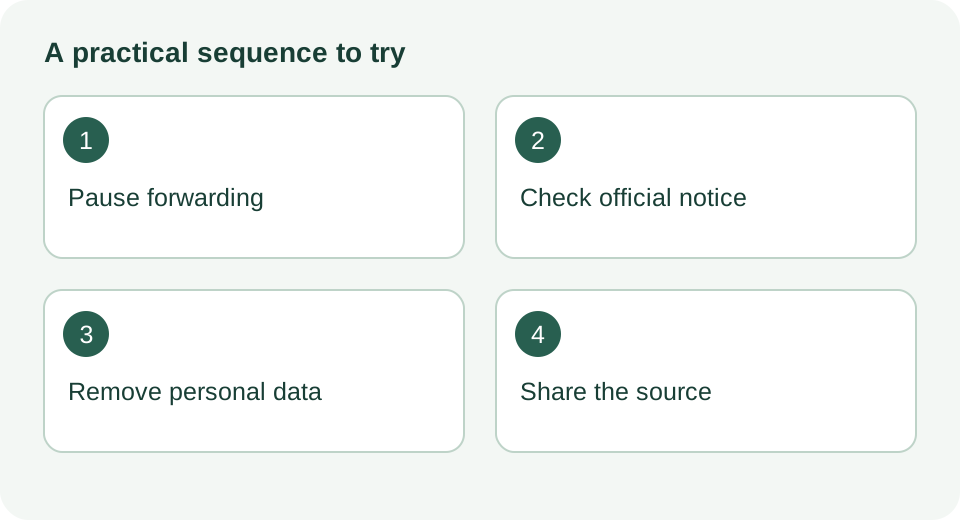
None of this comes from bad intentions. The problem is that a chat group removes the pauses that normally filter information: in conversation someone would ask 'Are you sure?', but a forwarded message arrives looking official because it has been typed, sent and seen. The checks below are about the small pauses each of us can run before pressing send.
The notice board test
Before posting, ask: would this be appropriate pinned on a notice board at the school gate, where any parent, teacher or student could read it? A fair-date reminder passes. A screenshot of another parent's child fails. An admissions rumour fails, because you would not want the principal reading it as the school's official position. If you would be uncomfortable seeing your message there with your name beside it, revise it.
Why forwarding feels safer than it is
A forwarded message often arrives stripped of context: you may not know who wrote it, when it was true, or whether it was ever true. Screenshots are weaker still — cropping can remove a date or a later correction. A useful rule is to never forward school information you have not seen confirmed in a channel the school controls. The most helpful message is often: 'Has anyone received the official circular yet? I will wait for that before making plans.'
The Source Verification Worksheet: Three Fictional Messages
The worksheet is an original practice exercise. All three messages, families and situations are fictional and written for training purposes only. For each, run four checks before deciding what to post: Source (who originally said this, with first-hand knowledge?), Confirmation (has the school confirmed it officially?), Exposure (does it contain any child's face, name, school, class or work?), and Need (does the group need this from me now?). If any check fails, the answer is usually to reply privately, ask the school, or post nothing.
| Check | Deadline rumour | Interview questions | Child-photo share |
|---|---|---|---|
| Source | Fails: second-hand | Fails: anonymous second-hand | Passes: own photo |
| Confirmation | Fails: contradicts circular | Fails: unpublished, varies | Not applicable |
| Exposure | Passes | Borderline | Fails: other children visible |
| Best action | Check circular; ask school directly | Point to own school notice; do not forward | Remove or ask poster to remove; propose group norm |
Message 1: the deadline rumour
Fictional message: 'Heard from another mum that the trip consent forms are actually due this Friday, not the 30th like the circular said. Better hand them in early!' Source: fails, second-hand at best. Confirmation: fails, the circular is more reliable. Exposure: passes. Need: weak — rushing parents on an unverified date causes panic.
The action: check your own copy of the circular, and if unsure ask the class teacher or office directly rather than the group. If the school confirms a change, it will announce it through its own channels; then it is helpful to remind the group to check the latest official message.
Message 2: the reported interview questions
Fictional message: 'My friend's son had his interview at a private school yesterday and says they asked him to describe a picture and count backwards. Everyone start practising!' Source: fails, anonymous second-hand. Confirmation: fails, and interview practices vary between schools and years. Exposure: borderline, since naming a school's process pressures families. Need: low, as it may not apply to your school.
Interview speculation snowballs: one claimed question becomes a list, the list becomes 'what the school wants', and families reorganise preparation around an unverified anecdote. The safer contribution points parents back to authoritative material — their own school's notice, and original school-neutral practice prompts such as those on our /interview/ page — without treating any rumour as a syllabus.
Message 3: the accidental child-photo share
Fictional message: a parent posts a sports day group photo showing several children's faces and a class name board, captioned 'Great day everyone!' Source: passes, they took it themselves. Exposure: fails clearly, since other children appear without confirmed permission. Need: fails, as warmth does not require identifiable faces.
The action depends on group norms. Some groups agree in advance that photos of other children will not be posted; others allow only cropped images. If yours has no agreement, propose one using the admin welcome template below. If you were the poster, use the correction template; if an observer, the private reply template.
Exact Wording: The Polite Reply Templates
The hardest moments are responding to rumours without creating conflict. The templates below are starting points to adapt to your own voice. In each case the goal is the same: move the conversation toward the school's official channel, or out of the group entirely, without accusing anyone.
Replying to a rumour without endorsing it
Sample wording: 'Thanks for flagging this! I have not seen it in any official message yet. I will check with the school office / class teacher and share whatever comes back in writing, so we are all working from the same information.'
This thanks the poster so no one loses face, names the official channel as the source of truth, and commits you to written confirmation only. If the school confirms the rumour was wrong, a note like 'The teacher has confirmed the original date on the circular stands' closes the loop; if it confirms a change, quote the official message rather than your memory of it.
Raising a photo concern privately
Sample private message: 'Hi [name], lovely to see the sports day went well. I wanted to mention privately rather than in the group: the photo shows a few other children's faces, and I am not sure every family is comfortable with that. Would you mind taking it down, or cropping to your own child? Happy to help if it is fiddly. No worries at all if you did not realise.'
Keep it private even if you feel embarrassed; public correction tends to produce defensiveness rather than deletion. Admins of long-standing posts can add: 'I have hidden it from the group for now so we can sort it out calmly.'
Deflecting admissions pressure politely
Sample wording when speculation starts: 'I think this differs a lot between schools and years, so I am going by my own school's notice rather than what we hear second-hand. If anyone wants, there are original practice prompts at /interview/ that are not tied to any particular school.' If the thread continues anyway, it is perfectly acceptable not to reply. Silence declines to amplify; it does not mean agreement.
Admin and Correction Templates
Admins have an easier job when expectations are written early, ideally when the group is created or a school year starts. Corrections work on the same principle: trust survives mistakes when repair is visible.
Admin welcome template
Sample wording: 'Welcome to the [Class] parent group! A few friendly house rules so this stays useful for everyone: (1) This group is for practical reminders and questions, not official announcements — the school's circulars and notices remain the source of truth. (2) Please do not post photos showing other people's children; cropped photos of your own child are fine. (3) If you hear a rumour about dates or school matters, please check with the school office before posting it here. (4) Admissions and individual family matters are best discussed privately, not in the group. (5) Admins may quietly remove anything that breaks these rules. Thanks all — looking forward to a good year together!'
Pin this or re-send it at the start of each term. It does not lecture or promise enforcement beyond the group; it frames the school's channels as the source of truth, stopping rumours at the source.
Admin mid-year reminder
If problems reappear mid-term, a light touch works better than a crackdown. Sample wording: 'Quick reminder as we get busy this term: please hold rumour-type messages until the school confirms in writing, and keep photos of other children out of the group. Most of what we need is already in the latest circular. Thanks!' Handle specific incidents privately, and use the group message only to restate the norm without naming anyone.
Correcting your own post
Send the correction in the same thread where the mistake appeared. Sample wording: 'Correction to my earlier message: I passed on something second-hand about [topic] that turned out not to be confirmed. The school's latest official notice says [brief accurate point]. Sorry for the confusion, and please go by the circular rather than my earlier post. I have deleted the old message too.' It states plainly what was wrong, replaces it with the correct source, and mentions deleting the original so it cannot be screenshotted and recirculated.
For a photo including other children, keep it brief: 'Taking down my earlier photo as it showed other children's faces — cropping to just [own child's name] instead. Thanks for understanding!' Do not name whoever raised it; a brief, unbothered correction shows the whole group the norm.
The Private-School Query Template: Asking Without Spreading
Parents navigating private or Direct Subsidy Scheme applications have genuine questions, but group answers tend to be guesses dressed up as knowledge. These templates keep the question but move it to where a reliable answer exists.
Asking the school directly
Sample wording to the office or teacher: 'Dear [teacher / office], I am a parent of [child's class]. Could you confirm the school's current arrangements for [specific matter, e.g. interview format or document submission]? I have heard different versions from other parents and would like to go by the school's own information. Thank you very much.'
This produces an answer in writing that you can legitimately share if the school is happy for it to be shared. Not every school answers every query, particularly on admissions; then the school's published notice is your reference point. Note that interview formats, portfolio expectations and deadlines differ between schools and change between years: always defer to your own school's notice rather than any general advice, including this guide.
Asking in the group without inviting rumours
Frame the question so hearsay is an obviously poor answer: 'Has anyone received the official circular about [matter]? I would rather wait for the school's version than rely on what is going around.' Compare 'What have you heard about [matter]?' — the first treats parents as witnesses to official information; the second treats them as sources, which is exactly what produces rumour problems.
Notification Boundaries and Child Comfort
A different harm is exhaustion: when every message buzzes, notices get buried and anxiety rises. Boundaries make you a better reader because you engage deliberately rather than reactively. The same review applies to your own child's image.
Three levels of engagement
Level one, full notifications, suits very small groups used only for urgent logistics, such as a five-family carpool. Level two, muted with a daily check, suits most large class groups: open the chat once or twice a day, scan for anything official, close it. Level three, muted with an agreed escalation path, adds one safety valve: a family member who will call directly if something genuinely urgent appears. These are examples to adapt, not a prescription; a family with a child who has additional needs, or a parent managing shift work, may arrange things entirely differently and that is equally sound.
Protecting your own child's information
Before posting your own child's photo, consider whether it shows the school badge, class board, home address, or a uniform identifying the school. Ask your child, age-appropriately, whether they are comfortable with the photo being shared; their comfort matters even when they are young, and respecting a no is good practice even if the photo seems harmless. Review periodically what you have sent: groups change members, and a photo shared comfortably in Primary 1 may not feel appropriate by Primary 5. You cannot delete what others have saved, but you can stop adding to the pile.
When to take a conversation out of the group
Some topics belong in private messages no matter how the group is run: a child's specific difficulty, a disagreement with a teacher, another family's circumstances, anything medical. A one-liner such as 'So sorry to hear — sending you a private message' acknowledges support without exposing details. If a sensitive topic has already unfolded, the kindest repair is a gentle redirect: 'Perhaps worth discussing one-to-one so we do not clutter the group?'
What to Do When the First Approach Does Not Work
Not every group responds to polite templates. Sometimes a rumour keeps resurfacing, or a member repeatedly posts other children's photos despite private requests. This section is about realistic escalation — widening the conversation calmly, not confrontation.
Stepwise escalation for a persistent problem
A workable sequence, adapted to your situation: first, a private message to the individual; second, if the issue involves the school's reputation or children's safety, a factual note to the class teacher or office describing what is circulating, without demanding anyone be disciplined; third, if you are an admin, using group tools to remove messages and, as a last resort, removing a member after a clear warning; fourth, if the group is beyond repair, quietly leaving and relying on official channels plus a smaller circle of families you trust.
Expect tradeoffs. Some schools will not want to be involved in parent-chat matters, so describe facts rather than make complaints and let the school decide. Removing a member resolves a problem but may create awkwardness at the school gate; leaving costs convenience but often buys back peace. There is no universally correct point to stop; that judgement belongs to you.
Repairing a group after a bad episode
After an unpleasant public argument, a short reset from any respected member helps: 'I think we all got a bit heated. Can I suggest we go back to basics: school notices for facts, private messages for personal matters, and no photos of other children? This group is genuinely useful when we keep it simple.' Then follow through: be the first to model a correction, move sensitive topics private, and wait for the official circular. Groups follow their strongest habits, not their written rules.
Teaching children about group chats by example
Children eventually run their own class chats, and norms absorbed from watching us outlast any lecture. Saying aloud 'I will wait for the official circular before forwarding that', or asking your child's permission before posting their photo, demonstrates source checking and consent in action. You can also walk a fictional rumour through the four checks together — our /game/ page includes parent-child activities on spotting reliable information, suited to upper primary children. For school transitions, remember admissions details live in the school's own notices, and our /school/ directory can help you find published information rather than relying on second-hand accounts.
Quick Reference: The Whole System on One Card
Before posting: run the four checks — source, confirmation, exposure, need. When you see a rumour: reply with the polite redirect or say nothing, and verify with the school yourself. When you make a mistake: correct in the same thread, replace the wrong information with the official source, delete the original. When you join or run a group: agree the norms early with a short welcome message. Every day: keep the group muted and check it at a time you choose. At home: ask your child before sharing their image, and model the checking habits you want them to inherit.
None of this requires technical skill — only the small pause between reading and forwarding, which multiplied across a class of families keeps a school group a helpful notice board rather than a rumour mill.
Frequently asked questions
Someone posted a photo of my child in the class group without asking me. What should I do?
Send the poster a short private message rather than replying in the group, for example: 'Hi, I noticed the photo from today includes [child's name]'s face. We are not comfortable with photos being shared — would you mind taking it down? Thank you for understanding.' Many parents remove the photo promptly once asked privately. If they do not respond, message the admin with the facts and ask them to remove it. Public call-outs tend to harden positions without deleting the photo any faster.
Is it acceptable to share a screenshot of a teacher's message in another group?
Be cautious. A screenshot can be cropped or forwarded out of context, and most teachers would not expect their messages to travel beyond the intended families. If the information matters more widely, ask the teacher or office whether it can be shared officially, or tell the other group that the school has sent a notice and encourage them to check their own messages. When in doubt, paraphrase the substance rather than forwarding the image, and only after confirming it is accurate.
How do I mute the group without missing genuinely urgent school notices?
Mute the chat and set a fixed daily check, such as once after pickup and once in the evening. Schools normally use official channels — circulars, SMS or the school app — for anything genuinely urgent, so the WhatsApp group is rarely the first place critical information appears. As a safety net, agree with one trusted parent that you will call each other directly if something truly time-critical appears.
A rumour about admissions is spreading in our group and parents are getting anxious. How do I stop it?
Post one calm redirect rather than debating each message: 'I have not seen this in any official school communication, so I am waiting for the school's notice before making any plans. Requirements differ between schools and change between years.' Privately encourage one or two level-headed parents to do the same. If the anxiety concerns your own school's process, email the office for written confirmation, and share the reply only if the school is comfortable with that.
Put the preparation into practice
Find schools and official websites · Parent-child practice games · Editorial policy