
HK Primary Interview editorial content · Updated:
The examples and exercises below are illustrative material, not real student case studies or school test questions. Use them for family preparation; check each school’s current requirements before submitting documents.
Thirty Optional Starter Chinese Characters
The set below favours characters that show up naturally in Hong Kong life—on signs, packets, calendars and storybook pages—so your child meets them again without extra effort. Traditional forms are shown, and there are exactly 30 distinct characters. Many began as simple pictures of familiar things (日 sun, 月 moon, 山 mountain, 水 water), or are social and number words children hear daily. They appear here because they are easy to meet in ordinary life, not because any authority has ranked them.
The playful cue is a small gesture or moment linking a character's shape or sound to its meaning; treat it as a starting point and invent your own. As a hypothetical example, a parent points at 花 in a florist's window, says 'That is 花, flower,' and at home they sniff an imaginary bloom and trace it once in the air. Nothing is tested—the character simply becomes one more interesting thing the family noticed.
| Character | Everyday meaning | Example from daily life | Playful cue |
|---|---|---|---|
| 大 | big | 大山, a big mountain on a walk | stretch both arms wide |
| 小 | small | 小雨, light rain | pinch fingertips together |
| 上 | up; on | 上車, getting on the bus | lift your hands upward |
| 下 | down | 下車, getting off the bus | crouch slowly down |
| 日 | sun; day | 日曆, the family calendar | draw a circle with rays |
| 月 | moon; month | 月亮, the moon at bedtime | curve arms like a crescent |
| 水 | water | 飲水, drinking water | wiggle fingers like drops |
| 火 | fire | 火車, the train | flick fingers upward like flames |
| 山 | mountain | 爬山, climbing a hill | make a triangle with your hands |
| 木 | tree; wood | 木頭, wooden blocks | gently knock on wood |
| 人 | person | 大人, a grown-up | stand tall like a statue |
| 口 | mouth; opening | 入口, an entrance sign | point to your own mouth |
| 手 | hand | 手錶, a wristwatch | wave your hand hello |
| 女 | girl; female | 女生, a girl | trace the character with a finger |
| 子 | child | 孩子, a child | gently pat your own head |
| 馬 | horse | 小馬, a pony in a book | gallop legs on the spot |
| 鳥 | bird | 小鳥, a bird outside | flap arms like wings |
| 魚 | fish | 大魚, a fish at the market | glide a hand like a fin |
| 花 | flower | 花, flowers in a shop window | sniff an imaginary bloom |
| 好 | good | 你好, hello | give a thumbs up |
| 看 | look; watch | 看看, take a look | shade your eyes like an explorer |
| 吃 | eat | 吃飯, eating rice | stir an invisible bowl |
| 跑 | run | 跑步, running in the playground | jog on the spot |
| 飛 | fly | 飛機, a plane overhead | launch a pretend paper plane |
| 我 | I; me | 我, saying my turn | point to yourself |
| 你 | you | 你先, you first | point kindly to the other person |
| 他 | he; him | 他, a character in a story | point to someone else |
| 一 | one | 一個, one apple | hold up one finger |
| 二 | two | 二月, February | hold up two fingers |
| 三 | three | 三本, three books | hold up three fingers |
Thirty Optional Starter English Words
This set mixes meaning words children can act out—run, jump, hungry—with two glue words, the and and, which stitch sentences together. All 30 are distinct, ordinary words met in any children's book from the library or a shop, not a graded syllabus. Meaning words like cat and hot are easy to play with; glue words are rarely noticed alone but heard in every sentence, so including them encourages reading whole sentences aloud rather than naming isolated items.
As a hypothetical example, during a board game a parent holds out a flat palm and says, 'Stop at the red square!' The word stop now lives inside a fun rule, not a flashcard. Days later the child may shout stop during a chase game—that is the word beginning to be used, as the next section explains.
| Word | Example in a story moment | Playful cue |
|---|---|---|
| cat | The cat sleeps on my lap. | stroke a soft toy gently |
| dog | The dog wags its tail. | wag an imaginary tail |
| run | We run to the slide! | jog two steps to the door |
| jump | Jump over the puddle! | take two small hops |
| big | A big red bus. | spread both arms wide |
| small | A small ant crawls by. | pinch fingertips together |
| sun | The sun warms my face. | turn your face to the window |
| moon | Goodnight, moon. | wave slowly to the sky |
| star | One star, two stars. | flick fingers like twinkles |
| tree | The tree gives us shade. | stand tall like a trunk |
| fish | A fish swims past. | glide a hand like a fin |
| bird | The bird sings hello. | chirp or whistle twice |
| book | Open the book slowly. | turn one page carefully |
| ball | Roll the ball back to me. | roll a soft ball |
| red | The red apple crunches. | mime a big crunchy bite |
| blue | Blue sea, blue sky. | point out of the window |
| happy | Happy to see you! | show a big smile |
| hungry | The bunny is hungry. | rub your tummy |
| eat | Time to eat bananas. | mime peeling a banana |
| look | Look what I found! | shade your eyes with a hand |
| stop | Stop at the line! | hold out a flat palm, then freeze |
| go | Ready, set, go! | dash two steps |
| my | My turn to choose. | rest a hand on your chest |
| you | You pick the story. | offer two books |
| yes | Yes, please. | nod slowly |
| no | No, thank you. | shake your head gently |
| hot | The soup is hot. | blow on an invisible spoon |
| cold | Ice feels cold. | hug yourself and shiver |
| the | The end. | close the book softly |
| and | Cats and dogs. | clap once between the words |
Recognising, Understanding, Using: Three Different Steps
Families feel pressure when these three steps are squashed together, as though a child must do all three at once. In typical development they often arrive separately, and noticing the difference makes shared reading far more relaxed.
- Recognising: pointing, matching, turning back to a favourite page.
- Understanding: acting out the meaning, pointing to a picture, explaining in any home language.
- Using: saying the word or character spontaneously in play or daily routines.
Recognising: I have met that one before
The child notices the item and reacts—pointing at 大 on a shop sign, or pulling the book back to the page with 月. In a hypothetical example, a child pointing at a bakery sign and laughing, because the family once played with that character, shows recognition without saying a word.
Understanding: I know what it means here
Understanding shows in what the child does with meaning: acting out stop, pointing to the fish when you read 魚, or explaining in the home language. A child who hears 'The bunny is hungry' and pats her tummy demonstrates understanding beautifully, even saying nothing in English.
Using: I can say it or play with it
Using is most visible: demanding 'you first' with 你先, or announcing 'jump!' before hopping off a step. In a hypothetical example, a child who builds a block tower and declares it 大 is using the character for his own purpose—which grows naturally out of the games in the next section.
Three Shared-Reading Games
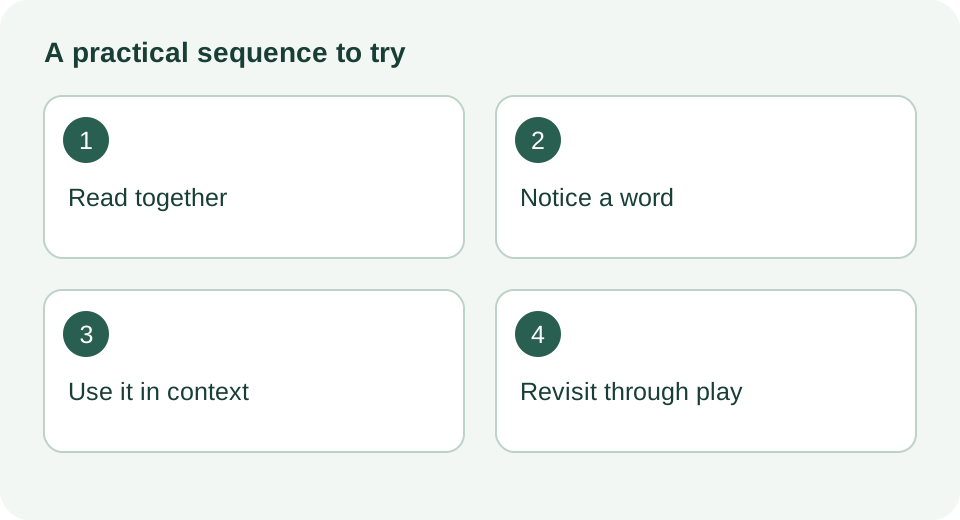
Each game uses items from the tables above, needs little or no preparation, and ends the same way if it flops: change something small, or park it and try another.
Game One: Story Treasure Hunt
Choose a book your child likes and pick three items—say 鳥, star and jump—jotted on sticky notes. Tell your child the treasures are hiding in the story, and spotting one earns a silly celebration you invent together. Try: 'Tonight our book has three treasures: a bird, a star and jumping. When you spot one, shout treasure and we do our penguin dance.'
Hypothetically, a parent hides jump three times in an outdoor story and adds 跑 on a page with running; the child shouts treasure, does a wobbly ostrich dance, and by the third night shouts 'Jump!' before the page turns. If your child shows no interest, drop the framing and simply point out one item per night; if it still falls flat after a week, try Game Two.
Game Two: The Silly Sentence Menu
Announce tonight's menu with two columns: who or what (the cat, my ball, the big fish) and what happens (runs, jumps, says no). Each of you picks one from each column and every combination becomes a sentence you read dramatically, like a waiter: 'Good evening! What will it be?' Laughter is the point; grammar precision is not.
Hypothetically, a child chooses the cat and jumps, then the fish and runs, and finally invents her own entry, the moon says yes—evidence of genuine using, since she combined known words for a new joke. If your child only wants to hear your sentences, that is still useful listening; if the open menu overwhelms her, offer just two options per column.
Game Three: The Character and Word Postbox
An adult cuts a slot in a tissue box or shoebox; decorate it together if you like. Write each chosen item on its own card—handwriting is fine, and letting your child hold the pen while you guide makes the shapes familiar. Scatter five or six cards face up: 'Special delivery! Can you find 你 and post it?' Wrong choices are handled lightly: 'Oops, that one is cold, not hot. It escaped! Try again.'
Hypothetically, a family starts with 一, 二, 三, the, and and go. After a week the child posts 一 and 三 confidently but mixes 二 with 三, so the parent adds a floor game—holding up two fingers, then three—rather than more posting rounds. If sorting feels too test-like, flip roles and let your child be the postmaster who tells you which card to post; being the one who knows is often the most motivating position.
Adapting for Multilingual Families
Many Hong Kong homes blend Cantonese, English, Putonghua or other home languages such as Filipino, Indonesian, Urdu or Hindi. The games never require a single 'correct' language of response. Meaning often sticks well when it connects to the language a child thinks in, so it is fine to introduce 跑 through a Cantonese explanation, or hungry through a home language word; translate the playful cues into whatever works in your family.
If your child answers 'treasure!' in Cantonese, or says 'fish 魚!' in one breath, there is no need to correct the mixing—it is a normal stage for children growing up with more than one language, and most children sort languages by context gradually. Never force speech, repetition on demand, or eye contact; a child who watches quietly, points, or posts the right card is participating fully. Children who speak less or differently—through speech differences, shyness or temperament—can show recognition and understanding through gesture, gaze or action. Follow your child's lead on closeness and duration; two happy minutes beat twenty tense ones.
A Gentle Observation Sheet
Rather than scores, this sheet captures small, real moments. Note the date, the book or routine, the item noticed, your best guess at the step (recognising, understanding or using), and your child's exact words or actions. Do not record scores, mastery dates or comparisons with other children. As a flexible editorial example, glancing back every two or three weeks is often enough; an empty month usually means life got busy, not that progress stopped. For optional tidy record-keeping, the portfolio creator tool offers browser-based PDF editing; it asks for a parent email address (no login or verified email required) and sends the finished download to that address—entirely optional, purely for home memory-keeping.
| Date | Where we noticed it | Item | Step (R / U / Use) | My child's words or actions |
|---|---|---|---|---|
| 3 March (hypothetical example) | Bus stop sign on the way to the park | 大 | R | Pointed and said 'big!' with arms wide |
| 10 March (hypothetical example) | Bedtime story about a rabbit | hungry | U | Patted tummy when the bunny was hungry |
| 17 March (hypothetical example) | Bath time | stop | Use | Said 'Stop!' to the rubber duck and giggled |
Tradeoffs, Troubleshooting and Further Reading
No single approach suits every child. Story-first play builds a love of books but covers fewer items slowly; item-first games cover more, faster, but risk turning warmth into testing. Following your child's current obsession makes everything easier but may leave parts of any list untouched—fine, because the lists are optional. Some families introduce Chinese and English items in the same week; others settle one first.
If the first approach does not help, try in order: change the book genre (comic-style or wordless books suit many children); move items into routines, such as posting 跑 on the front door before the playground; or pause all character and word play for a fortnight and simply read for pleasure. If you have lasting concerns about your child's hearing, speech or language development, raise them with your child's teacher or a healthcare professional rather than increasing practice at home. For more activity ideas, the /game/ directory collects additional home play formats; for comparing kindergartens, the /school/ directory and /interview/ prompts may help you prepare questions. For further official reading on kindergarten education in Hong Kong, the Education Bureau's resource page may be useful.
Further reading: www.edb.gov.hk
Frequently asked questions
Must my child master all 30 characters and 30 words before Primary 1?
No. The lists in this guide are optional starter selections for playful reading, not entry requirements, and involve no certification. Admission and class expectations vary by school, so rely on your own school's notice for actual requirements.
How long should a playful reading session last?
There is no fixed duration. As a flexible editorial example, many families find ten to fifteen minutes, or even just one book and one game, is plenty for a young child. End while your child is still enjoying it so tomorrow's session starts happily.
My child mixes Cantonese and English mid-sentence. Should I correct this?
Mixing is a normal stage for children growing up with more than one language and needs no correcting during play. Respond to the meaning, model your own sentence naturally, and record mixed answers on the observation sheet as genuine understanding. Most children sort languages by context gradually.
Should I add flashcards and daily quizzes to speed things up?
This guide deliberately avoids drilling, because pressure can turn reading together into a test and put some children off books. Playful noticing is slower but usually warmer. If progress feels too slow, try the troubleshooting steps in the final section first—new book genres, items in daily routines, or a short pause—rather than adding quizzes.
Put the preparation into practice
Find schools and official websites · Parent-child practice games · Editorial policy